La Montagne Saint-Victoire
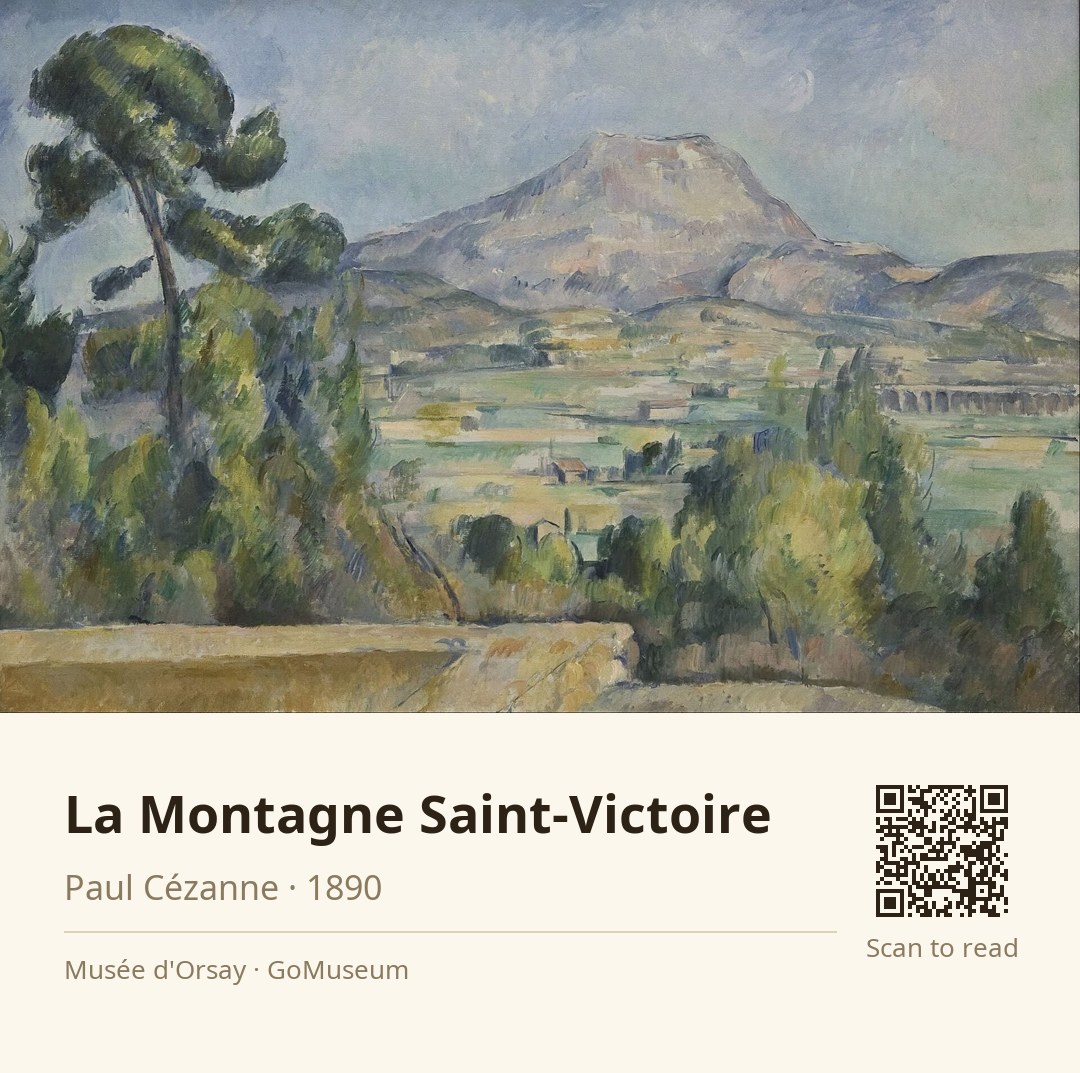
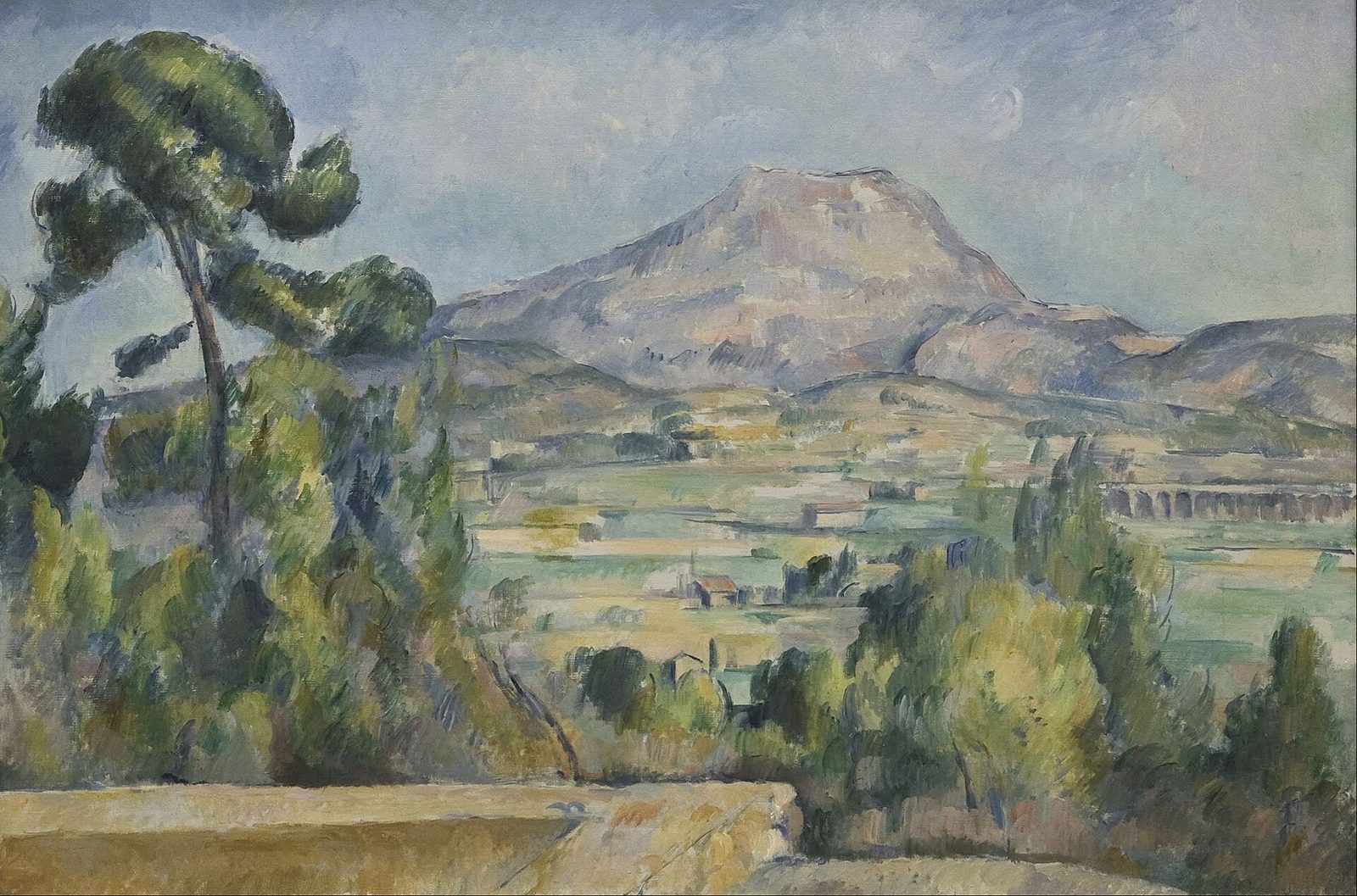
🎧 This work has audio narration — listen in the appLook straight ahead and the mountain fills the horizon: a great flat-topped mass washed in lilac, pink and grey, rising above everything else in the scene.
Notice first the tall pine at the left, its slender reddish trunk holding up layers of green foliage against a pale, streaked blue sky. Then look down into the middle distance, where a patchwork of green, ochre and pale pink fields holds a few small buildings, one with an orange-red roof. Everything is built from short, visible strokes of oil paint rather than smooth blending, so the land seems to be made of colour planes laid side by side.
Those strokes are the key to what Cézanne was after. Instead of softening the view into a fleeting impression of light, he kept the surface visibly constructed, and he treated the landscape as something with weight and structure, the way the mountain itself has a solid, geometric shape. That approach, in which form is built from colour and the underlying structure of things is emphasised, is what later painters would take further.
Early in his career his paintings provoked ridicule from critics. It was largely fellow painters such as Camille Pissarro, and the dealer Ambroise Vollard, who recognised his work, and Vollard's first solo exhibition of Cézanne in his Paris gallery in 1895 began the wider reassessment. Matisse and Picasso are both said to have called him "the father of us all."
Paul Cézanne was a French Post-Impressionist painter born on January 19, 1839, in Aix-en-Provence. His innovative approach to color and form bridged the gap between Impressionism and the emerging Cubism of the early 20th century. Initially influenced by Romanticism and Realism, Cézanne developed a unique style that emphasized the underlying structure of objects, using repetitive brushstrokes and planes of color to create depth and complexity in his work.
Despite facing ridicule and misunderstanding from critics during his early career, Cézanne garnered support from fellow artists like Camille Pissarro and the art dealer Ambroise Vollard, who recognized his talent. His first solo exhibition in 1895 marked a turning point, leading to greater appreciation of his contributions to art. Cézanne's legacy is profound; both Henri Matisse and Pablo Picasso acknowledged him as a foundational figure in modern art, dubbing him "the father of us all." He passed away on October 22, 1906, leaving behind a transformative body of work that continues to influence artists today.
Pale blue sky streaked with thin marks sits behind everything, and the mountain is not a single flat shape but a block of lilac, pink and grey that seems to lean into the picture plane. In the foreground the rounded trees are massed in yellow-green, olive and blue-green, so the lower edge of the picture feels dense and close while the mountain feels far and cool. The flat tan-ochre band across the bottom reads like a wall or the edge of a field, and it anchors the whole scene. The arched structure running along the horizon at right is a low, quiet line that holds the eye from drifting off the edge.
Fellow painters such as Camille Pissarro, and the dealer Ambroise Vollard, recognised his work first, and Vollard's 1895 solo show in Paris began a wider reassessment.
No. As a schoolboy his friend Émile Zola urged him to take poetry seriously, but Cézanne treated it as just a pastime.