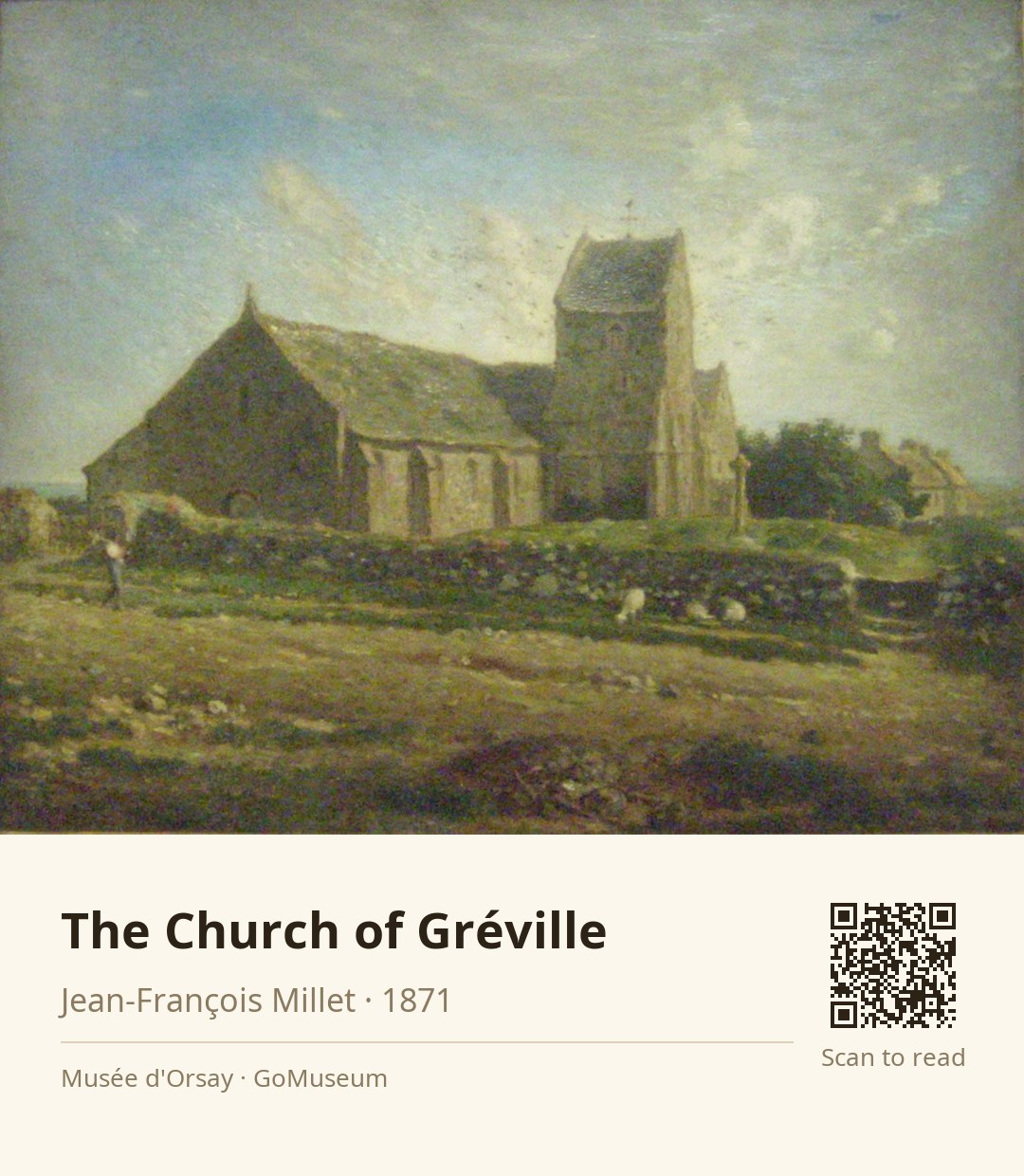
The Church of Gréville
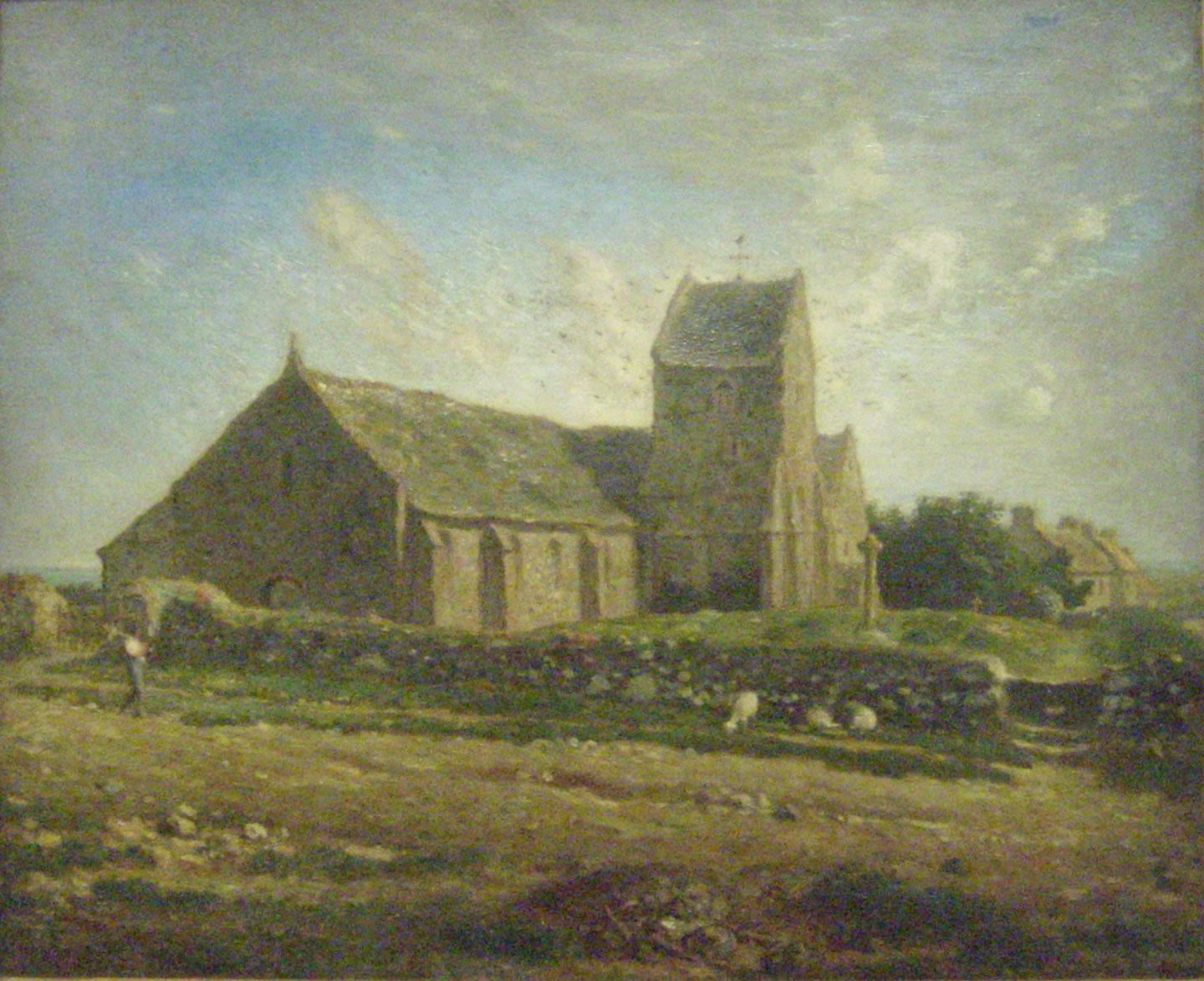
🎧 This work has audio narration — listen in the appSet against a pale blue sky, a small stone church stands on a low rise, its square tower crowned by a tiny weathervane.
Look closely at the walls: they are rough, grey-ochre masonry pierced by narrow arched windows, and the paint is thick and dragged, so the stone seems to have weight and grit. Near the base of the tower is a small cross-like marker, and beside it a lone figure walks along a path, carrying a pale bundle, while a few pale sheep graze by a dry-stone wall in the foreground.
The work gives the painting its character: the wall, the grazing flock and the solitary walker belong to a rural landscape he knew from the inside. Beyond that, the sources I have do not say when or why this particular view was painted, nor how it was received at the time.
Jean-François Millet was a pivotal figure in 19th-century French art, born on October 4, 1814, in Gruchy, Normandy. As a founding member of the Barbizon school, he is celebrated for his profound depictions of peasant life, embodying the Realism movement. Millet's early years were steeped in agricultural labor, which deeply influenced his artistic themes. After studying under various artists, he moved to Paris, where he initially struggled but eventually gained recognition for his work.
Millet's paintings often highlighted the dignity of rural laborers, showcasing their struggles and connection to the land. His notable works, such as "The Gleaners" and "The Angelus," reflect a shift from idealized pastoral scenes to a more authentic representation of contemporary social conditions. Despite facing criticism early in his career, he found success in the mid-1850s, producing masterpieces that resonated with the public and critics alike.
Millet's legacy lies in his ability to elevate the everyday lives of farmers to the realm of fine art, influencing generations of artists and solidifying his place in art history as a champion of the working class. He passed away on January 20, 1875, in Barbizon, leaving behind a rich body of work that continues to inspire.
The painting is dated 1871, so it was made in the years right after the Franco-Prussian War. It was not sold in his lifetime as far as the record shows: it stayed in his own collection, and it appeared at the sale of Millet's estate at the Hôtel Drouot in Paris on 10 May 1875, catalogue number 50. The work later reached the museum's collection under inventory number RF 140. Beyond that, the sources do not say who commissioned it or how it was received.
Set your eye on the stone itself. The church rises as a squat, heavy block against a pale blue sky, its steep slate roof sloping down toward a square tower that ends in a small weathervane. The walls are grey-ochre and rough, and the narrow arched windows look almost like slits cut into the masonry. The foreground is where the painting gets earthy: olive, brown and ochre ground, a rough dry-stone wall crossing the grassy slope, and a few pale sheep grazing against it. Off to the right, dark green trees and low thatched cottages press in from the side. The sky is not flat; it carries scumbled white cloud, and near the tower there are tiny dark flecks that might be birds. Paint is thick and dragged across the surface, so the texture of the stone and the earth comes through as something you can almost feel.
Yes. In 1984 scientists at the Museum of Fine Arts in Boston X-rayed his 1870 painting The Young Shepherdess and found it had been painted over The Captivity of the Jews in Babylon, a work that had otherwise disappeared.