Les Choristes
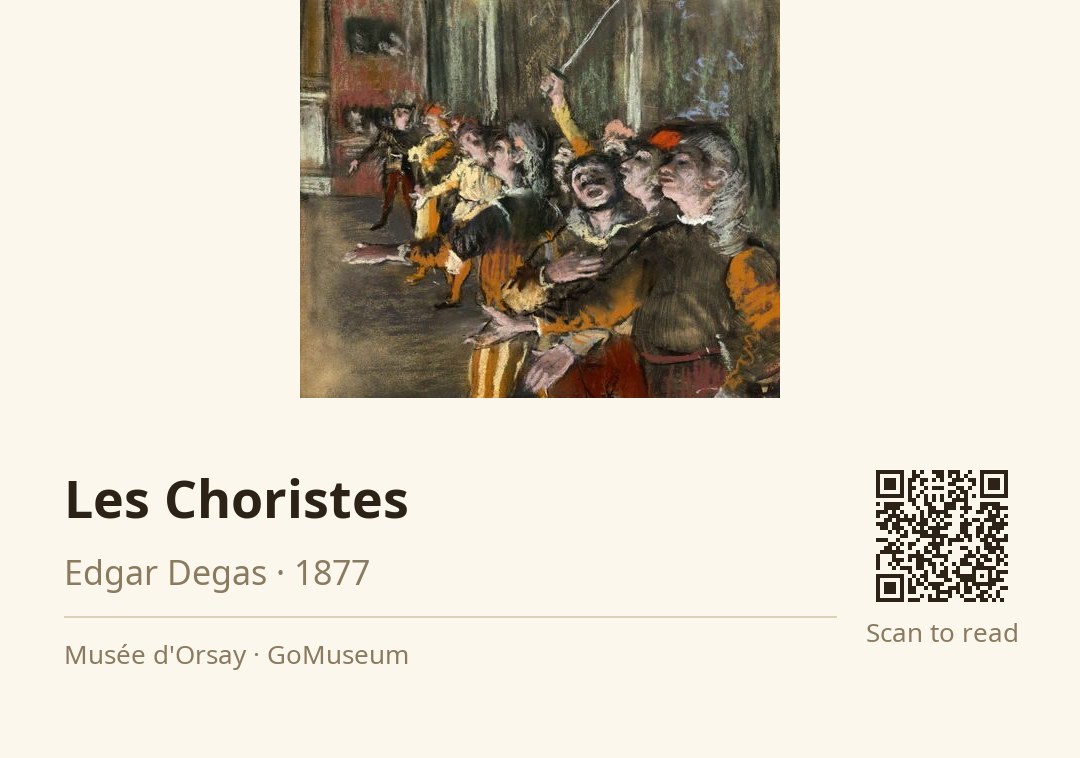
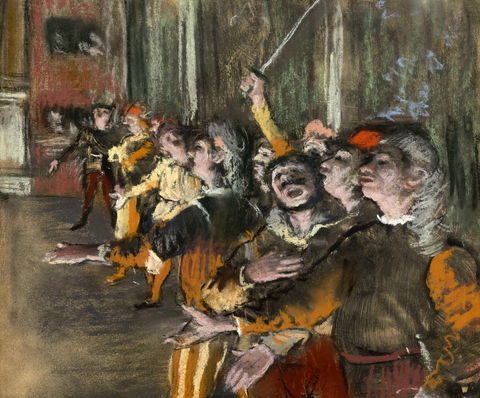
🎧 This work has audio narration — listen in the appTake a moment to look closely at "Les Choristes" by Edgar Degas. Notice how the singers are arranged in a line, their mouths wide open as they belt out a tune. Look at the vibrant orange and yellow costumes—they almost seem to glow under the footlights. These details matter because they capture a moment of raw emotion and energy, a snapshot of life that feels both immediate and timeless. Degas, known for his focus on movement, here shifts his gaze from dancers to singers, giving us a rare glimpse into the world of opera, specifically a scene from Mozart's "Don Giovanni." This choice reflects his desire to portray the everyday realities of performance, rather than the idealized beauty often associated with the stage. Created in 1877, this pastel work was part of the Third Impressionist Exhibition and was praised for its realism, with critics noting the "hideous" yet authentic expressions of the singers. It was purchased by fellow artist Gustave Caillebotte, who recognized its significance. As you stand here, think about the voices that filled the air during that performance. What do you imagine the atmosphere was like? What stories might these singers have told beyond the music?
Edgar Degas, born on July 19, 1834, in Paris, was a pivotal figure in the Impressionist movement, though he preferred to be labeled a realist. Known for his exceptional skill in drawing, Degas focused on capturing movement, particularly in his depictions of dancers, which constitute over half of his oeuvre. His works also include racehorses and portraits that reveal psychological depth and human isolation.
Degas came from a cultured, affluent family; his mother was a Creole from New Orleans, and his father was a banker. After his mother's death, he pursued art against his father's wishes, studying at the École des Beaux-Arts and drawing inspiration from classical masters during his time in Italy. His early ambition to be a history painter shifted as he embraced contemporary subjects, influenced by artists like Édouard Manet.
Despite being a founding member of the Impressionists, Degas's approach diverged from his peers, as he often worked in his studio rather than en plein air. His innovative techniques and themes sparked debate among critics and continue to influence art history today. Degas passed away on September 27, 1917, leaving behind a legacy that challenges traditional boundaries in art.
Edgar Degas created 'Les Choristes' in 1877, a pivotal year for the Impressionist movement. This pastel work was part of the Third Impressionist Exhibition in Paris, where it garnered attention for its raw realism. Critics noted the 'hideous' yet authentic expressions of the singers, which marked a departure from the idealized beauty often found in art. Caillebotte later bequeathed it to the state, leading to its inclusion in the collections of the Musée du Luxembourg and later the Louvre. In 1986, it found its home at the Musée d'Orsay. However, the artwork's journey took a dark turn when it was stolen in 2009 while on loan to the Musée Cantini. It was not until 2018 that it was recovered, found in the luggage compartment of a bus, relatively undamaged, yet the thieves remain unidentified.
Degas employed a unique technique in 'Les Choristes,' using pastel over an earlier monotype, a method that allowed for a rich layering of color and texture. The composition is strikingly rectangular, almost square, measuring just 27 by 32 centimeters. Notice how the singers are arranged in a line, their open mouths and extended hands creating a dynamic sense of movement. The brushwork feels restless, capturing the energy of the performance. The vibrant orange and yellow costumes pop against the darker background, illuminated by the footlights, drawing your eye to the performers. The faces, while lacking intricate detail, convey a sense of immediacy and emotion, embodying the Impressionist ethos of capturing a fleeting moment. The background features patrons in box seats, adding depth and context to the scene, while the overall composition invites you to feel as if you're part of the audience, experiencing the performance firsthand.
One surprising anecdote about 'Les Choristes' is its dramatic theft in 2009. While on loan to the Musée Cantini, it was stolen during a temporary exhibition. The artwork remained missing for nearly a decade, only to be recovered in 2018 during a routine customs inspection. Inspectors found it hidden in the luggage compartment of a bus, and remarkably, it was relatively undamaged. The mystery of the thieves, however, remains unsolved.
Critics noted that 'Les Choristes' reflects the influence of contemporary French caricaturists, particularly Honoré Daumier, as Degas's portrayal of the singers' exaggerated expressions adds a layer of humor and realism that aligns with the satirical nature of caricature.