Head of a Young Arab Woman
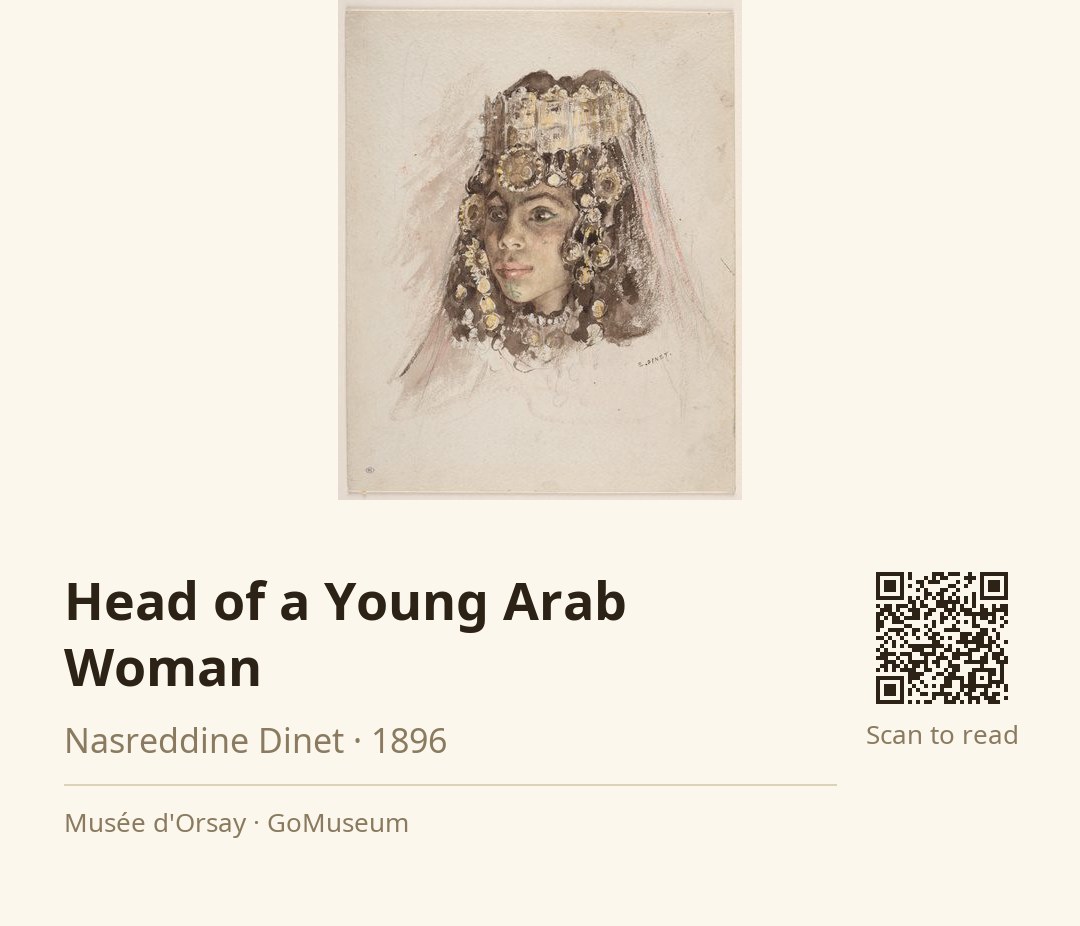
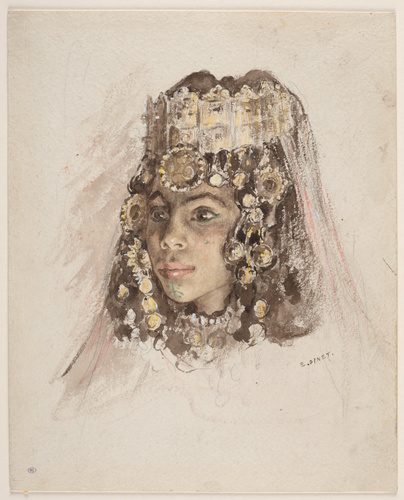
🎧 This work has audio narration — listen in the appThe woman in this sheet wears a crown of pale gold panels and two large gilt discs that hang beside her face, and all of it is drawn on a plain cream card that has not been filled with a background. Look first at those round discs: each has a dark centre, and they sit at the level of her cheeks like pendants, while a strand of beads and medallions circles her neck below. Her eyes are outlined in black, and a faint greenish-blue mark touches her chin, small touches that make the face feel alive against the warm ochre and pink of the skin.
Those details carry the portrait's meaning. The ornaments are not decoration added for effect; they are the subject, and Dinet has rendered them with the same care as the face, so the sitter is presented through what she wears as much as through her features. The veil is suggested only with light pink and grey strokes, and the body fades into loose, sketchy marks, which leaves the head and jewellery as the centre of attention.
The sheet is a pencil-and-watercolour work on cardboard, made in the years before 1896 by Étienne Dinet, the French painter who spent long periods in Algeria from the mid-1880s and who would later be known as Nasreddine Dinet after his conversion to Islam. Dinet first travelled to Algeria in 1884 and returned repeatedly, and from 1895 he painted almost exclusively Algerian subjects. The Louvre's records show the drawing entered the museum in 1977, when the French state acquired it, and it has been kept in the department of graphic arts since then. The sheet's earlier history is recorded as passing through the Musée du Luxembourg and the Musée d'Art Moderne in Paris before reaching the Louvre.
Nasreddine Dinet, born Alphonse-Étienne Dinet in Paris on March 28, 1861, was a prominent French orientalist painter who dedicated much of his life to capturing the essence of Algeria and its culture. His artistic journey began at the École nationale supérieure des Beaux-Arts, where he trained under esteemed artists. Dinet's fascination with Algeria ignited during his travels there, leading him to convert to Islam and adopt the name Nasr ad-Din, meaning "defender of the faith." This transformation deepened his connection to the land and its people, allowing him to create works that were both ethnographic and deeply personal.
Dinet's paintings often depicted daily life in Algerian villages, religious themes, and landscapes, reflecting his immersion in the local culture. His ability to speak Arabic and understand Islamic traditions set him apart from many of his contemporaries. He was a founding member of the Société des Peintres Orientalistes Français and received accolades for his work, including a silver medal at the 1889 Exposition Universelle. His legacy endures, celebrated as a master of Algerian painting, and his life story continues to inspire discussions on orientalism and cultural exchange. Dinet passed away on December 24, 1929, leaving behind a rich body of work and a profound impact on the art world.