 Image: Shonagon · Unknown authorUnknown author · Sailko
Barberini ivory
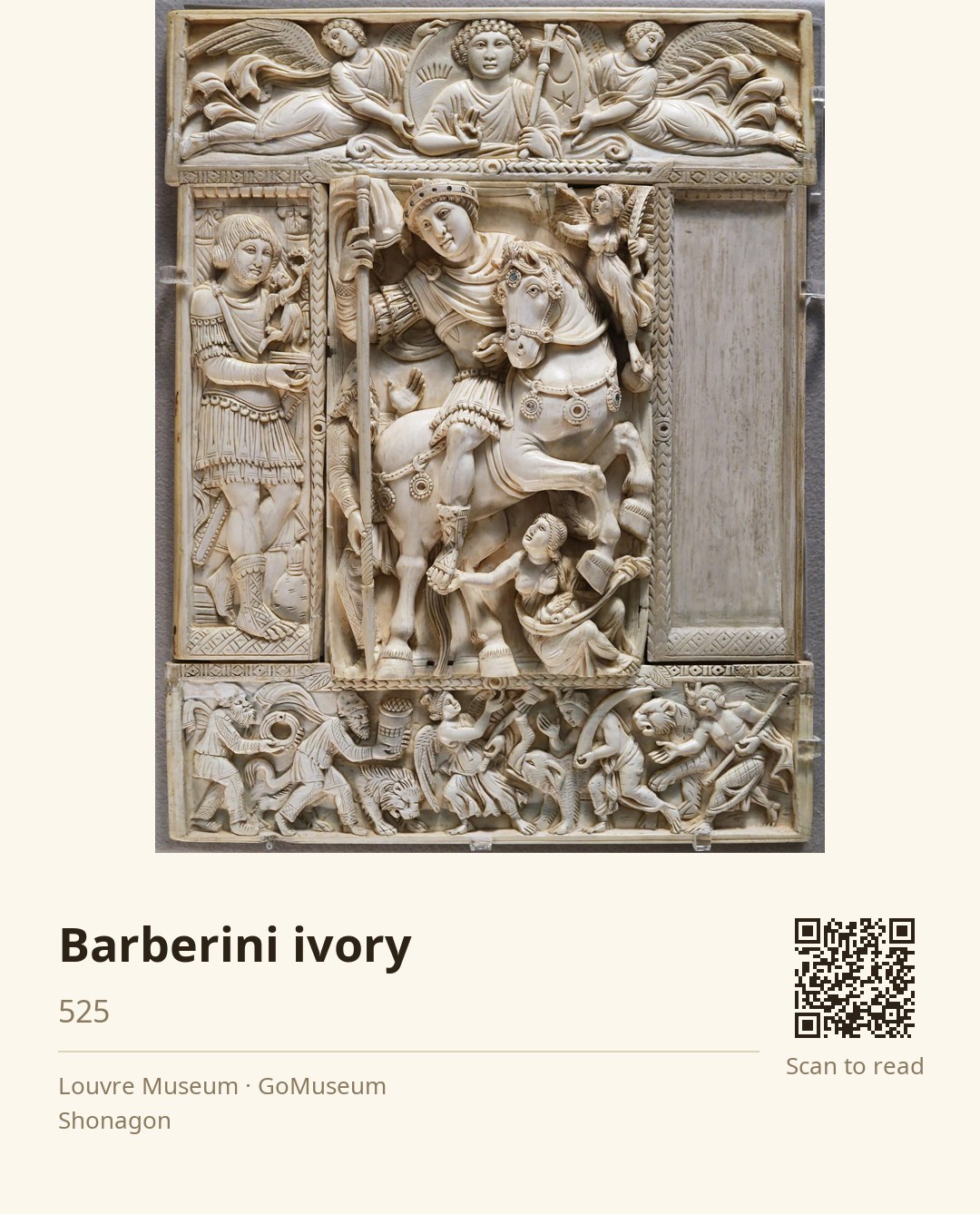
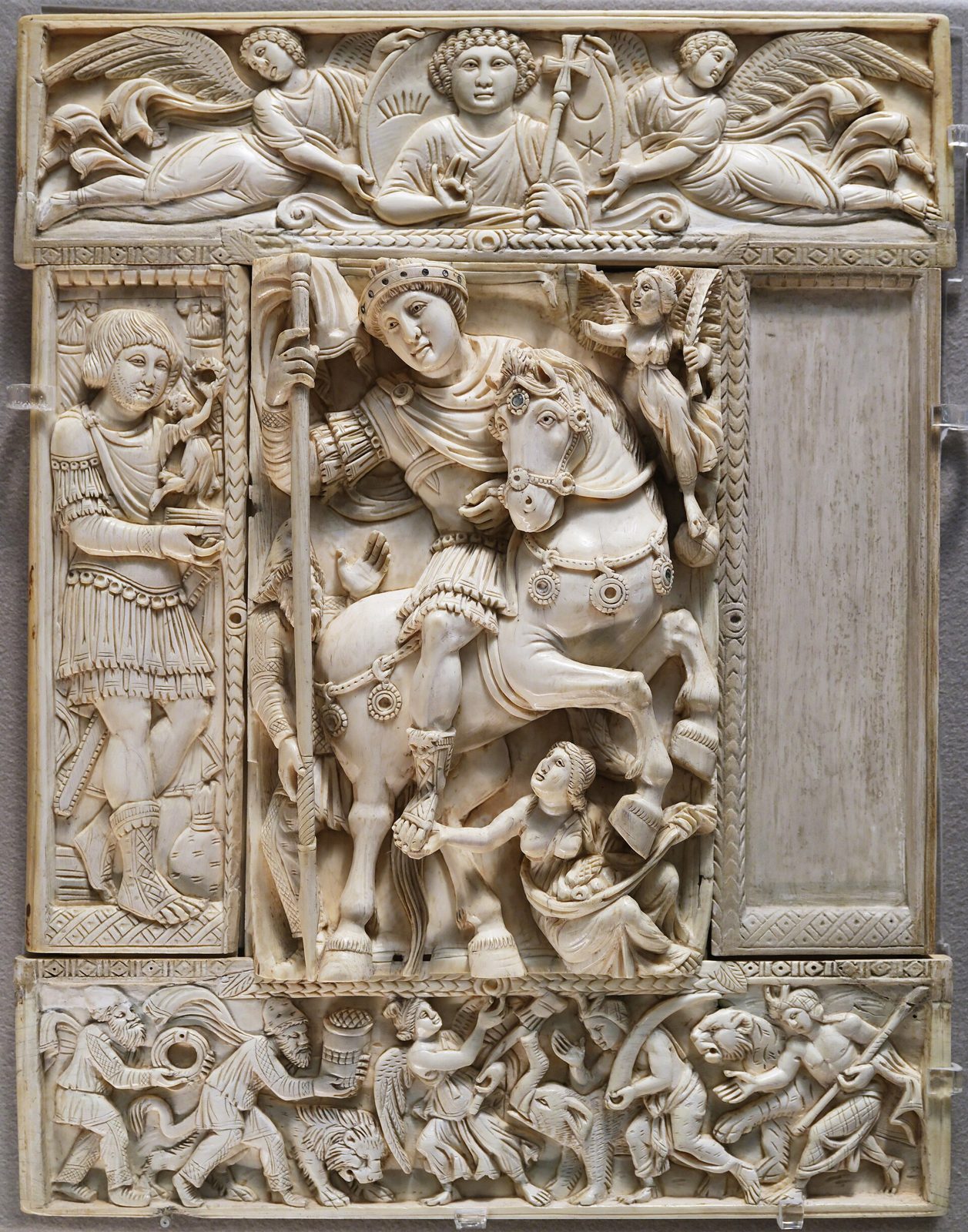
🎧 This work has audio narration — listen in the appTake a moment to really look at the Barberini ivory. Notice how the emperor, possibly Justinian, sits triumphantly on his rearing horse, spear in hand. To his left, a barbarian figure, dressed in trousers, seems almost in awe rather than combative, his hand touching the spear in a gesture of submission.
This piece, crafted in 525, is a remarkable survival from the Byzantine era, showcasing the artistry of an imperial workshop in Constantinople. It’s not just a decorative object; it’s a historical document linking the emperor’s reign to the broader narrative of Christian victory and imperial power. The back of the ivory bears inscriptions, including names of Frankish kings related to Queen Brunhilda, hinting at its journey through history and its significance as a votive offering.
As you stand here, think about the stories this ivory could tell — what would it say if it could speak of the power struggles, the divine right of kings, and the cultural exchanges of its time? What does this artwork reveal about the world it came from?
As you examine the Barberini ivory, let your eyes wander over the intricate details of its craftsmanship. Made from elephant ivory, this piece is a marvel of sculptural technique. Notice how the five rectangular plaques fit together seamlessly, held by tongue and groove joints. You can almost feel the weight of history in your hands as you observe the delicate carvings, where every curve and line tells a story. The absence of polychromy allows the natural beauty of the ivory to shine through, emphasizing the skill of the artisans who crafted it. Can you see the remnants of precious stones, like the seven pearls that still cling to its surface? Each detail is a testament to the artistry of the imperial workshop in Constantinople, where this piece was born.
Originally part of an imperial diptych, it was likely commissioned to celebrate the power of the emperor, often thought to be Justinian. This piece was not just a work of art; it served as a votive offering, inscribed with the names of Frankish kings related to Queen Brunhilda, hinting at its significance in the political landscape of the time. After its creation, the ivory traveled through various hands, with its journey becoming somewhat of a mystery until 1625 when it was gifted to Cardinal Francesco Barberini. It became a prized possession in the Barberini collection in Rome before finding its home in the Louvre in 1899.
Created in the early 6th century, it reflects the political and religious dynamics of its time, particularly the intertwining of Christian authority and imperial might. This piece not only showcases the craftsmanship of an imperial workshop in Constantinople but also serves as a historical document linking to Queen Brunhilda of Austrasia, highlighting her influence and the connections between the Byzantine Empire and the Frankish kingdoms. The ivory's intricate iconography, depicting the emperor crowned by Victory and flanked by allegorical figures, set a precedent for future representations of power in art. Its survival in such excellent condition allows us to glimpse the aesthetic values and political messages of the era, making it a crucial piece for understanding the evolution of imperial imagery in art history.
One fascinating tidbit about the Barberini ivory is that it was originally thought to be a writing tablet, but its weight and lack of a hinge suggest it was never intended for practical use. Instead, it served a ceremonial purpose, reinforcing the emperor's divine right to rule.
Initially, it was thought to be a writing tablet, but its weight and lack of a hinge indicate it was likely intended for ceremonial use instead.
In 1625, it was gifted to Cardinal Francesco Barberini by the antiquary Nicolas-Claude Fabri de Peiresc, who had recovered it earlier and recognized its significance.
It is the only surviving secular object of its kind in such good condition, showcasing the exceptional craftsmanship of the imperial workshop in Constantinople.