 Image: Unidentified painter
Portrait of a Couple
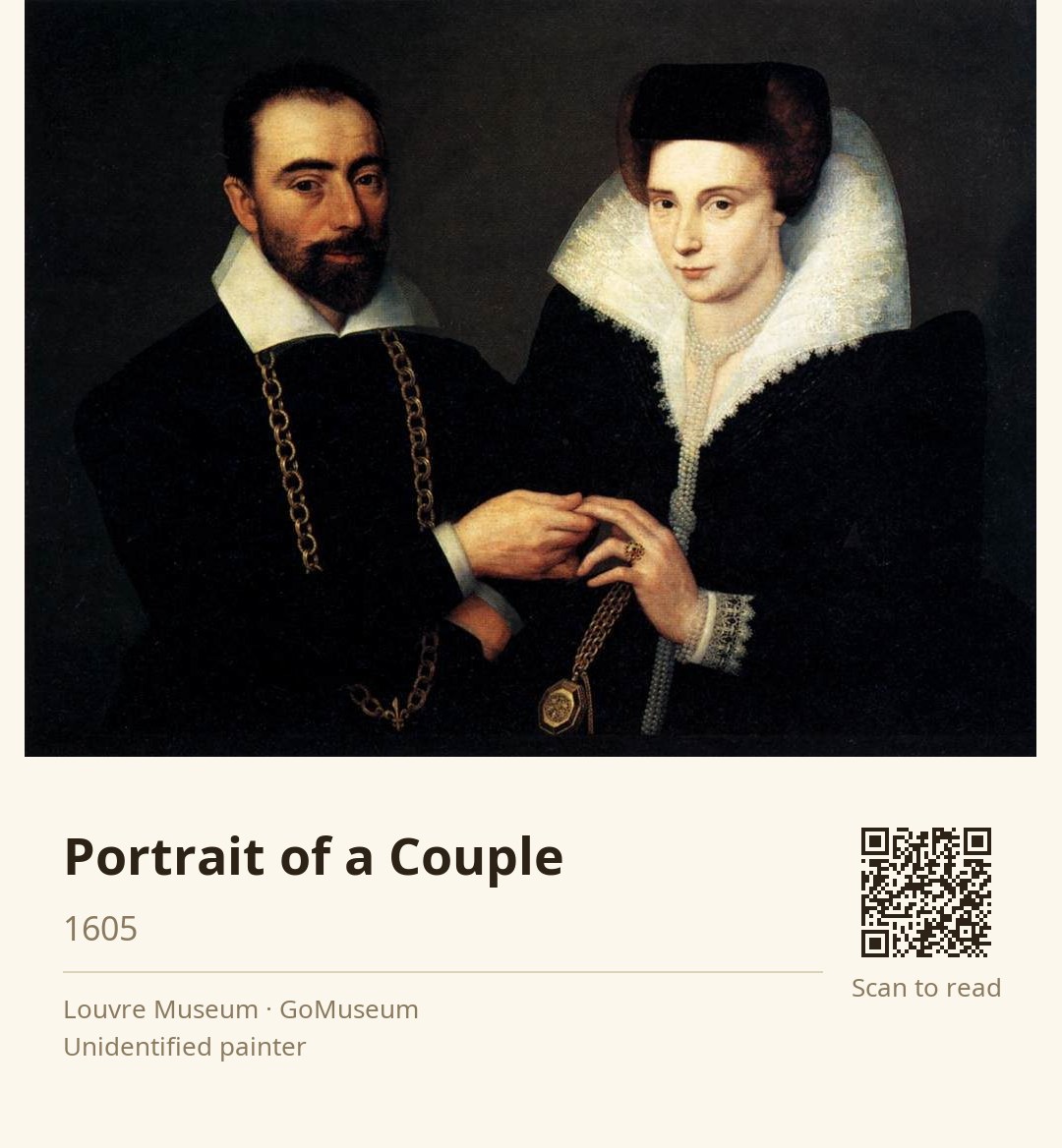
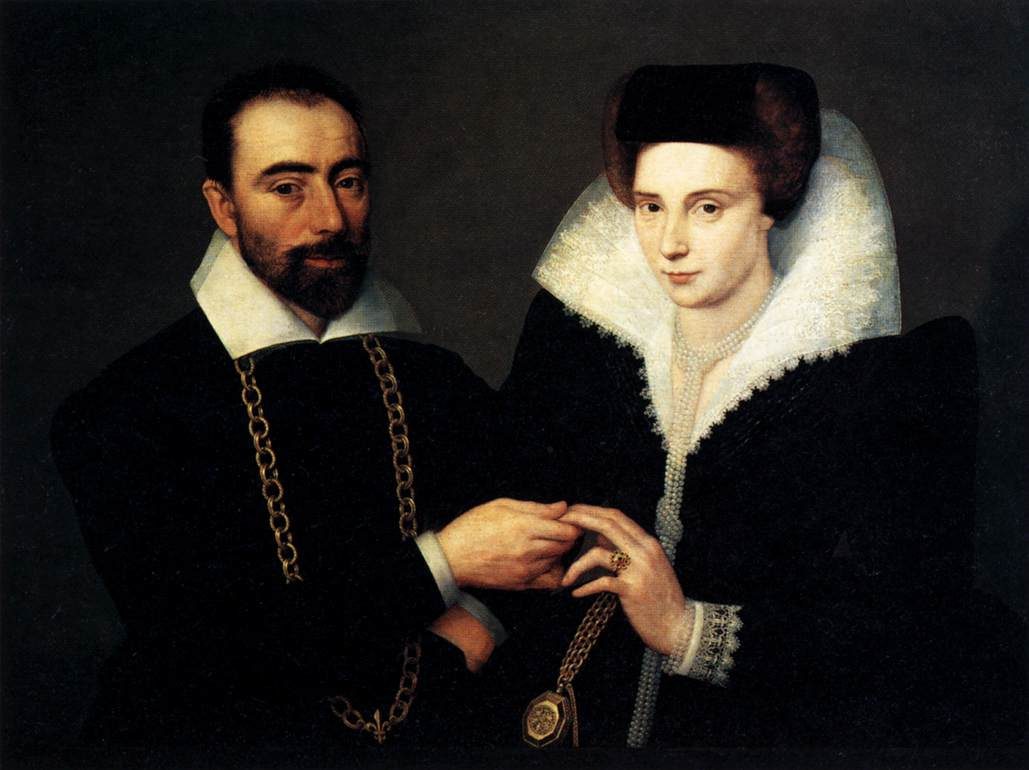
🎧 This work has audio narration — listen in the appA bearded man and a woman stand shoulder to shoulder against a plain dark ground, their hands joined at the centre, and the picture asks you to read the pair as one unit. Start with the hands: his fingers close around hers, and from her wrist hangs a gold chain with an octagonal pendant, a small bright accent that catches the eye against all the black. Look too at her cap, edged with dark fur, and the wide white lace ruff that frames her face like a halo of light.
Those details carry the painting's meaning. The pale flesh and white lace stand out against the black garments, so the artist directs your gaze to the faces and hands.
What the material can tell us is limited. The painting is oil on wood, a panel measuring about 73 by 96 centimetres, and it dates from the last quarter of the sixteenth century, though the 1605 date given in the record is the one used here. It entered the Louvre's collection through the Dupichot Alexandre provenance, and it is held today under the inventory number RF 1967-9. The figures are rendered with smooth, finely detailed paint, and no inscription identifies who they are.
Nothing here names the sitters or says why they were painted together, so the couple's identity remains open, and the portrait's story survives mainly in its clothing, jewellery and the careful way two people were brought together on a single panel.
The records give this panel a date of 1605, and the museum's catalogue lists it under the inventory number RF 1967-9. Its provenance is recorded as passing through a collector named Alexandre Dupichot before it reached the museum. No painter is named; the work is catalogued as anonymous. Beyond that, the material says nothing about who commissioned it, where it was first shown, or how it was received, so those gaps have to stay open.
The panel is a dark ground of grey-brown with nothing behind the two figures, so the picture seems to rest entirely on the bodies and the jewellery. The man's garment is black and high-necked, with a small white flat collar, and the heavy gold chain of oval links falls across his chest. The woman's black dress has broad shoulders, and her white lace ruff and cuffs are the brightest notes in the whole picture. Her long pearl strand, her ring and the octagonal pendant hanging from her hand give the panel its sparkle. The paint is described as smooth and finely detailed, and that fineness is what makes the gold and pearls read so clearly against the black.
The record names Alexandre Dupichot as the previous owner before the work came to the museum, but the material says nothing more about who he was.
The work is cited in a publication under the reference C.P. P.411, though the material does not say what that source discusses.
The artist is recorded as anonymous, so the material gives no name for whoever painted the panel.