 Image: King
Magdalena Bay
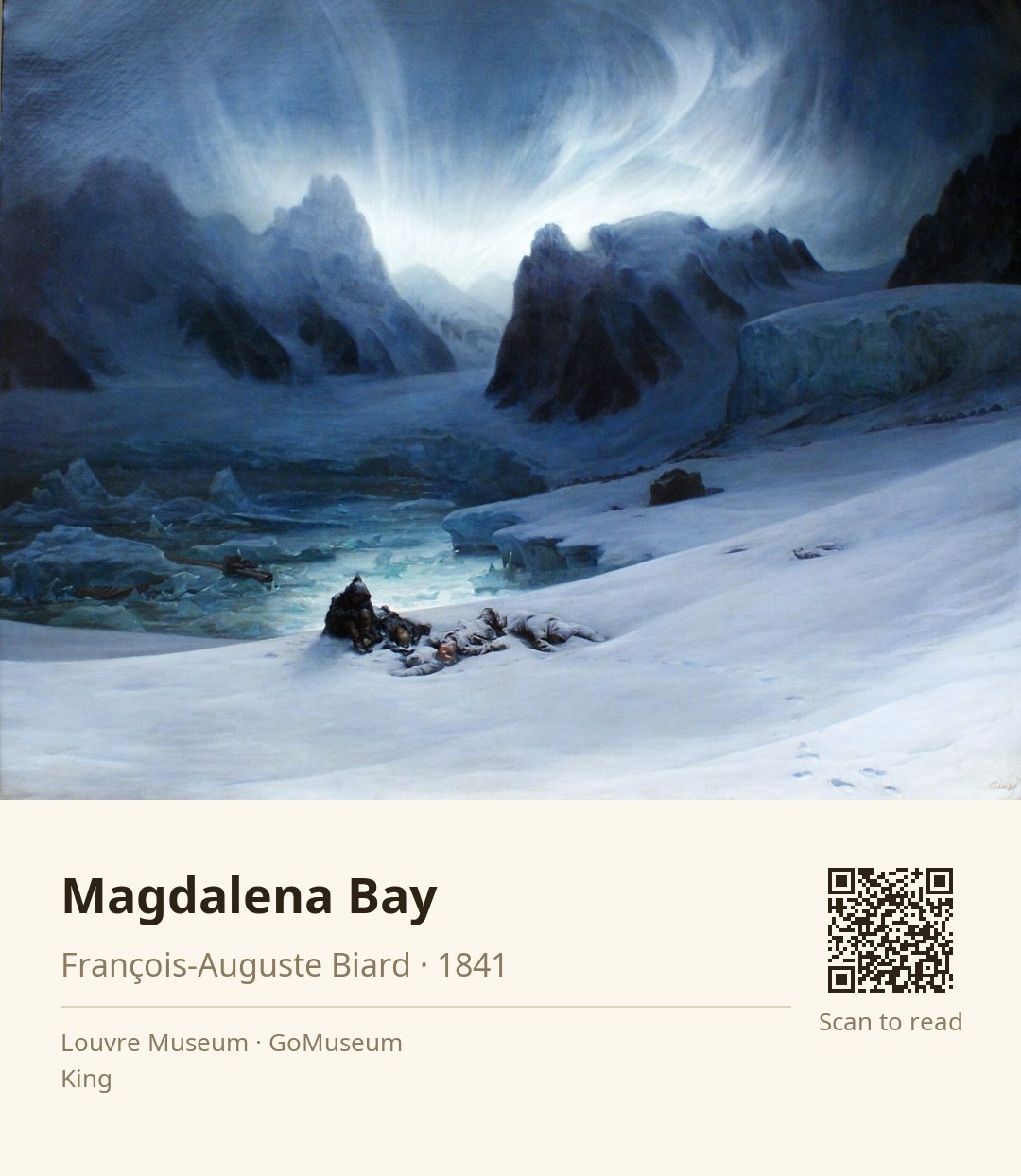
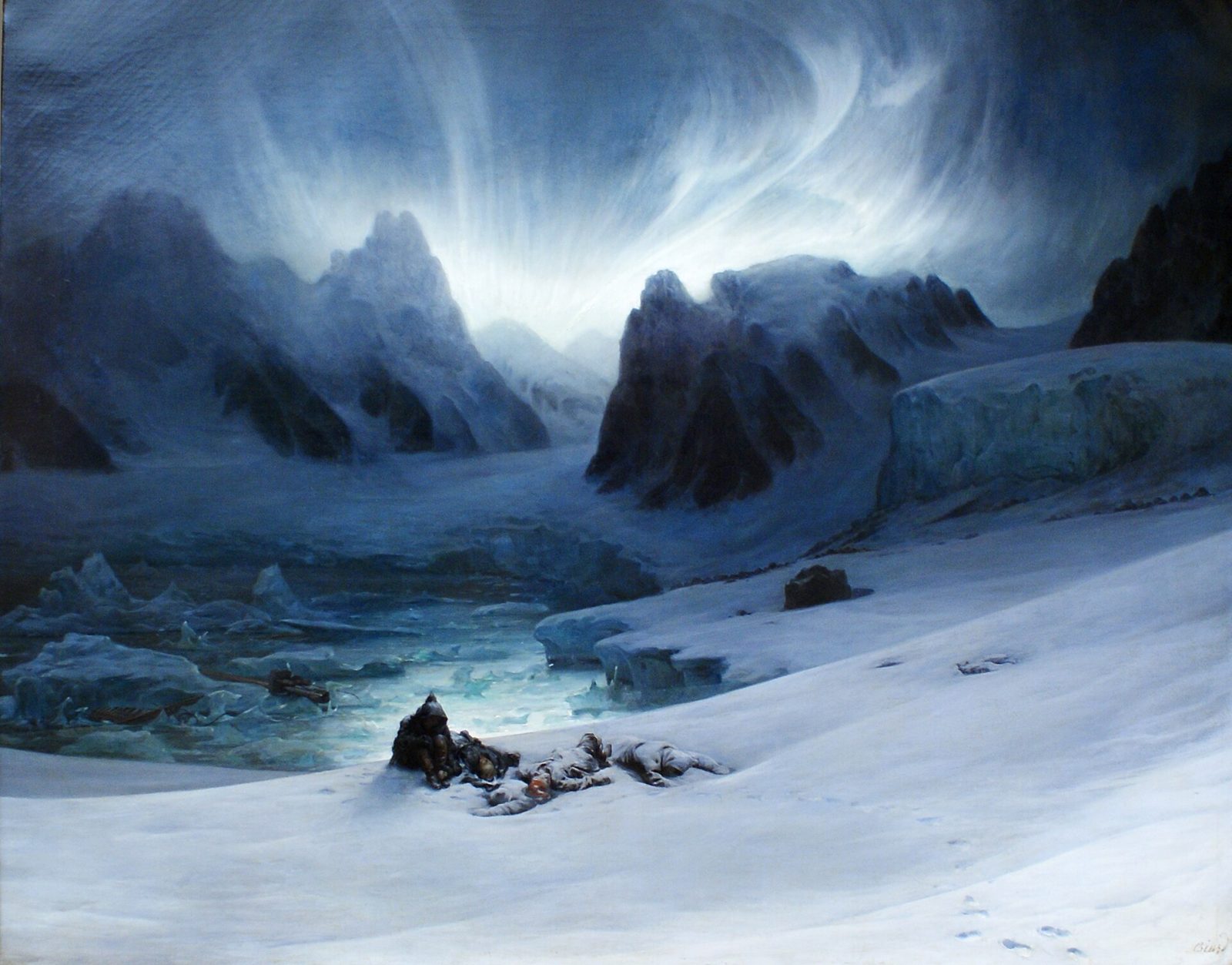
🎧 This work has audio narration — listen in the appLook just beyond them, where a small boat and oars lie tangled among the broken floes of a pale turquoise pool, and you can read the scene's whole story in a few brushstrokes: a crew came to this place, and something went wrong.
The painting is an oil on canvas, and its subject is a landscape of the Arctic. Its title places the view at Magdalena Bay, seen from the Tombeaux peninsula on the north of Spitsbergen, and gives the effect as an aurora borealis. The material tells us that Biard was part of a scientific expedition led by Joseph Paul Gaimard that travelled to Spitsbergen and Lapland in 1839, and that he made this picture from that journey. The work was shown at the Paris Salon of 1841, and it came from the artist's own collection, which is how it passed to the museum. Biard was by then known for lively scenes of everyday life, and he had married Léonie d'Aunet, who went on the same expedition and later wrote her own account of it.
What the sources do not tell us is how the painting was received by critics or what Biard intended the bodies to mean, so the reading of the scene remains open.
François-Auguste Biard was a French painter born in Lyon in 1799 who spent much of his life on the move, and his restless wanderings became the very subject of his art. His parents had hoped he would enter the Church, but he turned instead to painting, first at a Lyon wallpaper factory and then at the local École des Beaux-Arts. His formal training was irregular, and he is often described as largely self-taught, learning as much from his own travels and observation as from his teachers.
Biard was driven by a love of adventure and a curiosity about distant peoples and places. He journeyed through Italy, Greece and the Middle East, then across the Mediterranean to Malta, Cyprus, Syria and Egypt, and later joined a scientific expedition to Spitsbergen and Lapland in 1839. He was also a lively, somewhat mischievous figure: his popular genre scenes often slipped humour into otherwise serious compositions, a habit that delighted some audiences and drew criticism from others. His personal life was turbulent, most notably through the scandal surrounding his wife, the writer Léonie d'Aunet, and her affair with Victor Hugo, which ended in their marriage being annulled.
His reputation rests on the blend of exploration and anecdote he brought to painting. He was among the first European painters to depict Indigenous peoples of the Brazilian Amazon, and his two years in Brazil, documented in the illustrated book Deux années au Brésil, remain a valued record of that period. In the history of art he is best seen as a Romantic-era travelling painter, whose images of distant lands and everyday scenes combined documentary interest with the appeal of storytelling.
This picture was painted by François-Auguste Biard, who had joined a scientific expedition led by Joseph Paul Gaimard to Spitsbergen and Lapland in 1839, and the canvas comes out of that journey. It was shown at the Salon des artistes français in Paris in 1841, and it was painted by Biard himself and came to the museum from his own collection. Keep in mind that it's the painter's own record of a trip he had made, not a commission someone handed him.
The scene is cold and almost colourless: blues, whites and slate greys, with the snow rendered smooth and blended, while the sky is handled with feathery, swirling white streaks. The eye is pulled into the middle of the canvas, where a flat glacier opens between jagged dark mountains on either side, and the bright gap of that opening is what keeps the composition from closing in. Toward the right a tall pale ice cliff meets a dark rock ledge, which gives the right side a heavier, more solid weight than the open left. Along the snow slope in the foreground, a few small footprint trails run across the white, a quiet record of movement. The turquoise pool sits right behind the dark figures and shows broken floes, so the coldest colours gather around the bodies. Nothing here is warm; even the light is pale and diffuse, so the whole view feels washed out and remote.
Yes. Léonie d'Aunet, who was travelling with him as his fiancée, later published her own account of the journey in 1854, titled Voyage d'une femme au Spitzberg.
Yes. Around 1858 he spent two years in Brazil, where he worked at the court of Emperor Pedro II, a friend of his, and made excursions into the interior and the Amazon.