The Victors of the Bastille in Front of the Hôtel de Ville
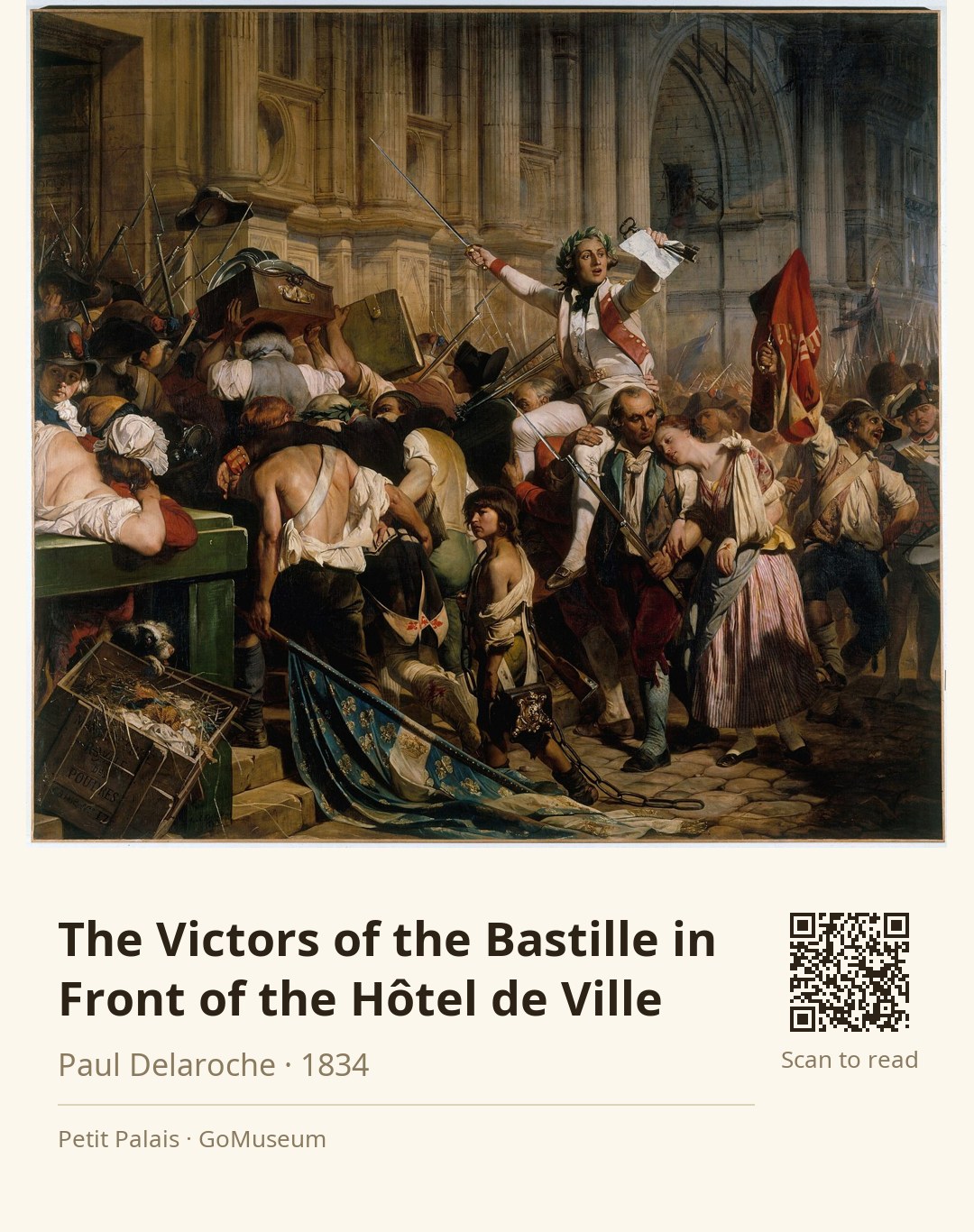
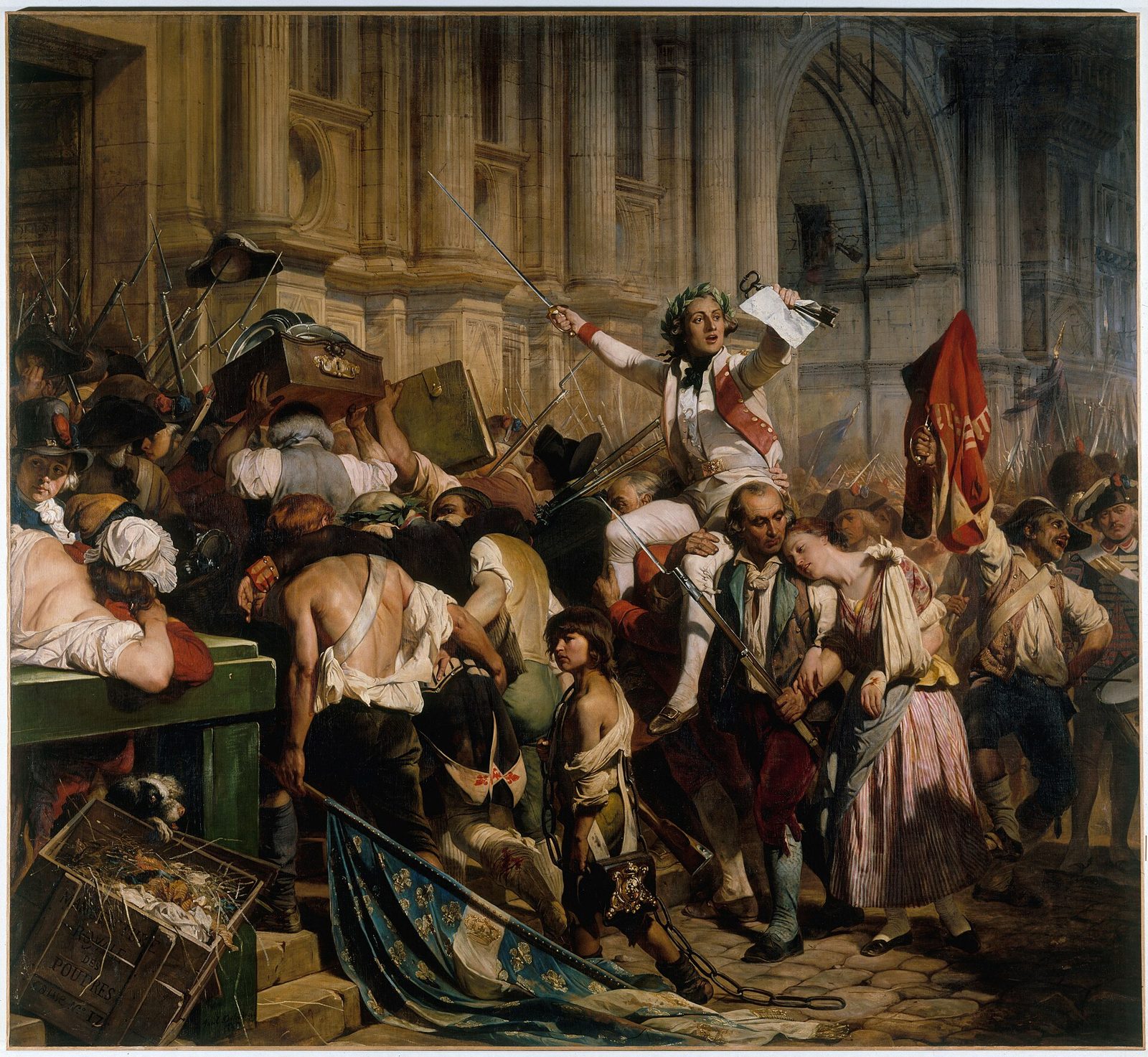
🎧 This work has audio narration — listen in the appA man with a laurel wreath and a sword stands triumphantly atop a pile of belongings, holding a document high in the air. Around him, a crowd is engaged in a flurry of activity: some carry large trunks, others clutch weapons, while a woman leans on a man for support. This chaotic scene captures the moment of victory on July 14, 1789, when the people who stormed the Bastille arrived at the Hôtel de Ville, celebrating their hard-won freedom.
The central figure, Jacob Job Élie, symbolizes the spirit of the revolution, brandishing the key to the fortress and a letter from its governor, who had just been lynched. This moment is not just a celebration; it represents the culmination of a struggle against oppression, where the people reclaim their power. Delaroche's use of rich earthy tones and vibrant reds adds to the emotional weight of the scene, immersing the viewer in the fervor of the moment.
Commissioned shortly after Louis-Philippe I's accession, Delaroche began this large oil painting in 1834, aiming to honor the heroes of the July revolutions. Despite its significance, the painting was never displayed during the reign of Louis-Philippe and was stored away, ultimately escaping the fire that ravaged the Hôtel de Ville in 1871.
Hippolyte-Paul Delaroche was a prominent French painter born on July 17, 1797, in Paris, where he spent most of his life until his death on November 4, 1856. Known for his historical scenes, Delaroche's work straddled the lines between Romanticism, Academicism, and Neoclassicism, reflecting the emotional depth of Romantic ideals while adhering to the meticulous detail favored by Academics. His pragmatic realism allowed him to portray historical figures, such as Marie Antoinette and Napoleon Bonaparte, with a sense of equality, devoid of glorification.
Delaroche emerged as a significant figure in the art world during a time of stylistic conflict between Romanticism and Classicism. His early works, particularly "The Execution of Lady Jane Grey," garnered acclaim and established him as a leading historical painter. He was a student of Antoine-Jean Gros and later mentored notable artists like Jean-Léon Gérôme and Jean-François Millet. Despite his success, Delaroche faced criticism for his later religious works, leading him to withdraw from public exhibitions after 1837.
His artistic journey began at L'École des Beaux-Arts, where he initially focused on landscapes but soon shifted to history painting under Gros's influence. Delaroche's legacy includes a rich body of work that resonated with the public and influenced future generations, making him a key figure in 19th-century art history. His marriage to Louise Vernet and the subsequent loss of her in 1845 deeply affected him, yet his contributions to the art world remain significant. Delaroche's paintings continue to be celebrated for their narrative quality and emotional resonance, solidifying his place in the annals of art history.
Paul Delaroche was commissioned to create 'The Victors of the Bastille in Front of the Hôtel de Ville' shortly after Louis-Philippe I ascended to the throne in 1830. This painting was part of a larger project to honor the heroes of the July revolutions of both 1789 and 1830, alongside works by fellow artists like Cogniet and Drolling. Delaroche began working on it in 1834, with the architectural elements drawn by Charles Séchan. Despite its historical significance, the painting was never displayed during Louis-Philippe's reign and was relegated to storage, where it miraculously survived the fire that consumed the Hôtel de Ville during the bloody week of 1871. Today, it resides in the Petit Palais in Paris, a testament to the tumultuous history it represents.
Delaroche's technique in this painting is strikingly vivid, employing a rich palette of earthy tones and vibrant reds that evoke the fervor of the moment. The brushwork is meticulous, with each figure rendered in detail, creating a sense of chaos and movement. The central figure, Jacob Job Élie, is elevated atop a pile of belongings, drawing the viewer's eye immediately. Delaroche's choice to depict a dense crowd, with figures partially obscured, enhances the feeling of a collective experience, almost overwhelming in its energy. The architectural backdrop, with its tall columns and arched entrance, adds depth and grandeur, framing the scene while emphasizing the significance of the Hôtel de Ville as a symbol of revolutionary triumph.
Interestingly, Delaroche's painting was so popular that it was reproduced by numerous engravers during his lifetime, making it accessible to the general public. This widespread reproduction helped cement his reputation and allowed the imagery to permeate everyday life, turning historical events into familiar scenes for many.
The popularity of Delaroche's painting led to its reproduction by many engravers, which made the imagery widely accessible and familiar to the general public, thereby enhancing his reputation.
Charles Séchan assisted Delaroche by drawing the architectural elements that form the background of the painting.