 Image: Didier Descouens
Age d'airain
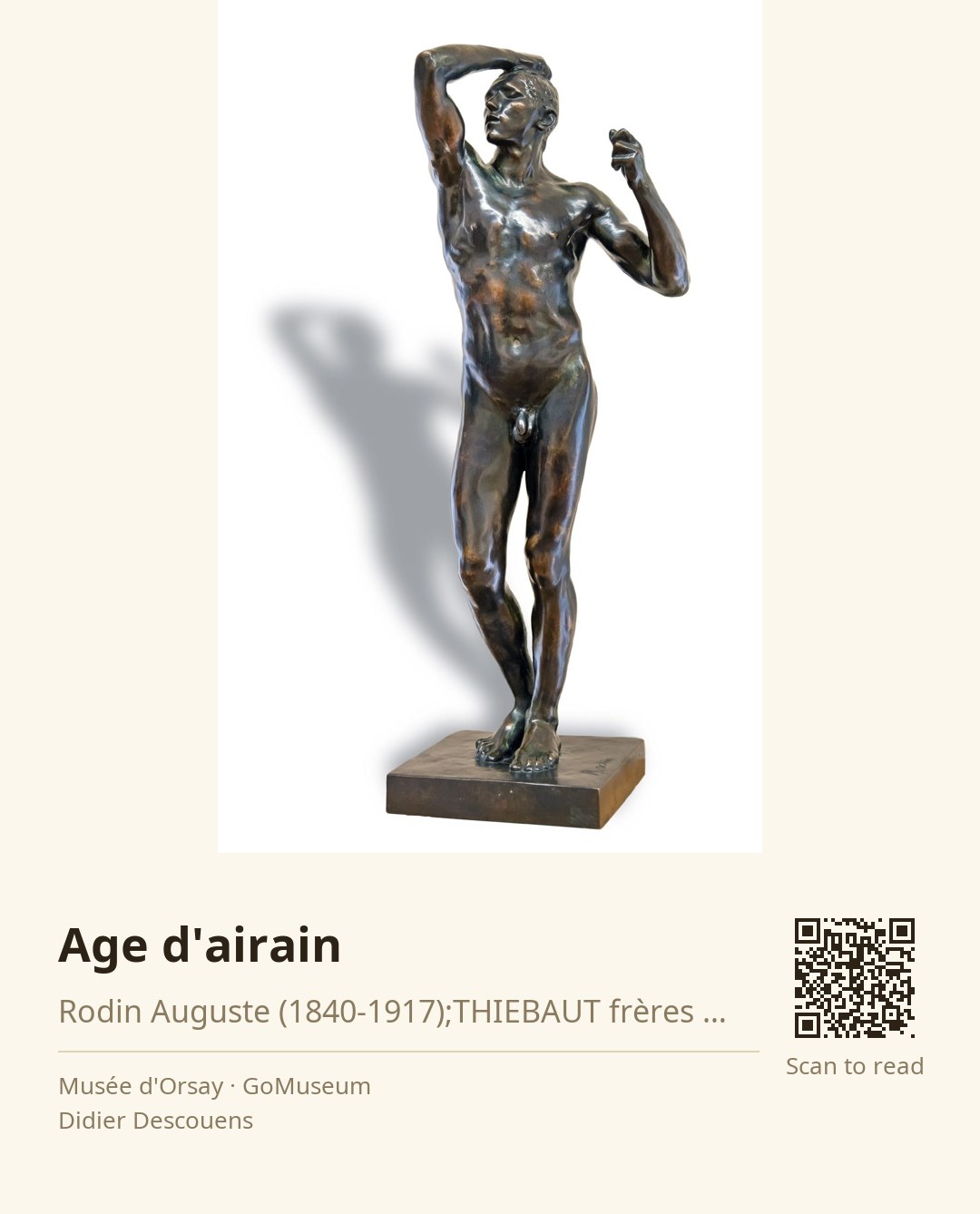
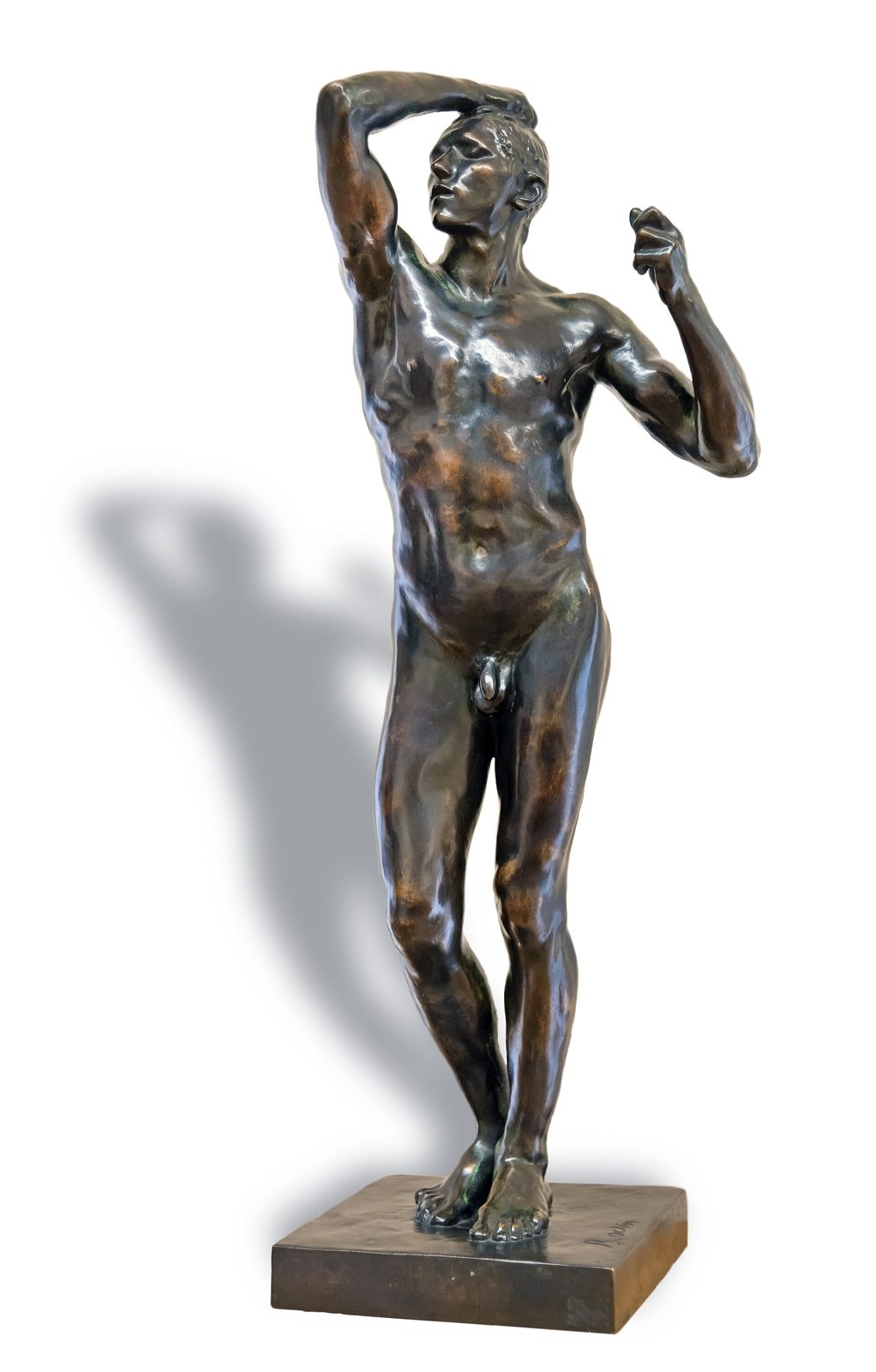
🎧 This work has audio narration — listen in the appThe nude male figure in "Age d'airain" stands poised on a rectangular base, one arm raised with a hand resting on his head, while the other is bent near his chest. The smooth surface of the bronze, enhanced by a dark patina, accentuates the intricate details of his musculature, creating a striking sense of vitality and movement.
Created between 1875 and 1876, this sculpture was first exhibited at the Salon des artistes français in Paris in 1880, where it garnered attention for its bold representation of the human form. The work has since been recognized as a significant piece in Rodin's oeuvre, showcasing his mastery in capturing the interplay of strength and vulnerability.
Rodin's 'Age d'airain' is crafted from bronze, a material known for its durability and ability to capture fine details. The smooth surface, combined with the dark patina, not only enhances the figure's musculature but also creates a rich visual texture that invites touch. You can see how the artist's skill in bronze casting brings out the subtle variations in the figure's form, from the defined muscles to the gentle curves of the body. This technique allows for a lifelike representation, making the figure seem almost ready to step off the base.
Created between 1875 and 1876, 'Age d'airain' was first shown at the Salon des artistes français in Paris in 1880, where it was met with both admiration and controversy. Rodin, already known for his innovative approach, faced criticism for the sculpture's raw depiction of the human body, which some deemed too realistic. The work was later exhibited at the 1883 Exposition Universelle in Vienna, and again at the 1889 and 1900 Expositions Universelles in Paris, solidifying its place in the art world.
'Age d'airain' was exhibited at the 1883 Exposition Universelle in Vienna, and later at the 1889 and 1900 Expositions Universelles in Paris.
'Age d'airain' is also known by several other titles, such as 'L'âge de pierre', 'L'âge de bronze', 'L'homme qui s'éveille', and 'Le vaincu'.