La encantadora de serpientes
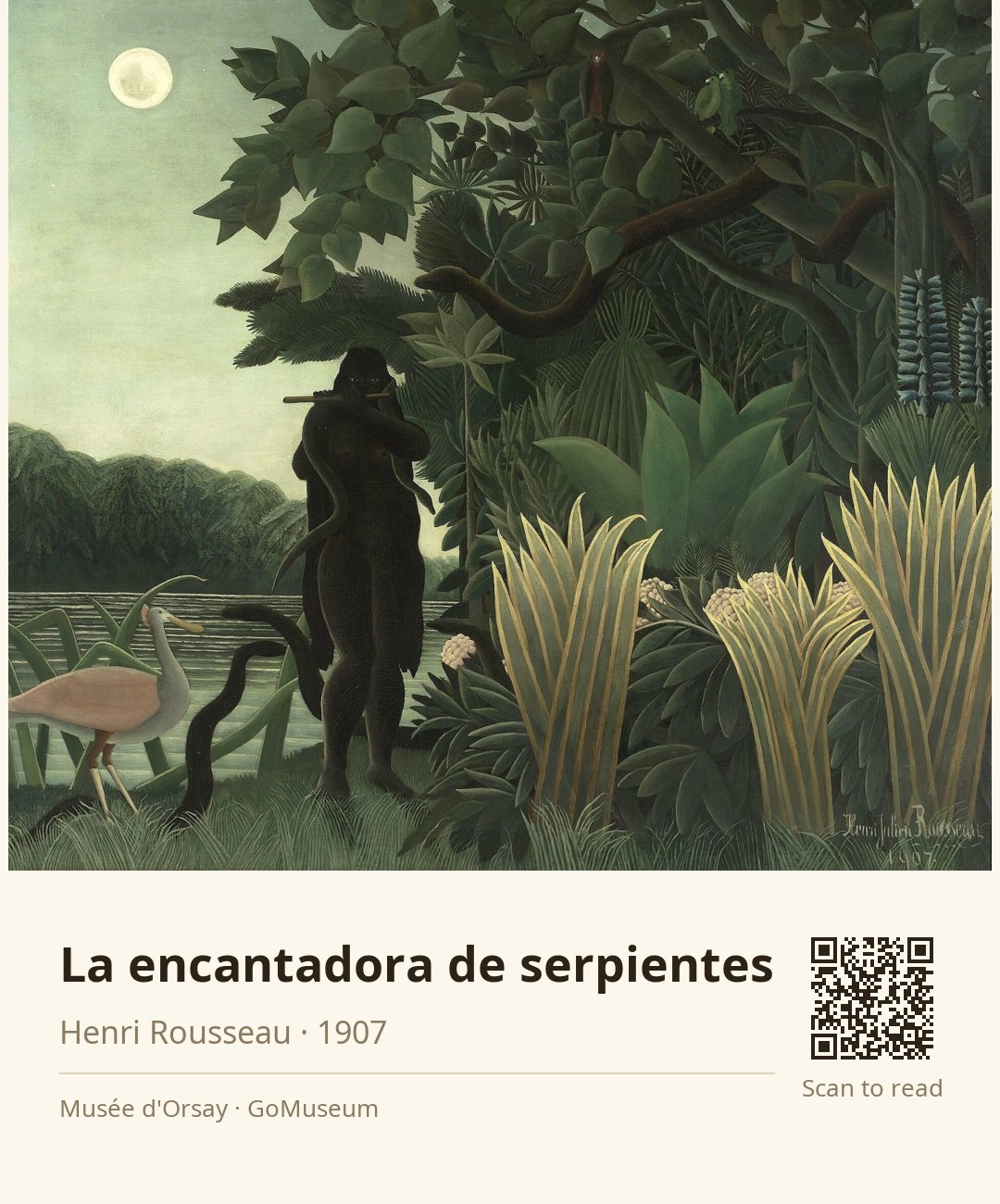
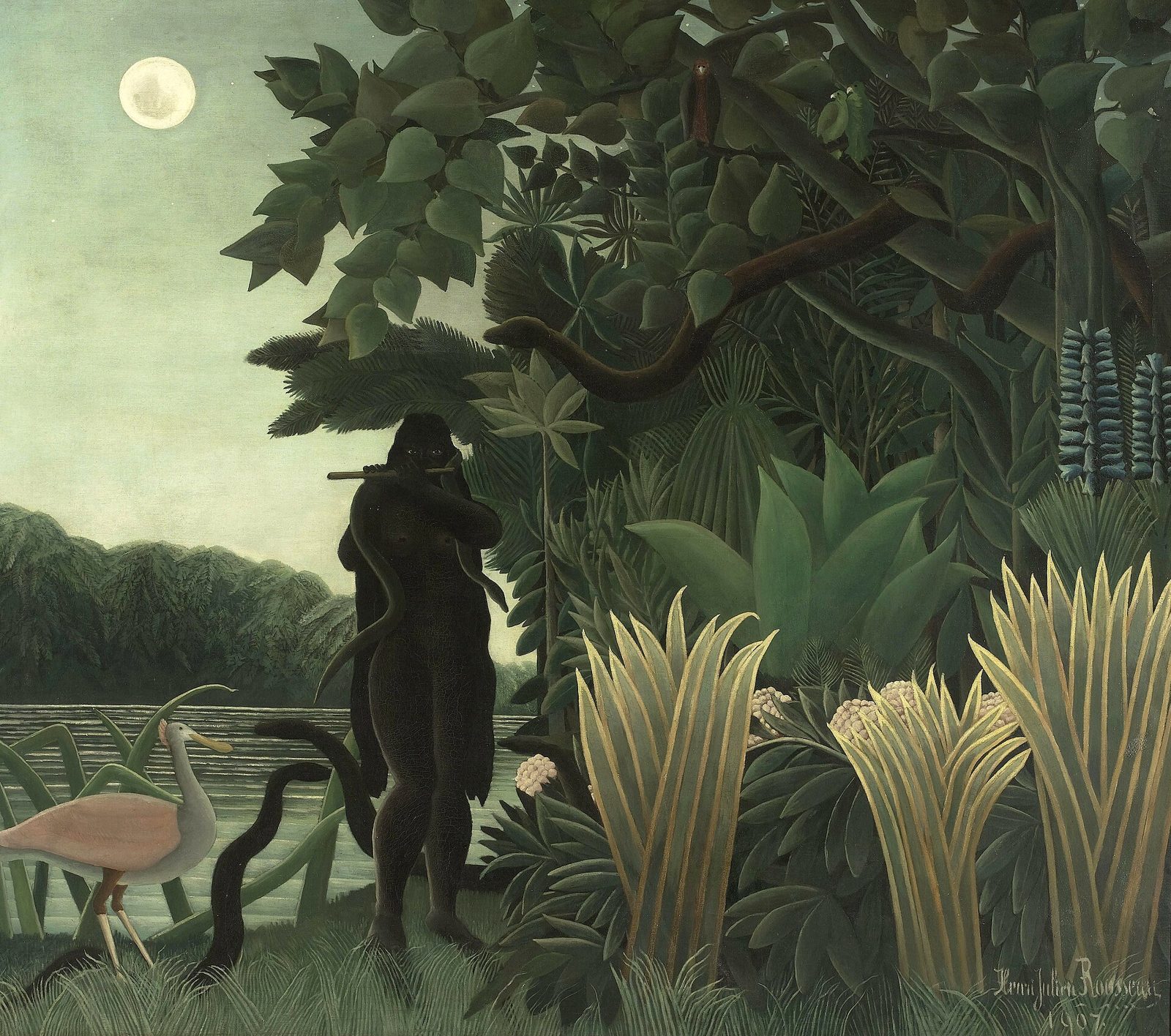
🎧 This work has audio narration — listen in the appAs you stand before "La encantadora de serpientes," let your gaze drift to the woman on the left, her glowing eyes piercing through the moonlit jungle. Notice how the snake, seemingly entranced, stretches toward her, its sinuous body contrasting against the lush greenery. This moment captures a delicate balance between danger and allure, a theme that resonates throughout Rousseau's work.
Why does this matter? Rousseau, a self-taught artist, never left France, yet he conjured this exotic scene from his imagination, inspired by botanical gardens and illustrated magazines. The vibrant colors and naive style invite you into a dreamlike world, one where the boundaries of reality blur. The painting reflects Rousseau's fascination with nature and the unknown, a sentiment that echoes in the hearts of many who seek adventure beyond their familiar surroundings.
Commissioned in 1907 by Berthe, Comtesse de Delaunay, this piece marked a significant moment in Rousseau's career, showcasing his unique vision at the Autumn Salon. It’s a testament to how art can transport us, allowing us to explore realms we may never physically visit.
As you take in this enchanting scene, consider: what does the snake symbolize to you? Is it a creature of danger, or does it represent the allure of the unknown?
Henri Rousseau, born on May 21, 1844, in Laval, France, was a self-taught painter who became a pivotal figure in the Naïve art movement. Known as "Le Douanier" due to his job as a customs officer, he began painting seriously in his forties after a modest life marked by early hardship and family responsibilities. Despite facing ridicule from critics during his lifetime, Rousseau's unique style, characterized by vivid colors and dreamlike jungle scenes, garnered a devoted following.
His works, inspired by visits to the Natural History Museum and botanical gardens in Paris, often depicted fantastical landscapes, despite his never having traveled outside France. He exhibited regularly at the Salon des indépendants, where his painting "Surprised!" received acclaim from fellow artists, including Félix Vallotton. By the end of his life, Rousseau was celebrated by avant-garde figures like Pablo Picasso, who recognized his genius and honored him with a banquet in 1908.
Rousseau's influence on modern art is profound, impacting generations of artists, including the Surrealists and the Fauves. His legacy endures as a testament to the power of imagination and the beauty of simplicity in art. He passed away on September 2, 1910, in Paris, leaving behind a body of work that continues to inspire and captivate audiences worldwide.
Henri Rousseau's 'La encantadora de serpientes' was commissioned in 1907 by Berthe, Comtesse de Delaunay, marking a pivotal moment in his artistic journey. This was his first large commission, and it was exhibited at the Autumn Salon in Paris the same year, where it was assigned the number 41. Despite Rousseau's lack of formal training and his never having traveled beyond France, he managed to create this exotic scene, drawing inspiration from the Jardin des Plantes and illustrated magazines. The painting remained in the Delaunay family until 1922, when it was acquired by the fashion designer Jacques Doucet, who purchased it for 50,000 francs on the advice of André Breton. It was promised to the Louvre in 1925 and officially became part of its collection in 1937, solidifying its place in art history.
As you gaze at 'La encantadora de serpientes,' notice the asymmetric vertical composition that Rousseau employs. The woman on the left, illuminated by the moonlight, contrasts sharply with the dense, dark jungle on the right. This play of light creates a sense of mystique and draws your eye across the canvas. The brushwork feels both naive and precise, capturing the lush foliage with vibrant colors that pop against the night sky. The snake, stretching horizontally across the painting, is not just a creature; it's a visual bridge between the woman and the jungle, embodying the tension between allure and danger. Rousseau's handling of oil paint adds a dreamlike quality, enhancing the fantastical atmosphere that invites viewers to lose themselves in this imagined world.
Created in 1907, it reflects Rousseau's fascination with exotic jungles—settings he never personally visited, but imagined through botanical gardens and illustrated magazines. This painting not only captivated the audiences of its time but also influenced a wave of avant-garde artists, including the surrealists. Its dreamlike quality and vibrant colors paved the way for future explorations of fantasy in art, making Rousseau a key figure in the transition to modernism. Remember, Rousseau's work was initially dismissed, yet it ultimately inspired generations, proving that true vision can transcend conventional boundaries.
A curious tidbit about 'La encantadora de serpientes' is that it inspired not only visual artists but also writers and musicians. Sylvia Plath's poem 'Snakecharmer' and Willard Elliot's composition for alto flute were both influenced by Rousseau's enchanting scene, demonstrating the painting's far-reaching impact beyond the canvas.
Rousseau's use of oil paint creates a distinct dreamlike quality in 'La encantadora de serpientes,' allowing vibrant colors to pop against the dark jungle backdrop and enhancing the fantastical atmosphere of the scene.
The painting inspired not only visual artists but also writers and musicians, with Sylvia Plath's poem 'Snakecharmer' and Willard Elliot's composition for alto flute reflecting its enchanting themes.
Commissioned by Berthe, Comtesse de Delaunay, 'La encantadora de serpientes' marked Rousseau's first large commission, showcasing his unique vision at the Autumn Salon and helping to elevate his status in the art world.