 Image: Chosovi, edited by MenkinAlRire · Chosovi · Moonik · GautierPoupeau
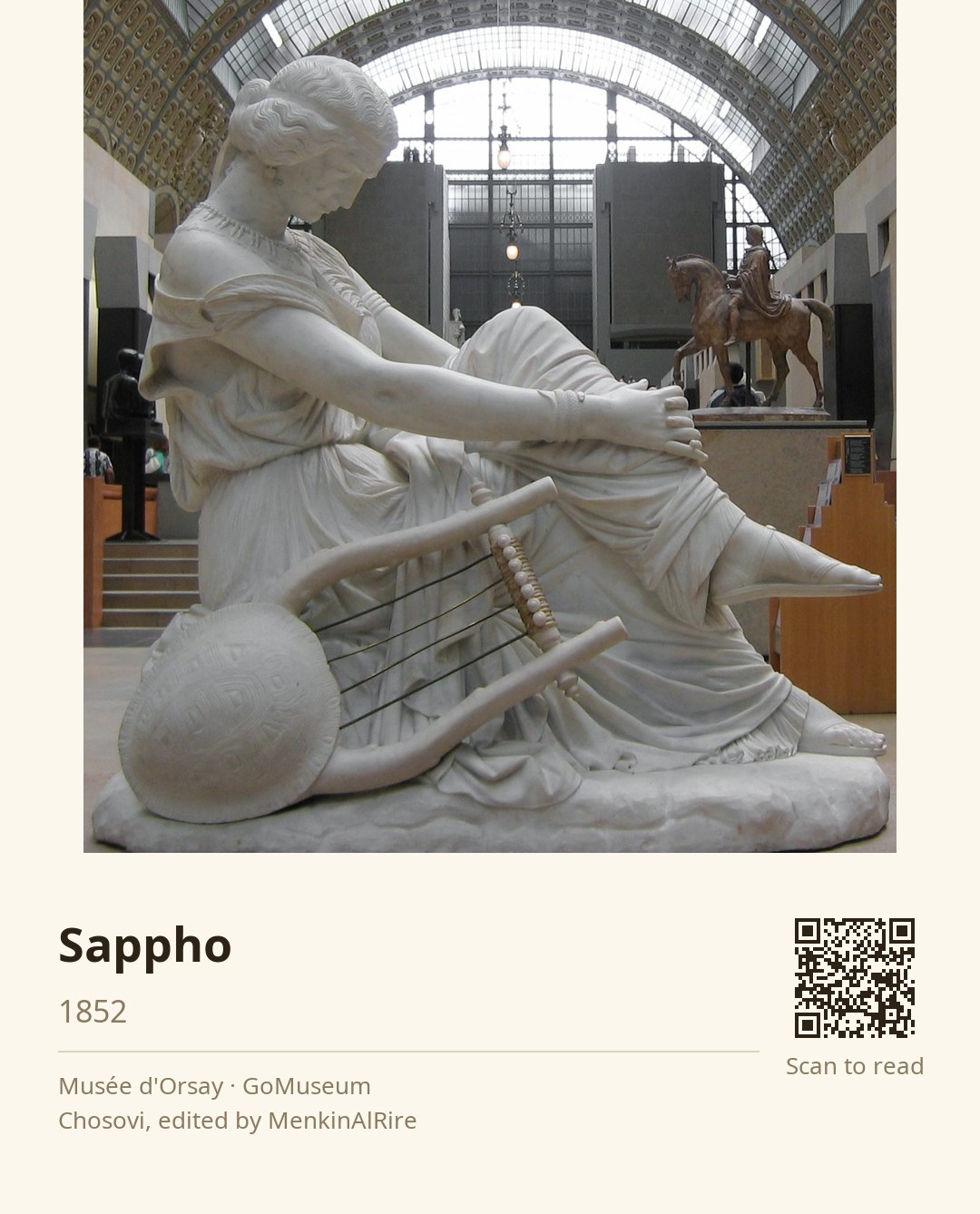
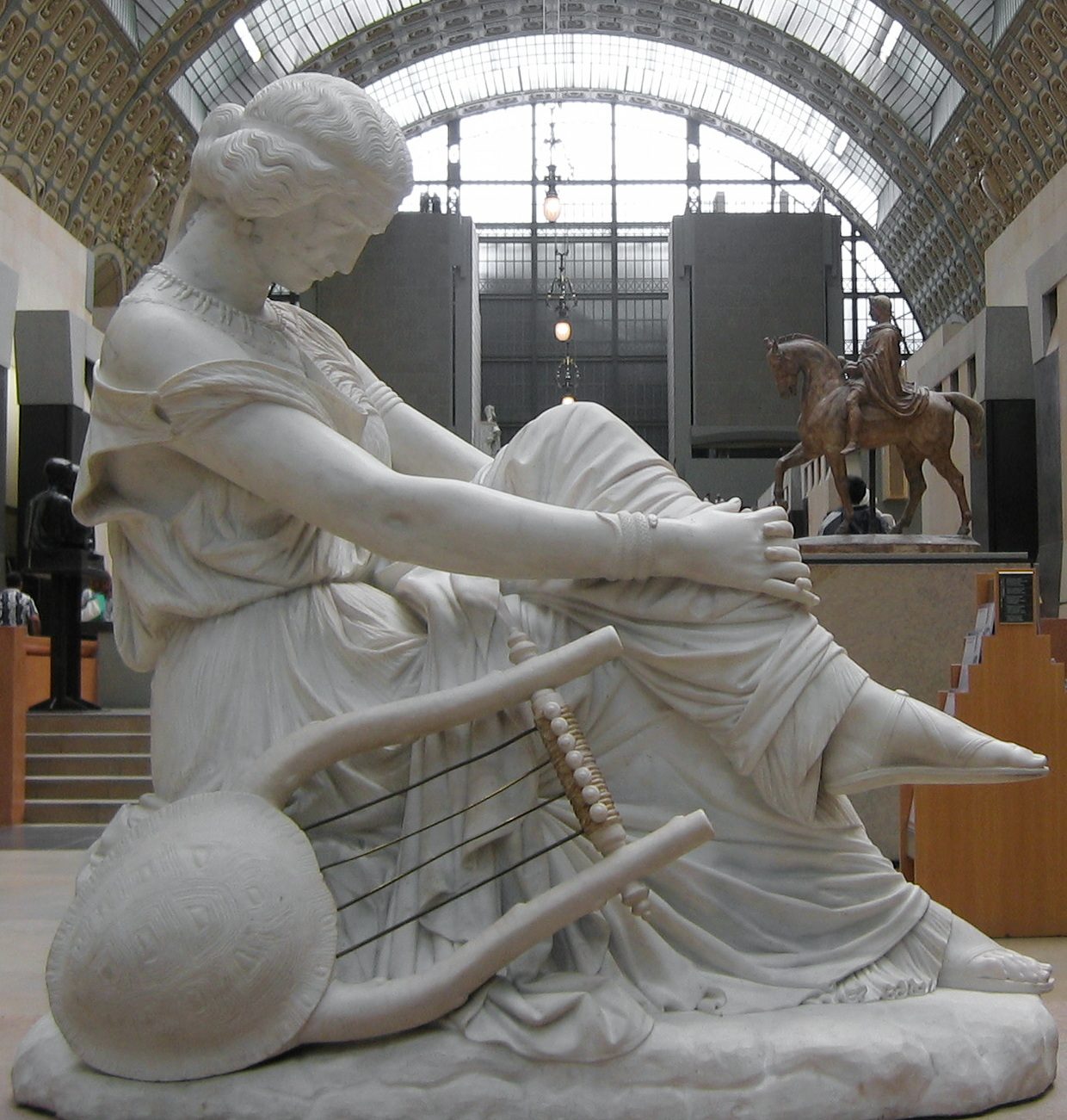
Sappho, seated gracefully on a rock, embodies the essence of ancient poetic inspiration. Her flowing classical robes, adorned with intricate folds, cascade elegantly around her form, while her left hand gently cradles her ankle, suggesting a moment of serene contemplation. At her feet lies a lyre, its visible strings hinting at her deep connection to music and the arts, reinforcing her identity as a celebrated poetess.
Pradier's Sappho was first exhibited at the Salon of 1852, where it earned a posthumous Medal of Honor for the artist, who passed away shortly before the exhibition opened.
James Pradier, born Jean-Jacques Pradier in Geneva on May 23, 1790, was a prominent French sculptor known for his neoclassical style. He moved to Paris in 1807 to work with his brother and studied at the École des Beaux-Arts, where he honed his craft. Winning the Prix de Rome allowed him to study in Italy, further shaping his artistic vision. Pradier debuted at the Salon in 1819, quickly gaining recognition for his skillful sculptures, which often blended mythological themes with a subtle eroticism.
His workshop became a hub for artists and writers, reflecting his vibrant social life, including a notable relationship with Juliette Drouet. Pradier's work, such as the scandalous "Satyr and Bacchante," showcased his ability to evoke emotion through form. He created significant public sculptures in Paris, including allegorical figures at the Place de la Concorde and the crypt of Napoleon at Les Invalides.
Despite his acclaim during his lifetime, Pradier's legacy faded after his death in 1852. His dedication to craftsmanship and artistry earned him respect, as noted by contemporaries like Gustave Flaubert. Today, his contributions to sculpture are recognized in various collections, including the Louvre, yet he remains a somewhat overlooked figure in art history. Pradier's influence persists through his students and the enduring quality of his work, which reflects the complexities of his life and the artistic currents of his time.
Crafted from smooth white marble, Pradier's Sappho showcases his mastery of the material. The intricate folds of her flowing robes are not just decorative; they reveal the artist's skill in carving, capturing the delicate play of fabric as it drapes over her form. You can see how he meticulously shaped her hair into soft waves, enhancing her serene expression. The lyre at her feet, with its visible strings, is a testament to his attention to detail, hinting at both musicality and the poetic spirit that Sappho embodies. The subtle gilding on her jewelry adds a touch of elegance, drawing your eye to the adornments that signify her status as a figure of beauty and intellect.
James Pradier's Sappho was unveiled at the Salon of 1852, a significant event in the Parisian art scene. This sculpture was commissioned shortly after he created a smaller bronze version for the Salon of 1848. Tragically, Pradier passed away just before the 1852 exhibition opened, leading to a poignant moment when the sculpture was draped in black fabric in his honor. The piece earned him a posthumous Medal of Honor, a testament to his impact on the art world. Initially acquired by the Service des achats aux artistes vivants, Sappho found a home at the Château de Saint-Cloud until its destruction in 1870, after which it was transferred to the Louvre. In 1986, it was moved to the Musée d'Orsay, where it continues to be celebrated.
Interestingly, the version of Sappho you see here is not the first; it follows a smaller bronze version that Pradier created for the Salon of 1848. This earlier work was pivotal in establishing his reputation, but it was the marble Sappho that truly captured the imagination of the public and critics alike, leading to its enduring legacy.
Pradier created a smaller bronze version of Sappho for the Salon of 1848 before making the marble sculpture in 1852.
At the Salon of 1852, Sappho was draped in black fabric as a tribute to Pradier, who had passed away shortly before the exhibition.
Pradier's workshop was a significant gathering place for artists, and it was presided over by his mistress, Juliette Drouet.