Villas at Bordighera
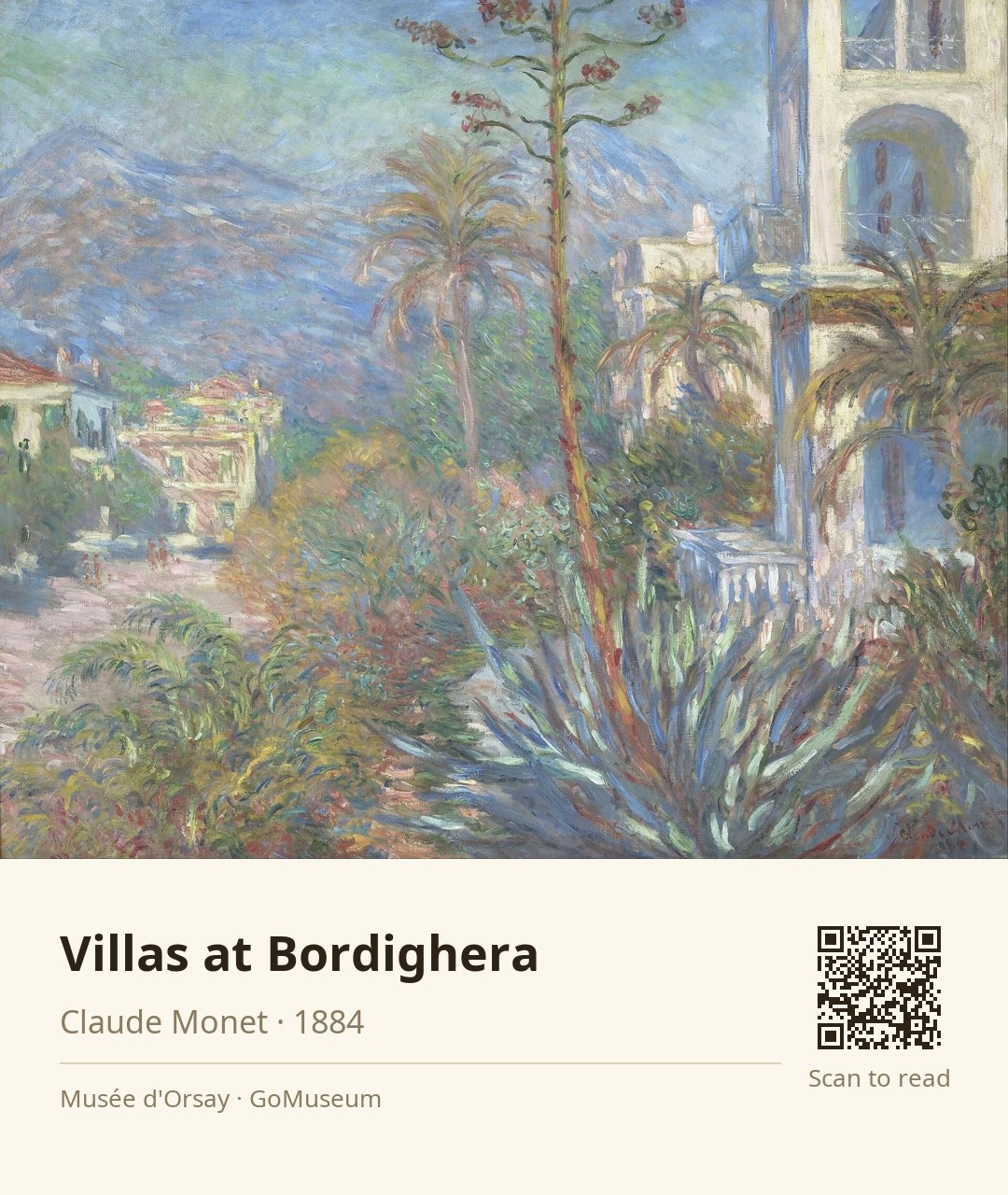
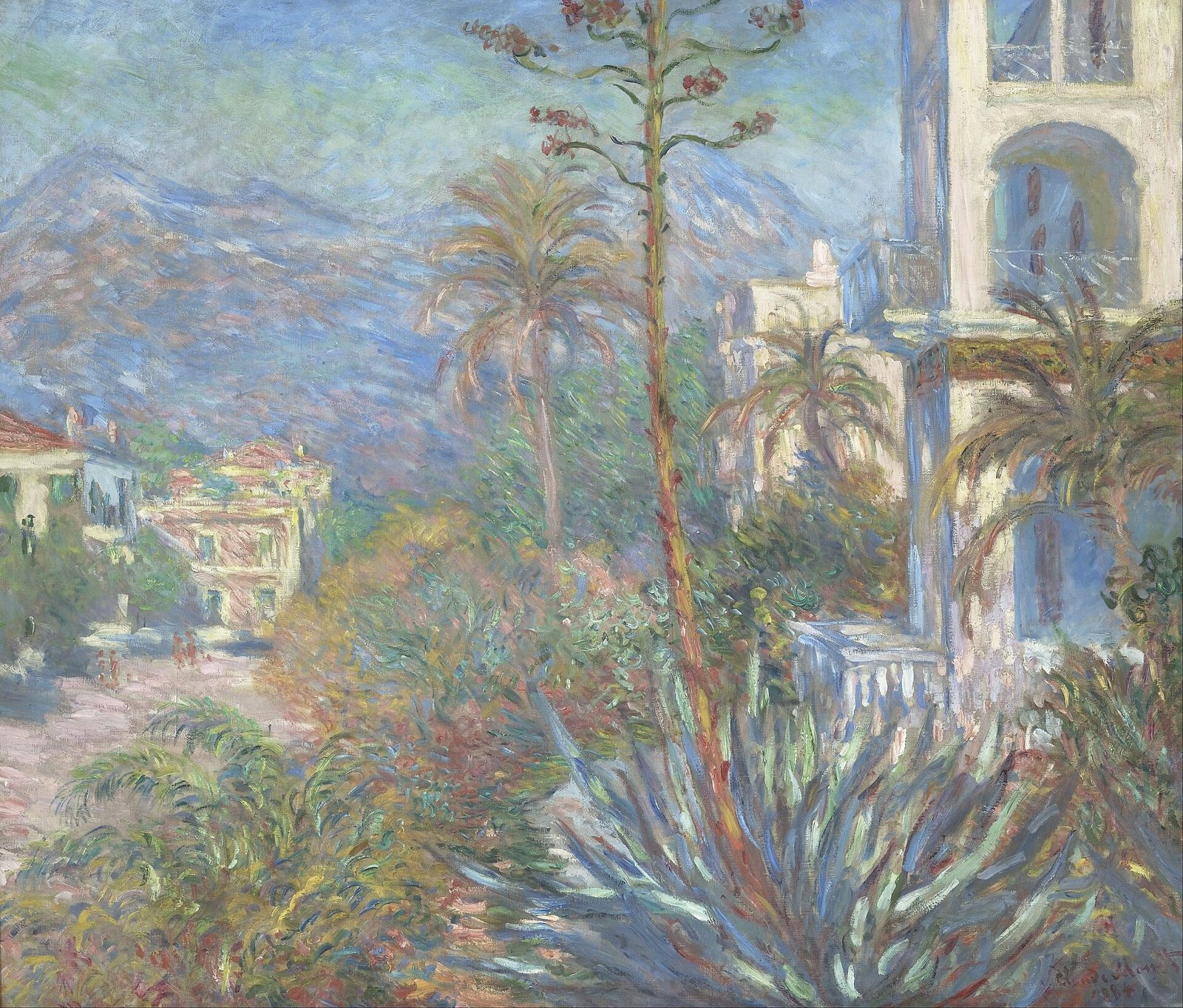
🎧 This work has audio narration — listen in the appBeneath a tall agave whose flowering stalk nearly touches the top of the canvas, a pale pink path winds past tiny figures toward a hillside of villas. The agave's long blue-green leaves dominate the foreground, while the stalk is dotted with reddish blooms, and scrubby bushes in orange, green and pink crowd the path's edge. Look closer at the surface and you'll notice short, broken, directional strokes, with the weave of the canvas showing through in the thinly painted areas.
What makes this painting striking is how Monet handles the Mediterranean subject with an almost decorative economy. The strokes are quick and fragmented, so the palms, the pale yellow and pink walls and the red-tiled roofs read as light and colour rather than as carefully outlined buildings. The bare canvas peeking through gives the scene a freshness, as though the sunlight itself had been caught in passing.
Oscar-Claude Monet, born on November 14, 1840, in Paris, was a pioneering French painter and a founder of Impressionism, a movement that transformed the art world. Raised in Le Havre, he developed a passion for nature and painting early on, encouraged by his mother, while his father hoped he would pursue a business career. After his mother's death in 1857, Monet moved in with his aunt, who supported his artistic ambitions.
Monet's career began with caricatures, but he soon sought formal training, studying under Eugène Boudin, who introduced him to plein air painting. His breakthrough came in 1866 with "La Femme à la robe verte," which garnered attention at the Salon. The term "Impressionism" originated from his work "Impression, Sunrise," exhibited in 1874, marking a shift away from traditional art.
Throughout his life, Monet focused on capturing the essence of light and color in nature, creating series of paintings that depicted the same scenes under varying conditions, such as his famous haystacks and water lilies. He settled in Giverny in 1883, where he cultivated a beautiful garden that became his muse. Despite personal hardships, including the loss of loved ones and health issues, Monet's relentless dedication to his craft solidified his place in art history as a master of modernism, influencing countless artists and leaving a lasting legacy. He died on December 5, 1926, in Giverny, celebrated as one of the most significant figures in art.
This square panel was painted in 1884 at Giverny, not on the Riviera it depicts. It shows the view of the hillside town of Bordighera on the Ligurian coast, with the tower of the Villa Bischoffsheim, also called Villa Etelinda, among the nearby buildings. It is one of two paintings Monet made of this subject that year. The work was acquired by the Musée d'Orsay in 2000, with the support of the Fonds du patrimoine, the participation of the Fondation Meyer, and an anonymous Canadian donation.
Look at the scene as a contrast of big and small. The agave fills the foreground with long blue-green leaves, while the villas, palms and tiny figures on the path are packed into a narrow band behind it. The paint is applied in short, broken, directional strokes, and in the thinly painted areas the weave of the canvas shows through, so the surface itself stays visibly unfinished.
It was acquired in 2000 with help from the Fonds du patrimoine, the participation of the Fondation Meyer, and an anonymous donation from Canada.
Not at first. Baptised Oscar-Claude, he was called simply Oscar by his parents, though he later became known as Claude.