 Image: Sailko
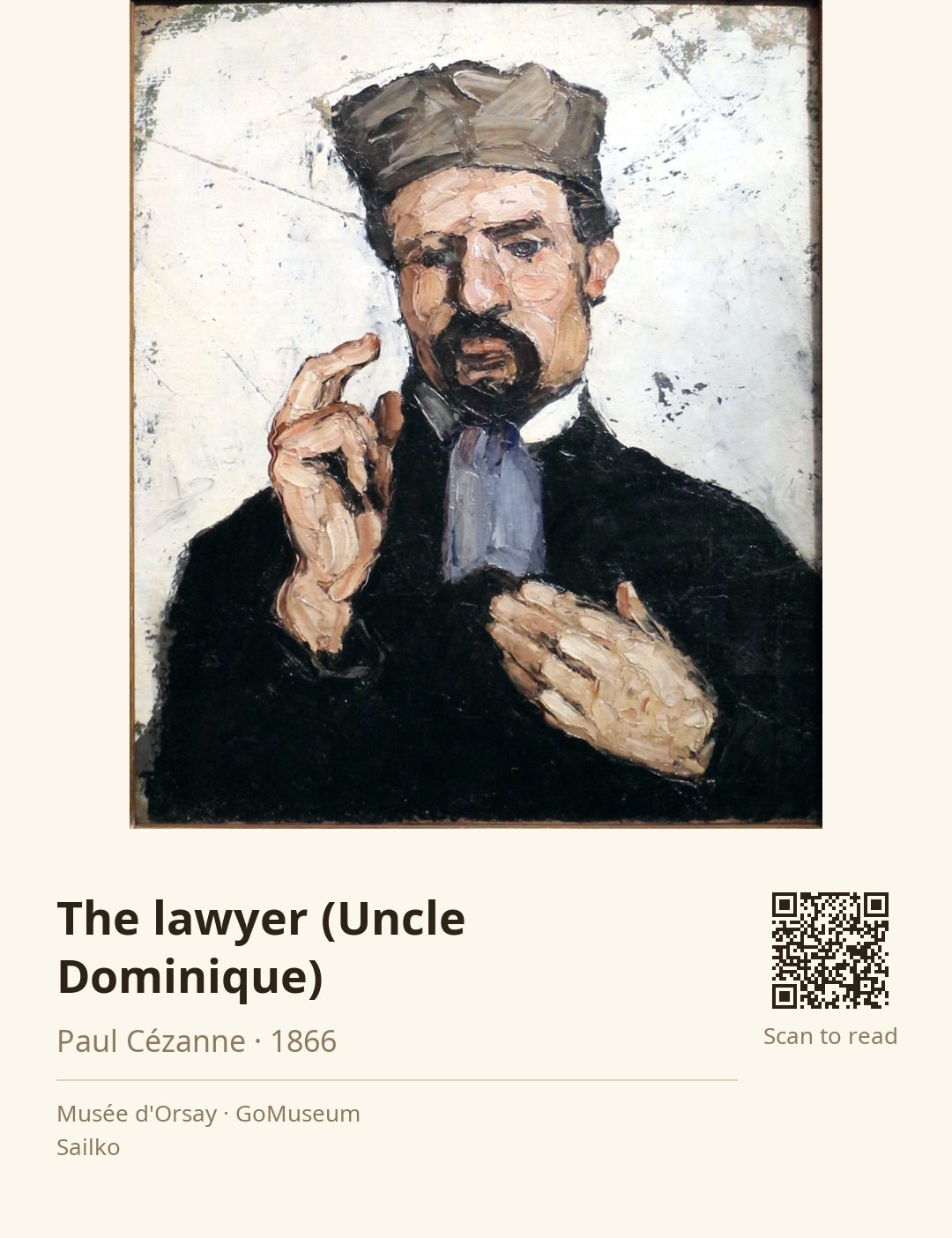
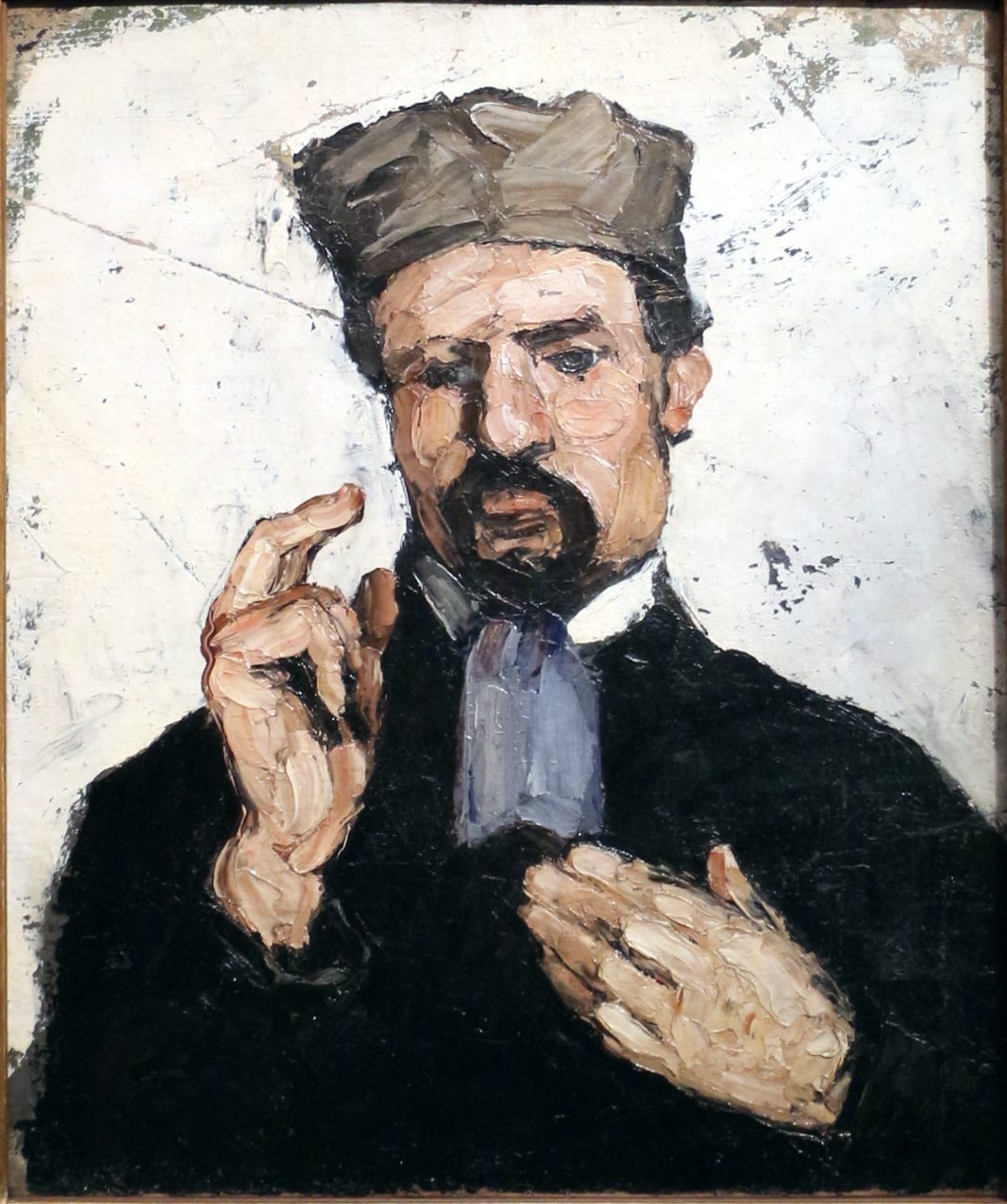
The lawyer (Uncle Dominique)
🎧 This work has audio narration — listen in the appBefore you, a bearded man in a squat grey-brown cap fixes the viewer with a direct, slightly furrowed stare, his heavy black coat set off against a pale ground that has been scuffed and cracked. Look closely at the hands: one rises at his left shoulder with its fingers curled and loosely crossed, while the other lies open across his chest. Those two gestures give the figure a stance that feels both guarded and deliberate.
The paint itself is worth a second look. Cézanne laid it on with a palette knife, in thick, blocky, faceted strokes that you can see most clearly in the pinks and tans of the face and hands. The coat is dense and dark, almost solid, while the cravat is a soft blue-lilac that cools the warmth of the flesh tones. Up close, the surface reads as a construction of planes rather than a smooth likeness, which is part of why the sitter seems so physically present.
The painting is oil on canvas and measures about 54 by 65 centimetres. It passed through the hands of the dealer Ambroise Vollard, who was among the first to champion Cézanne's work, and then through the collection of Auguste Pellerin in Paris. It stayed in the Pellerin family for several generations before entering the French state's collections in 1991, when it was accepted in lieu of inheritance duties and assigned to the Musée d'Orsay, where it hangs today.
Paul Cézanne was a French Post-Impressionist painter born on January 19, 1839, in Aix-en-Provence. His innovative approach to color and form bridged the gap between Impressionism and the emerging Cubism of the early 20th century. Initially influenced by Romanticism and Realism, Cézanne developed a unique style that emphasized the underlying structure of objects, using repetitive brushstrokes and planes of color to create depth and complexity in his work.
Despite facing ridicule and misunderstanding from critics during his early career, Cézanne garnered support from fellow artists like Camille Pissarro and the art dealer Ambroise Vollard, who recognized his talent. His first solo exhibition in 1895 marked a turning point, leading to greater appreciation of his contributions to art. Cézanne's legacy is profound; both Henri Matisse and Pablo Picasso acknowledged him as a foundational figure in modern art, dubbing him "the father of us all." He passed away on October 22, 1906, leaving behind a transformative body of work that continues to influence artists today.
Forget the glossy smoothness you might expect from a portrait of this period. Here the paint is laid on thick, with a palette knife, in blocky, faceted strokes. The figure is set frontally against a flat, off-white ground that has been scuffed and cracked, with dark flecks scattered across it. The black coat is dense, almost solid, and that dark mass sits hard against the pale background. The hands are a study in contrast: one rises on the left with fingers curled and loosely crossed, the other lies open across the chest. The figure fills most of the canvas, centred, with those two hands framing the torso.
The title in French is 'L'avocat (l'oncle Dominique)', and the sitter is identified in the material as Aubert Dominique, a lawyer. The painting spent decades in the Pellerin family's hands, passing down through Auguste Pellerin, his daughter Renée Lecomte, and his granddaughter Mme Louis de Chaisemartin before the state accepted it in 1991.