 Image: Unknown authorUnknown author
Tiara of Saitaferne
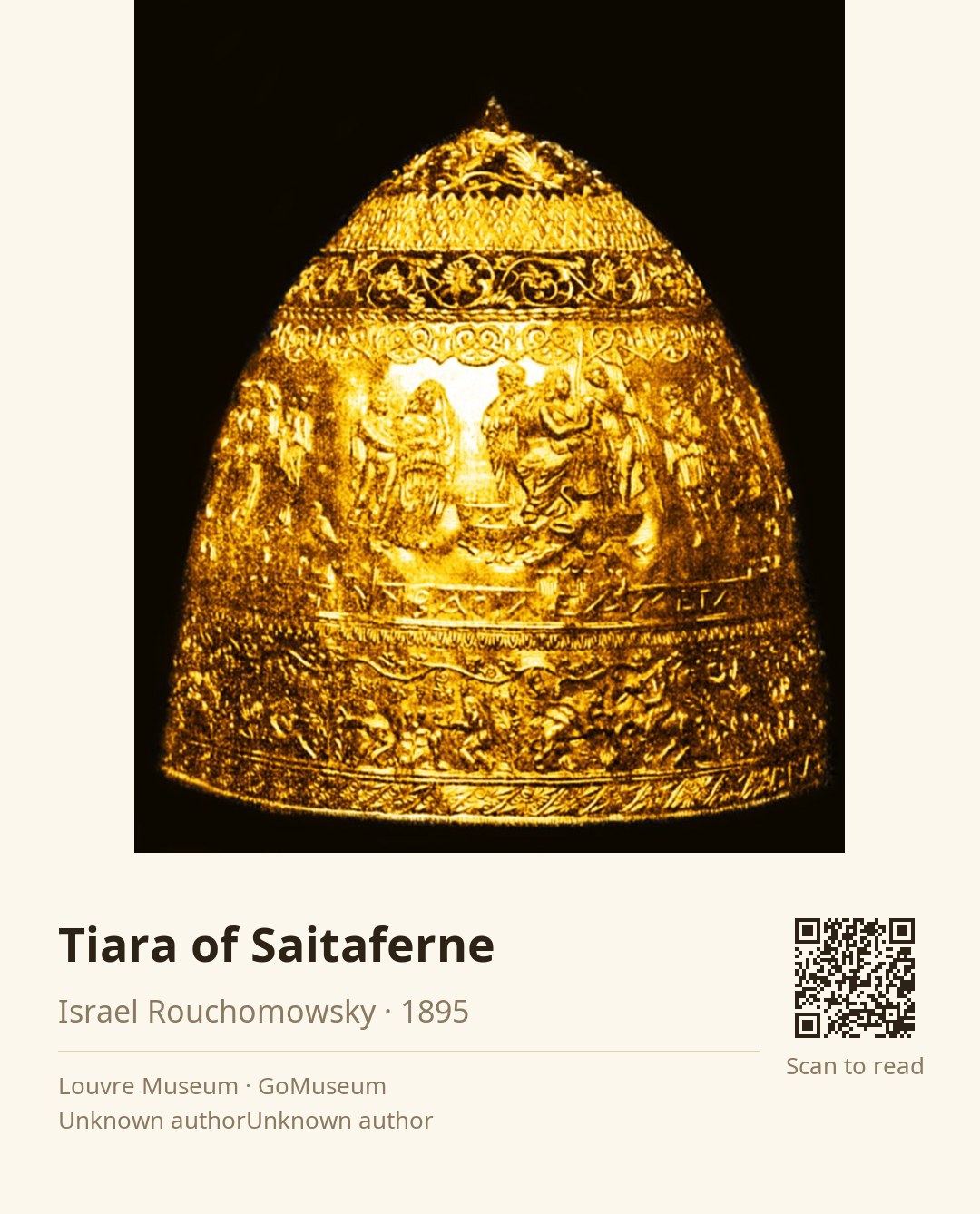
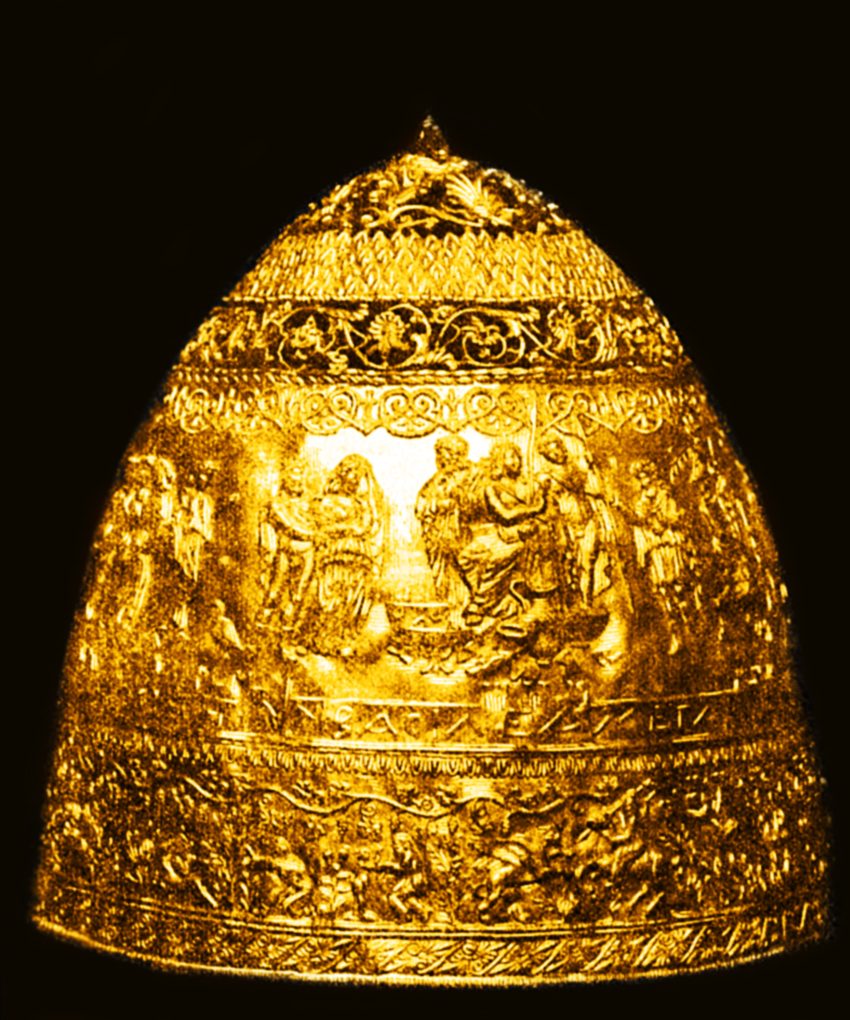
🎧 This work has audio narration — listen in the appTake a moment to gaze at the Tiara of Saitaferne, a shimmering piece that once dazzled the Louvre and the world. Notice the intricate gold work and the Greek inscription that reads, “The council and citizens of Olbia honor the great and invincible King Saitapharnes.” This detail is crucial; it was meant to lend authenticity to a story about a Scythian king who, legend has it, was appeased with treasures to spare a city from siege.
But here’s the twist: this tiara is a masterful forgery, crafted by Israel Rouchomowsky in 1895, who believed he was creating a gift for an archaeologist. The Louvre bought it for a staggering 200,000 francs, convinced it was a genuine artifact. It wasn’t until experts raised doubts about its authenticity that the truth unraveled, leading Rouchomowsky to Paris to claim his creation.
This scandal not only embarrassed the museum but also catapulted Rouchomowsky into fame, earning him accolades for his craftsmanship. Imagine the irony—what was meant to be a deception became a celebrated work of art. As you stand here, consider: how does the allure of a story shape our understanding of history?
Israël Katzkelevitch Roukhomovsky, born on October 2, 1860, in Mazyr, Belarus, was a Russian Jewish goldsmith, engraver, and metalworker. Driven by a passion for creation, he defied his father's wishes for a more conventional career, training first as a watchmaker and then as a silversmith. Roukhomovsky's early life in Kiev and Odessa saw him develop his craft, forming friendships with notable figures in the art world.
His most infamous work, the faux tiara of Saïtapharnès, was created in 1895 under dubious circumstances, leading to its acquisition by the Louvre and subsequent scandal over its authenticity. Despite initial denials, Roukhomovsky ultimately acknowledged his role in its creation, which brought him both notoriety and recognition. Following this event, he moved to France in 1903, where he established a successful workshop and continued to create art, including a silver sarcophagus that earned him accolades.
Roukhomovsky's legacy is marked by his unique contributions to metalwork and his entanglement in one of art history's notable forgeries. He passed away on March 17, 1936, in Boulogne-Billancourt, leaving behind a family of artists and a complex legacy that was later revisited in a 1997 retrospective at the Israel Museum.
The Tiara of Saitaferne's journey began on April 1, 1896, when the Louvre triumphantly announced its acquisition of this supposed ancient treasure for a staggering 200,000 gold francs. The tiara was believed to have belonged to the Scythian king Saitapharnes, a figure steeped in legend, who, according to lore, had spared the Greek colony of Olbia from siege in exchange for lavish gifts. However, doubts soon emerged, notably from German archaeologist Adolf Furtwängler, who pointed out stylistic inconsistencies and a lack of aging. Despite the Louvre's initial defense of the tiara's authenticity, the truth unraveled over the years. It was revealed that the tiara was a forgery crafted by Israel Rouchomowsky in 1894, commissioned under the pretense of a gift for an archaeologist. Rouchomowsky learned of the scandal only after it reached Odesa, prompting him to travel to Paris in 1903 to claim his creation. The museum, embarrassed and unable to deny the truth, eventually relegated the tiara to storage, marking one of the greatest archaeological scandals of the century.
Created by Israel Rouchomowsky in 1895, this tiara was initially hailed as an ancient artifact, a supposed royal treasure of the Scythian king Saitapharnes. Its acquisition by the Louvre for a staggering sum of 200,000 francs sent ripples through the art world. However, the truth unraveled quickly, revealing it as a clever forgery. This scandal not only embarrassed the Louvre but also sparked a broader conversation about authenticity in archaeology and the responsibilities of museums. The tiara's legacy endures, reminding us of the thin line between art and deception, and how one man's ambition can reshape the narrative of history.
Here's a twist in the tale: when the Louvre first acquired the Tiara of Saitaferne, they were convinced they had a genuine artifact from the Scythian king Saitapharnes. They paid a whopping 200,000 gold francs for it! But shortly after the grand unveiling, experts began to raise eyebrows over its authenticity. Among them was the keen-eyed German archaeologist Adolf Furtwängler, who spotted stylistic inconsistencies and a suspicious lack of aging. The tiara was actually crafted by Israel Rouchomowsky, who had no idea it was meant for a scam. He only found out about the scandal years later, leading to a dramatic confrontation at the Louvre where he proved his authorship by recreating part of the tiara from memory!
Rouchomowsky was led to believe that the tiara was a gift intended for an archaeologist, which influenced his design and craftsmanship.
Despite the controversy, Rouchomowsky gained fame for his craftsmanship, earning a gold medal at the Paris Salon of Decorative Arts and establishing a successful career in France.
He created a bronze plaque depicting a skeleton wearing the tiara, humorously reflecting on the scandal and the themes of truth and deception.