Elisabeth of Austria
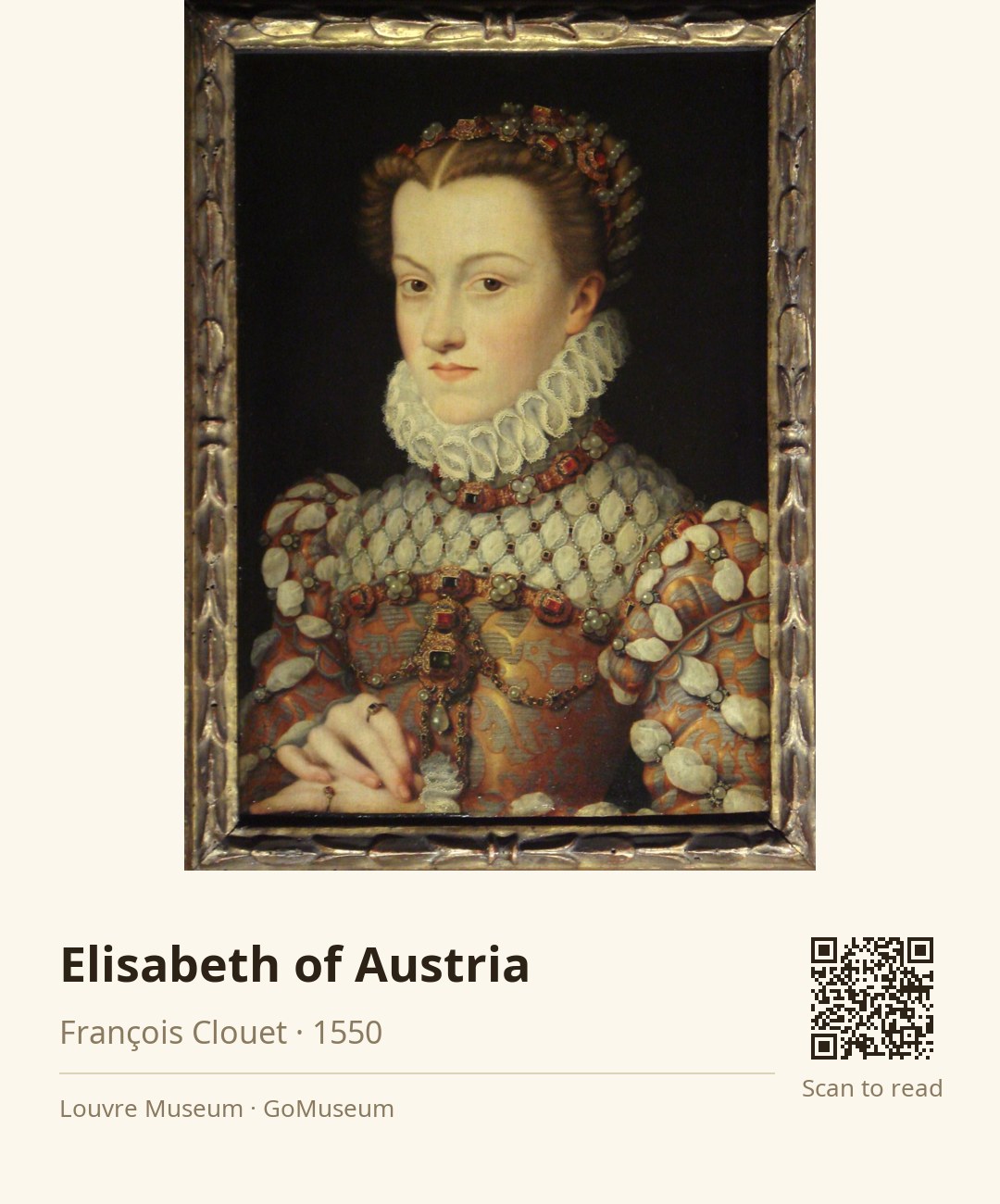
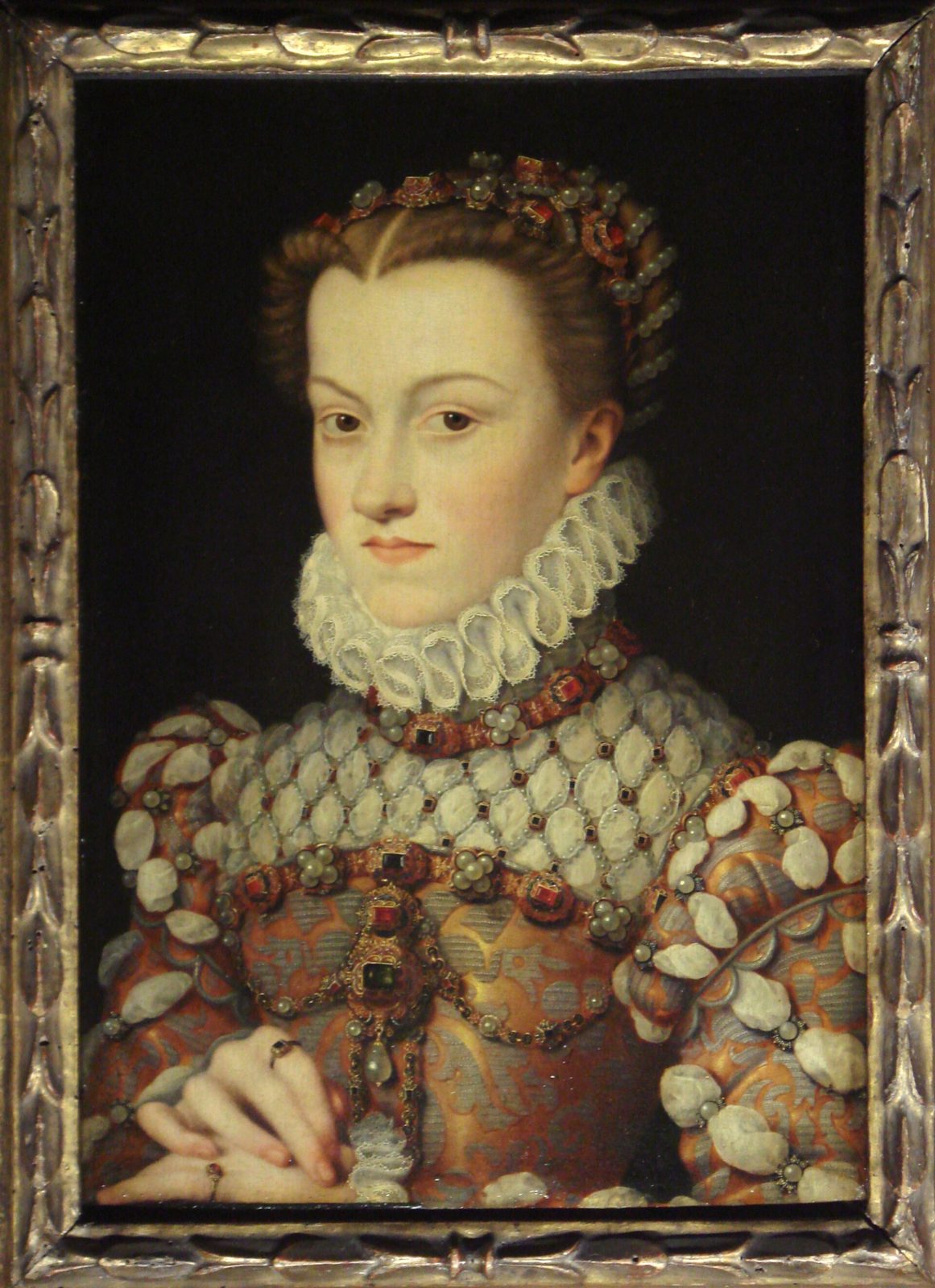
🎧 This work has audio narration — listen in the appElisabeth of Austria looks out at you from a panel no bigger than a sheet of paper, her brown eyes steady and direct. Before anything else, notice the collar: a broad white ruff of fine lace that frames her face like a halo of froth, set off against a background so flatly black that nothing competes with her. Then look down the front of her gown, where a large jewelled pendant hangs from chains over orange-gold fabric patterned with grey-blue foliage, and where her slashed white sleeves are clustered with pearls.
Those details do a great deal of work. The unbroken black behind her strips away any setting, so the viewer reads nothing but the sitter, her costume and her poise. It is a portrait built to be understood at a glance.
The painting is by François Clouet, who worked as a painter to the French court and followed closely in the footsteps of his father, Jean Clouet. He is known to have succeeded his father in the role of court painter, and much of what survives under his name has been attributed to him on the strength of tradition and of his many drawings, rather than on signed documents. The panel is painted in oil on oak, and it is small in size, a format suited to a jewel-like, intimate portrait.
François Clouet, known also by the nickname "Janet" inherited from his father, was a French Renaissance painter and miniaturist who served the royal court much as Jean Clouet had before him. Born in Tours to Jean Clouet, a court painter of Netherlandish origin, he trained under his father and followed him closely in style and in position: he held the offices of painter in ordinary and groom of the chamber to the king. Surviving records suggest a quiet personal life. He never married, had two illegitimate daughters who later became nuns, and in Paris he lived in the Temple quarter near the Hôtel de Guise, enjoying the patronage of Claude Gouffier and his wife Claude de Baune. His end came in December 1572, shortly after the St Bartholomew's Day massacre.
His drive seems to have been a near-scientific devotion to likeness. He carried on his father's sober, concentrated portraiture, stripping away superfluous detail, but pushed further, giving his drawings a finish that marked them as finished works in their own right rather than preparatory sketches. Around fifty-odd drawings are securely associated with him, and these, along with his paintings of Henri II, Charles IX, Elizabeth of Austria and Pierre Quthe, show a freer, more brilliant technique than his father's, with traces of Holbein, the Venetians and Italian Mannerism. He also worked on court occasions, taking the death mask of Francis I and preparing the effigies and banners for royal funerals.
His place in art history is secure. He is among the foremost portraitists of sixteenth-century France, and his drawings helped establish the taste for collecting likenesses of the royal family. The fascination his portraits held for the anthropologist Claude Lévi-Strauss, who drew on them in The Savage Mind, attests to their enduring influence.
The material gives a few concrete facts about this panel. It is catalogued in the Louvre under inventory number INV 3254. Its provenance chain runs from Roger de Gaignières, then to Louis XV, and then to the Couronne de France, the French crown. The material also tells you the sitter's identity as Élisabeth d'Autriche (1554–1592), queen of France and wife of Charles IX. The panel's painter, François Clouet, is said to have succeeded his father Jean Clouet as court painter, and the attribution rests on a long tradition and on his drawings, not on signed documents for this picture.
Look at how little the panel asks of you: a half-length figure turned slightly to her left, with her eyes meeting yours, set against a plain, uniform dark black that gives nothing else to look at. The figure fills the upright format almost to its edges. Her hair is parted at the centre and drawn back into rolls at either side, crowned by a band of pearls and red and dark stones. Her hands rest clasped low in the lower left corner, with two rings catching what light there is. The bodice shifts between orange-gold patterned cloth and grey-blue foliage, and the slashed white sleeves are clustered with pearl. The material describes the paint as smooth and finely detailed, with delicate modelling in the pale flesh tones, which is the most you can say about her skin without guessing at the technique beneath.
The material notes that the portrait is one of the pieces that made an important impression on Claude Lévi-Strauss, and that it helped inspire his theory of the modèle réduit, the idea of works of art as miniature models, in his book The Savage Mind. The encyclopaedia entry also calls the Louvre portrait of Elizabeth of Austria perhaps the masterpiece of François Clouet.
The material records that Catherine de Medici sorted and annotated portrait collections by family, and that such portrait collections were a fashionable pastime at court. That detail lets you see this little panel as one piece of a wider habit of collecting faces, which is a curiosity the other lanes do not cover.
It passed from the collector Roger de Gaignières to Louis XV, and then to the French crown.
Yes, the material says collections of portraits were very fashionable at the French court, and Catherine de Medici sorted and annotated them by family.