Portrait of Oopjen Coppit
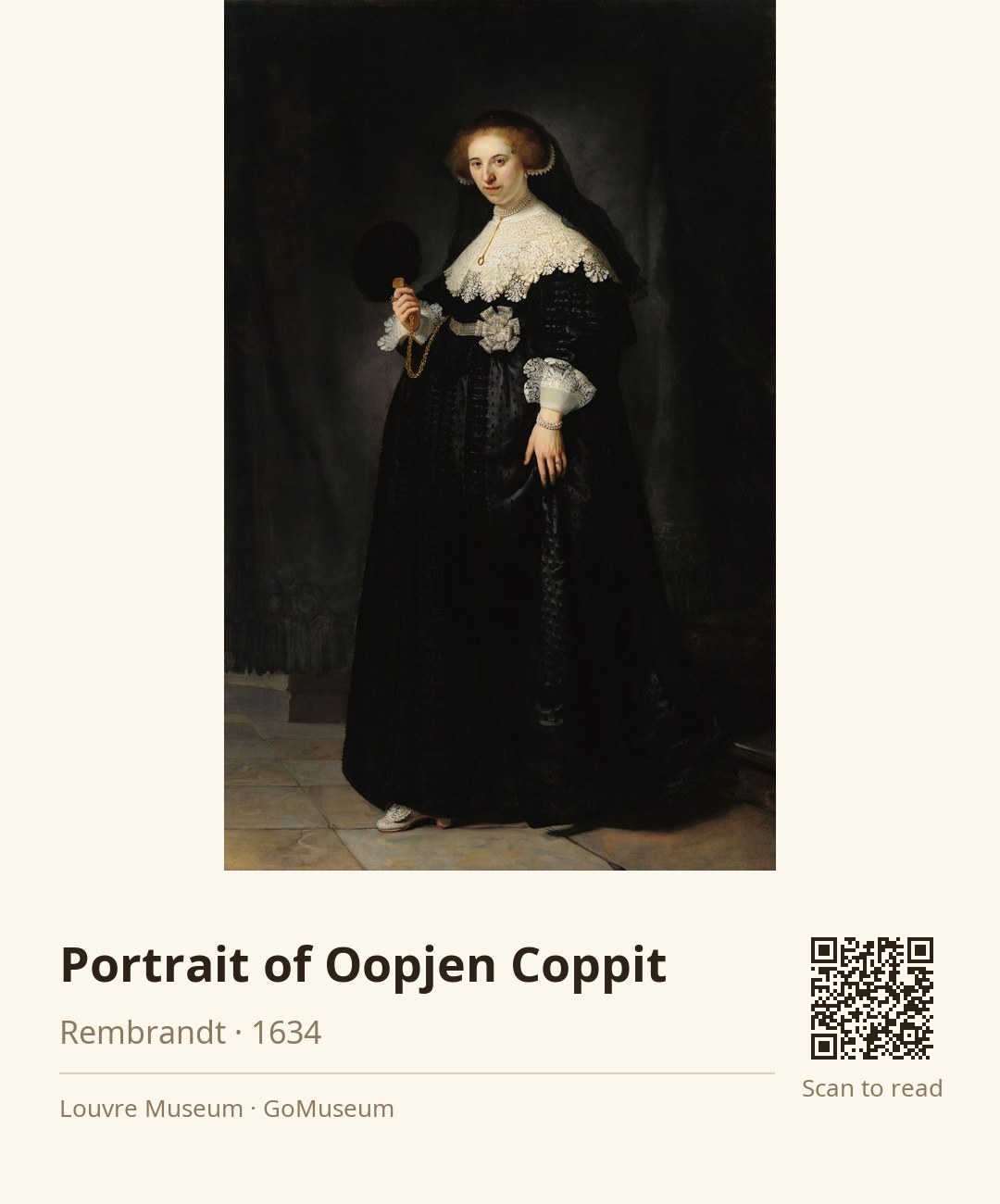
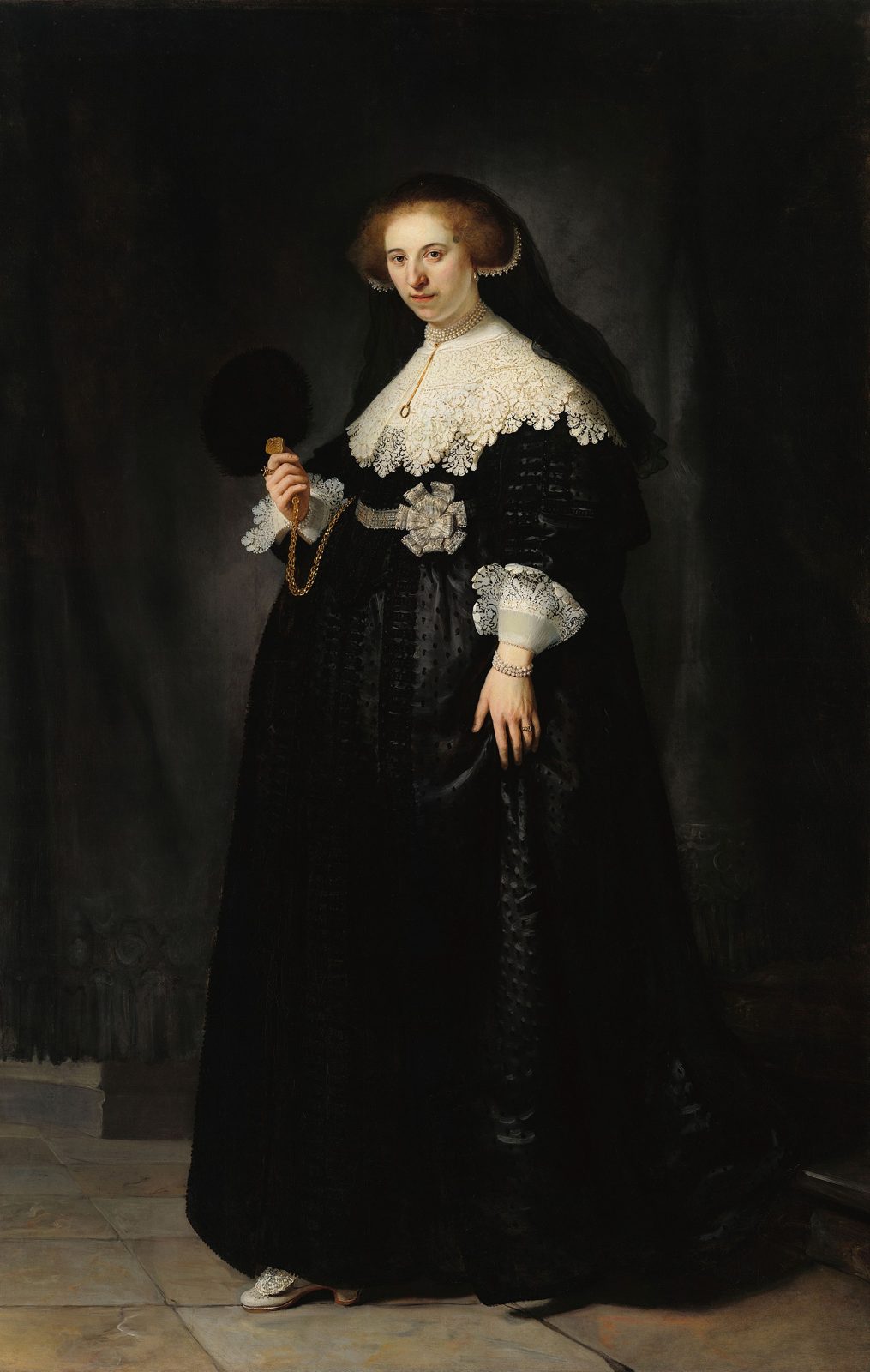
🎧 This work has audio narration — listen in the appOopjen Coppit stands elegantly in a full-length portrait, her elaborate black gown adorned with intricate lace at the collar and cuffs. The striking pearl necklace around her neck and the fan she holds, attached to a gold chain, draw the eye, while her left hand, adorned with rings and a bracelet, rests gracefully at her side.
The dark background enhances her presence, allowing the viewer to focus on her poised demeanor and the meticulous craftsmanship of her clothing. Rembrandt's masterful use of light illuminates her face, creating a vivid contrast that emphasizes her features and the textures of her attire, a hallmark of his portrait style.
Rembrandt Harmenszoon van Rijn, born on July 15, 1606, in Leiden, was a pivotal figure of the Dutch Golden Age and is celebrated as one of the greatest artists in Western art history. His oeuvre includes around three hundred paintings, three hundred etchings, and numerous drawings, showcasing a remarkable range of styles and subjects, from intimate portraits to grand historical and biblical scenes.
Rembrandt's artistic journey began in Leiden, where he was influenced by both Dutch and Italian masters. He opened his studio in 1625 and quickly gained recognition for his portrait work. His move to Amsterdam marked a significant turning point, as he became a sought-after portraitist and married Saskia van Uylenburgh, a union that brought both joy and tragedy. The couple faced immense personal losses, including the deaths of their children and Saskia's own passing in 1642, which deeply affected his work.
Despite financial struggles later in life, Rembrandt's innovative techniques, particularly in etching, transformed the medium into a respected art form. His mastery of light and shadow, known as chiaroscuro, and his empathetic portrayal of human experience set him apart from his contemporaries. Rembrandt's legacy endures through his profound ability to capture the complexities of the human condition, making him a cornerstone of art history.
Rembrandt painted the Portrait of Oopjen Coppit in 1634, a time when he was establishing himself as one of the leading portraitists in Amsterdam. This work was commissioned as part of a pair with the Portrait of Maerten Soolmans, intended to celebrate the couple's engagement. For over a century, the painting belonged to the French branch of the Rothschild family, remaining largely unseen by the public. It was only exhibited once in 150 years, during a joint exhibition in 1956 at the Rijksmuseum Amsterdam and the Boijmans Van Beuningen Museum in Rotterdam. In a remarkable turn of events in September 2015, both portraits were acquired for 80 million euros each by the Louvre and the Rijksmuseum, marking a significant moment in art history as they now share the spotlight in these prestigious institutions, alternating exhibitions between them.
Rembrandt's technique in the Portrait of Oopjen Coppit showcases his masterful use of oil paint on canvas, allowing for rich textures and deep colors. The brushwork is both meticulous and expressive, with fine detailing in the lace of the gown and the pearls that glisten against the dark backdrop. The way he layers paint creates a sense of depth, particularly in the folds of the fabric and the sheen of the necklace. The dark background isn't just a void; it serves to elevate Oopjen's figure, drawing the viewer's attention to her poised stance and the intricate details of her attire. Rembrandt's strategic placement of light highlights her face and hands, creating a striking contrast that brings her to life, while the tiled floor adds a subtle grounding element to the composition, enhancing the overall realism of the portrait.
The painting was owned by the French branch of the Rothschild family for over a hundred years and was mostly kept out of public view.
Before 2015, the painting was exhibited only once in a span of 150 years, during a joint exhibition in 1956.
In September 2015, both the Portrait of Oopjen Coppit and its pair were purchased for 80 million euros each by the Louvre and the Rijksmuseum.