 Image: Ricardo André Frantz (User:Tetraktys) · Ricardo André Frantz (User:Tetraktys) · Frank Kovalchek from Anchorage, Alaska, USA · Sandra Soster · Sharon Mollerus
Nymph with a Scorpion
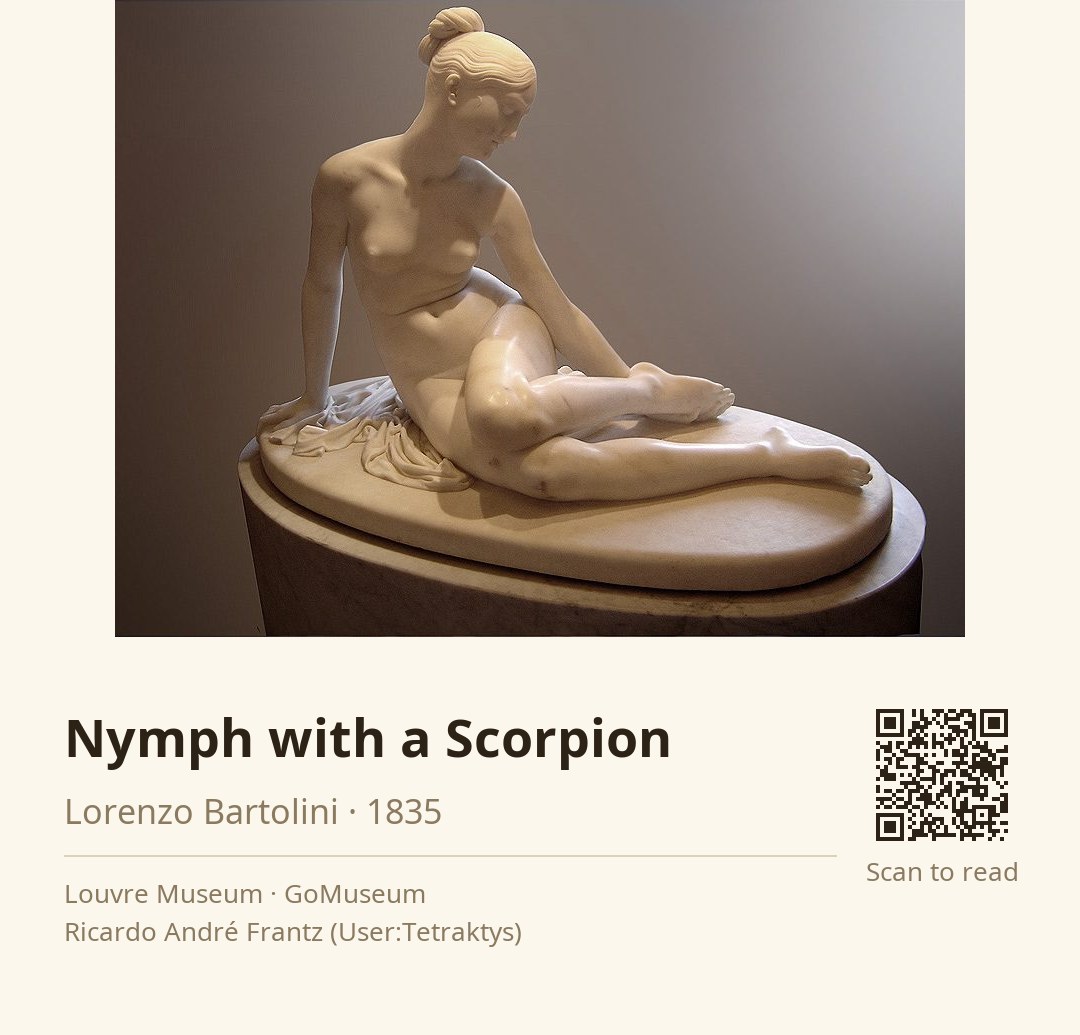
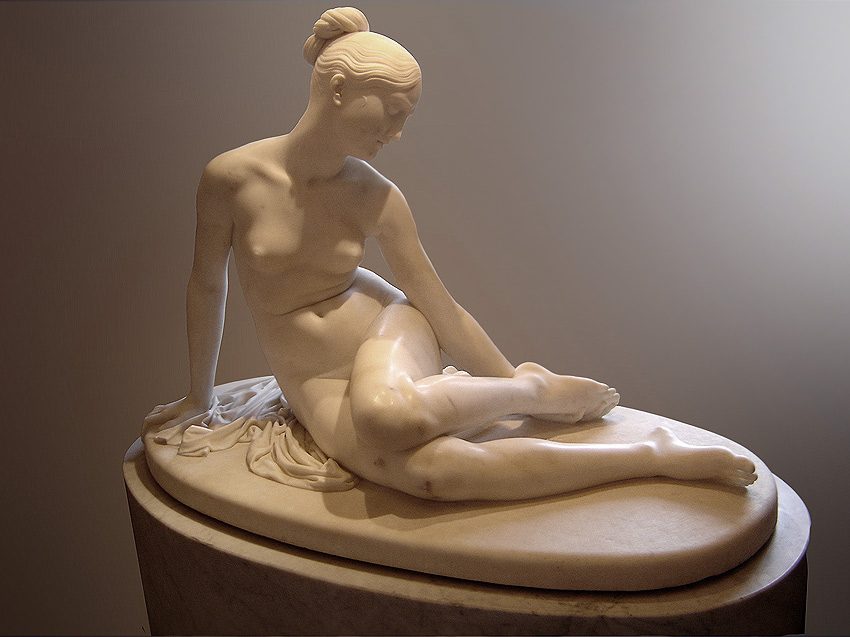
🎧 This work has audio narration — listen in the appThe Nymph with a Scorpion reveals a moment of vulnerability, captured in the elegant pose of a seated nude figure. Her body leans slightly back, supported by her left arm, while her right leg crosses over her extended left, creating a graceful yet tense composition. The smooth marble surface accentuates her delicate contours, and the subtle drapery beneath her adds depth to the scene.
This nymph, seemingly at peace, is ironically interrupted by the sting of a scorpion, which is reflected in her slight grimace and parted lips. The juxtaposition of her serene expression against the pain of the sting emphasizes a tension between beauty and discomfort, a hallmark of Bartolini's work. The artist's choice to depict this moment of anguish in such a refined manner speaks to his ability to blend classical beauty with emotional realism, challenging the viewer to engage with the complexity of the human experience.
Created in 1835, this sculpture was first exhibited at the Salon of 1845, where it garnered positive attention.
Lorenzo Bartolini was an Italian sculptor born on January 7, 1777, in Prato, Tuscany. His artistic journey began at the Florentine Academy of Fine Arts, where he developed a talent for alabaster modeling. In 1797, he moved to Paris, studying under prominent artists like Jean-Baptiste Frédéric Desmarais and François-Frédéric Lemot. Bartolini gained recognition with his bas-relief "Cleobis and Biton," which won him accolades and influential patrons, including Napoleon, for whom he created a colossal bust.
Despite his early success, Bartolini faced challenges after Napoleon's fall, leading to a period of financial hardship. His style, marked by sentimental piety and naturalistic detail, diverged from the strict neoclassicism favored by his contemporaries. He drew inspiration from earlier Florentine sculptors, creating notable works like "L'Ammostatore" and monuments in Santa Croce, including those for Princess Zofia Czartoryska and Charlotte Bonaparte.
Elected an Honorary member of the National Academy of Design in 1833, Bartolini continued to influence the art world until his death on January 20, 1850, in Florence, where he is buried. His legacy lies in his ability to blend neoclassicism with a more humanistic approach, securing his place in art history as a pivotal figure in the evolution of Italian sculpture.
Crafted from smooth, polished marble, Bartolini's Nymph with a Scorpion showcases the artist's mastery in sculpting. The figure's delicate contours are accentuated by the marble's sheen, which captures the softness of skin and the subtlety of human form. Notice the intricate carving of the drapery beneath her, which adds a layer of texture and depth. Each curve and line is a testament to Bartolini's skill, reflecting both classical beauty and emotional nuance, inviting you to appreciate the tactile quality of the material.
Lorenzo Bartolini created the Nymph with a Scorpion in 1835, and it first graced the Salon of 1845, where it received acclaim from critics and the public alike. The sculpture was commissioned by Prince Charles de Beauvau-Craon, who purchased it for his château in Haroué in 1843. After his death, it found its way to the Louvre, where it remains today. A second version of the sculpture was commissioned by Tsar Nicholas I of Russia, who visited Bartolini's studio shortly after the first version was completed, but it remained unfinished at the time of the artist's death in 1850.
The second version of the sculpture was commissioned by Tsar Nicholas I but remained unfinished when Bartolini died in 1850.
Charles Baudelaire expressed that it was impossible not to admire the work of the foreign artist, highlighting its impact.
Yes, a plaster model of the Nymph with a Scorpion is preserved in the gallery of the Academy of Florence.