La Femme à la cafetière (Woman with a Coffeepot)
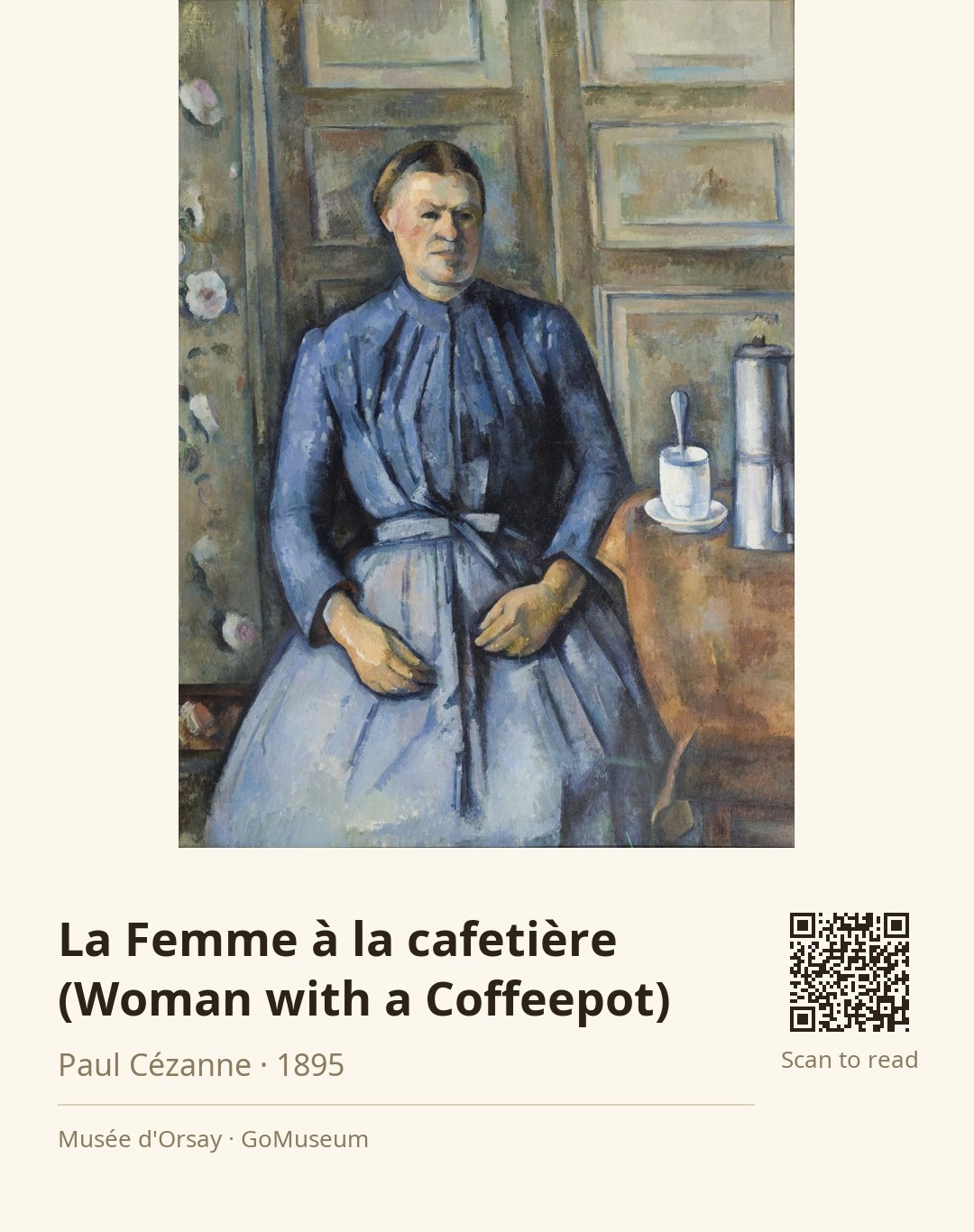
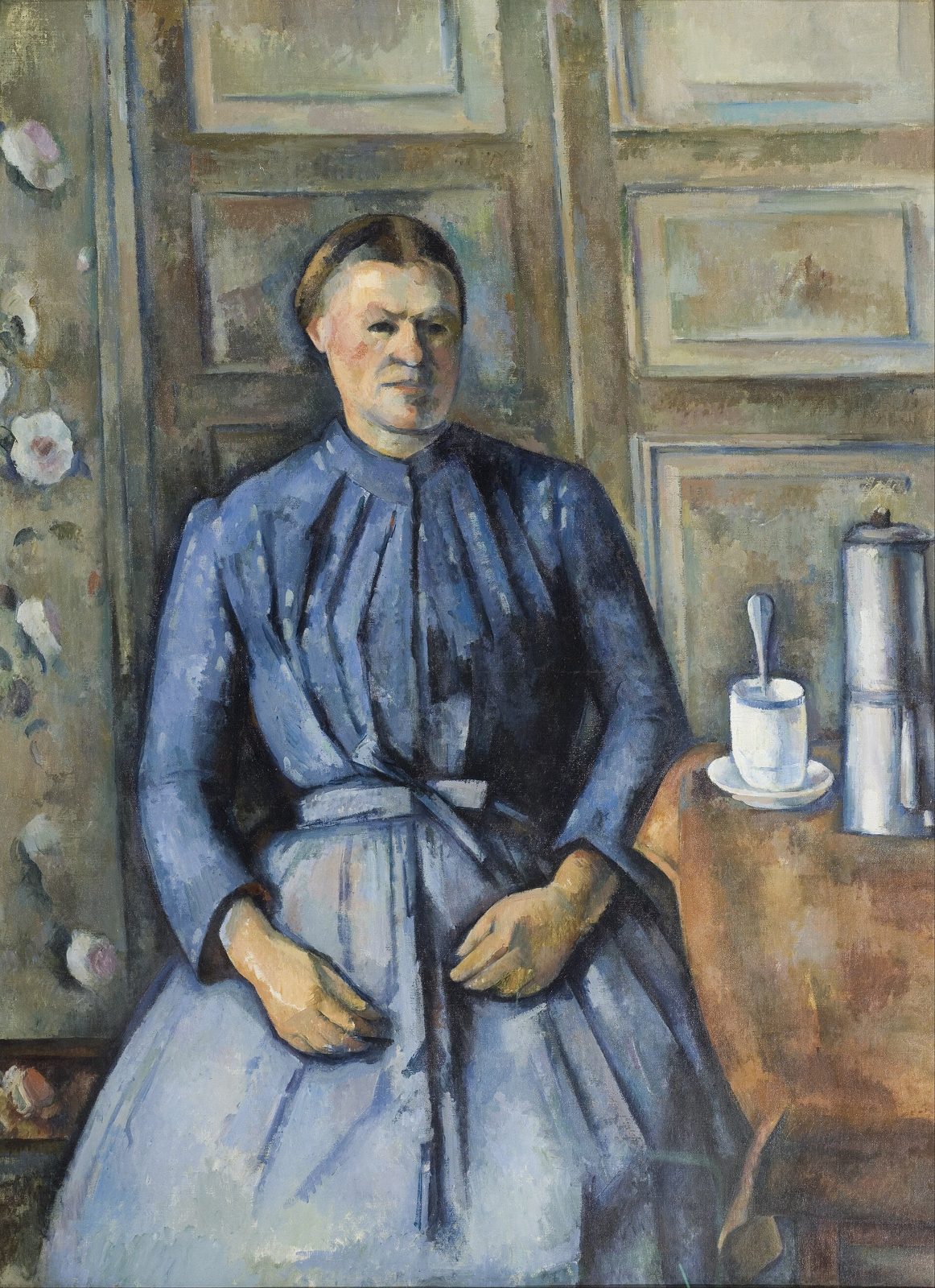
🎧 This work has audio narration — listen in the appTake a moment to really look at "La Femme à la cafetière." Notice how the woman, dressed in a deep blue gown, seems to almost merge with her surroundings, her expression serious yet intriguing. See how her hands rest in her lap, hinting at a life of labor, while the geometric shapes of her figure contrast with the slightly chaotic floral wallpaper behind her.
These details matter because they reveal Cézanne's revolutionary approach to painting. Rather than aiming for a photographic likeness, he constructs a visual truth through shapes and colors, creating a balance between the figure and the space around her. This interplay of vertical lines—the woman’s posture against the tilted background—foreshadows the cubist movement that would follow.
Cézanne painted this piece in the mid-1890s, a time when he was refining his unique style, moving away from Impressionism towards something more structured and abstract.
As you stand here, think about what this woman might be feeling. Is she aware of the artist's gaze, or is she lost in her thoughts? What stories could she tell if only she could speak?
Paul Cézanne was a French Post-Impressionist painter born on January 19, 1839, in Aix-en-Provence. His innovative approach to color and form bridged the gap between Impressionism and the emerging Cubism of the early 20th century. Initially influenced by Romanticism and Realism, Cézanne developed a unique style that emphasized the underlying structure of objects, using repetitive brushstrokes and planes of color to create depth and complexity in his work.
Despite facing ridicule and misunderstanding from critics during his early career, Cézanne garnered support from fellow artists like Camille Pissarro and the art dealer Ambroise Vollard, who recognized his talent. His first solo exhibition in 1895 marked a turning point, leading to greater appreciation of his contributions to art. Cézanne's legacy is profound; both Henri Matisse and Pablo Picasso acknowledged him as a foundational figure in modern art, dubbing him "the father of us all." He passed away on October 22, 1906, leaving behind a transformative body of work that continues to influence artists today.
The painting first gained significant attention during exhibitions in the 1930s, including a notable showing at the Orangerie des Tuileries in Paris. Its reception was mixed; while some critics struggled to understand Cézanne's innovative approach, others began to recognize his genius. Over the years, it has been featured in various exhibitions, including the 2010 Shanghai World Expo and the 2018-2019 Cubism exhibition at the Centre Pompidou in Paris, marking its importance in the evolution of modern art.
The brushwork is both deliberate and exploratory, with each stroke contributing to the overall structure of the composition. Notice how he employs vertical lines to create a tension between the figure and the background. The woman's posture is carefully constructed, almost triangular, which not only grounds her in the space but also echoes the geometric shapes of the floral wallpaper behind her. The color palette, dominated by deep blues and earthy tones, enhances the emotional weight of the piece. Cézanne's choice to simplify the woman's features while emphasizing her hands—symbols of labor—adds depth to her character, inviting viewers to ponder her story. This careful balance of form and color foreshadows the cubist movement, showcasing his role as a bridge between traditional and modern art.
Created during his mature period in the 1890s, this painting showcases his innovative approach to form and structure, influencing the development of Cubism. Artists like Picasso and Matisse regarded Cézanne as a foundational figure, often citing him as 'the father of us all.' His exploration of geometric shapes and the simplification of forms paved the way for future avant-garde movements, making this piece not just a portrait but a significant milestone in art history. Remember, it's not just about the woman with the coffeepot; it's about how she stands at the crossroads of artistic evolution.
Interestingly, this painting was part of the French art collection exhibited at the 2010 World Expo in Shanghai, showcasing its international recognition. Additionally, it has been the subject of various artistic interpretations, including a six-minute video by Bob Wilson in 1989, which reflects the enduring impact of Cézanne's work on contemporary art and culture.
The woman is believed to be one of the household staff from Cézanne's family home, Jas de Bouffan, which adds a personal connection to the artist's life and environment.
Cézanne's upbringing in a relatively affluent family allowed him the financial security to pursue art, while his friendships with Émile Zola and other future artists during his school years fostered his early interest in creative expression.
Cézanne focused on constructing a visual truth through geometric shapes and colors rather than aiming for a photographic likeness, which was a departure from the more realistic styles of his predecessors.