The clownesse cha-u-kao at the Moulin Rouge
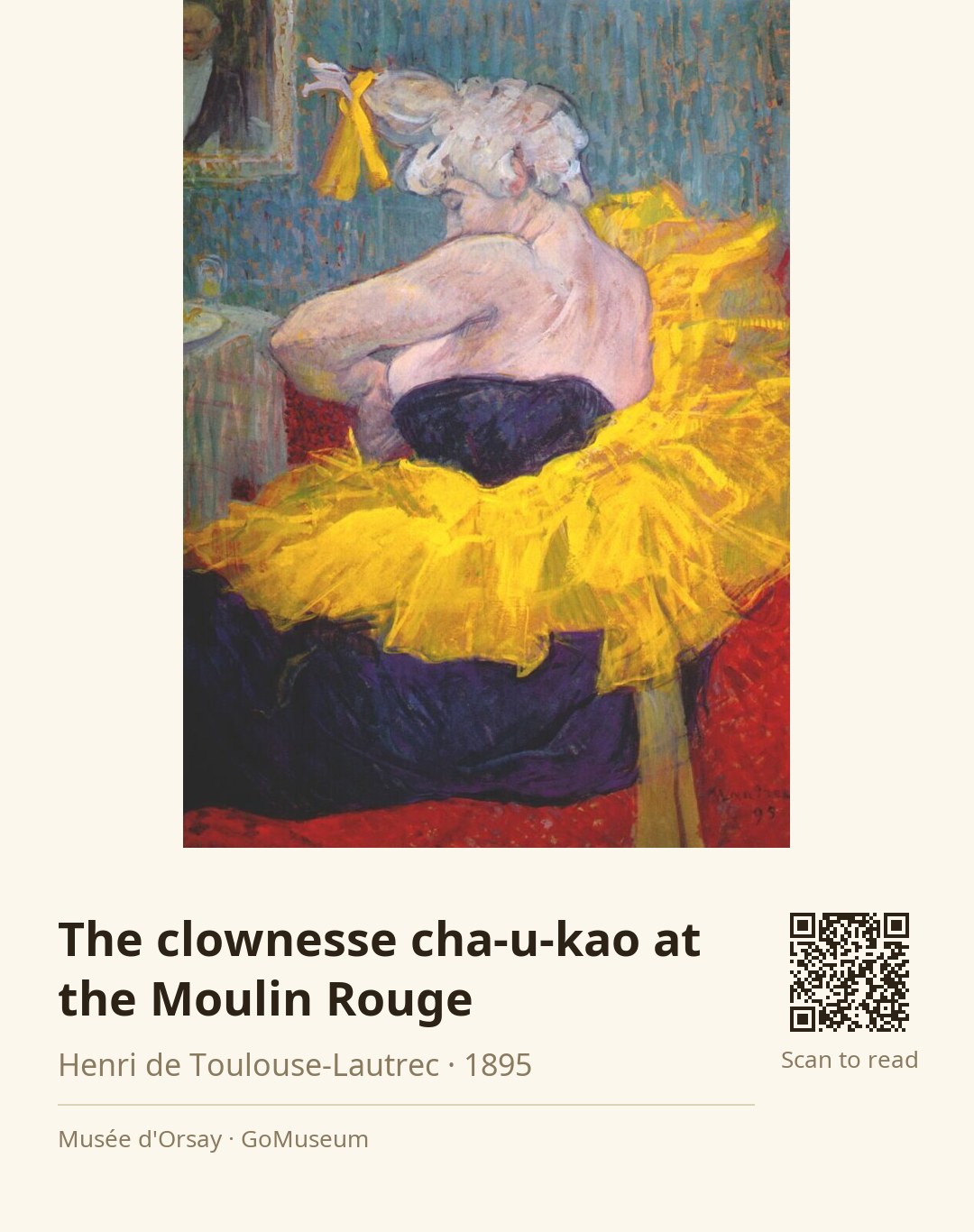
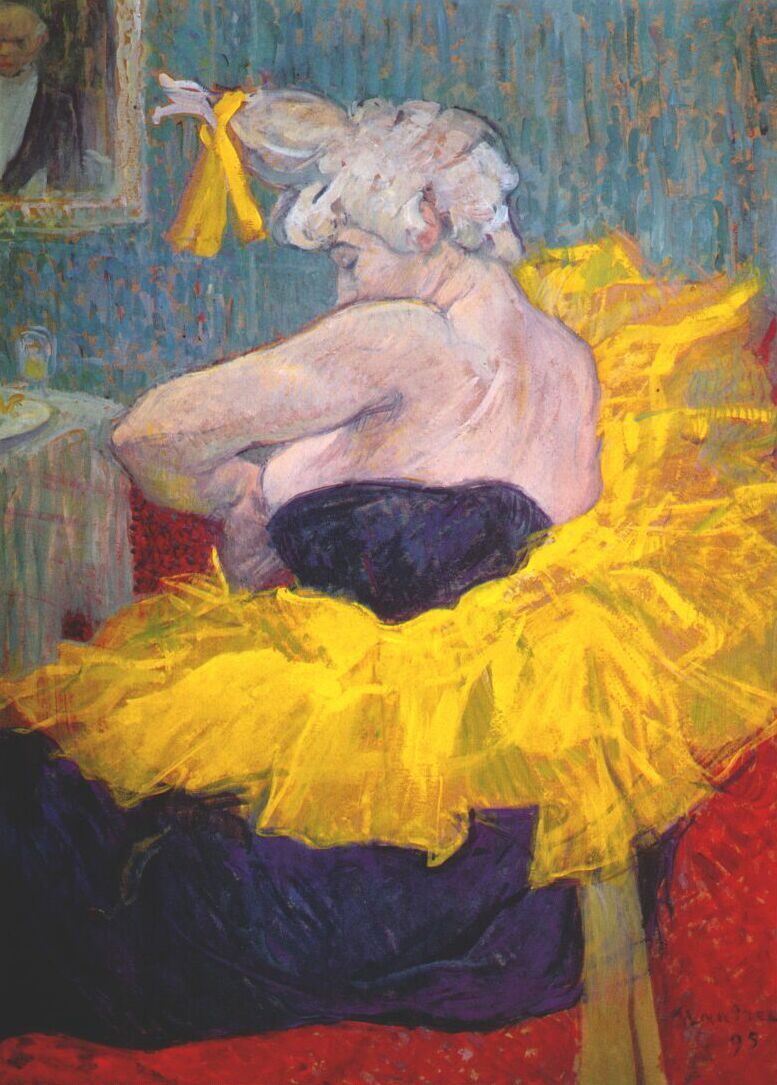
🎧 This work has audio narration — listen in the appTake a moment to really look at this painting, “The Clownesse Cha-U-Kao at the Moulin Rouge.” Notice how the vibrant yellow of her collar draws your eye, almost as if it’s beckoning you into her world. And then there’s the mirror—see that reflection of the older man? It adds a layer of intrigue, doesn’t it? These details matter because they capture the essence of Cha-U-Kao’s life as a performer, revealing the intimacy of her existence beyond the stage. Toulouse-Lautrec was fascinated by the nightlife of Paris, and here he presents a moment of vulnerability, a glimpse into the woman behind the clown. Created in 1895, this piece marks a pivotal time in Lautrec's career, showcasing his mature style and deepening connection to his subjects. It’s not just about the spectacle; it’s about the stories hidden within the glitz and glamour of the Moulin Rouge. As you stand here, think about the emotions Cha-U-Kao might have felt in this quiet moment, away from the audience. What stories do you think she carries with her?
Henri de Toulouse-Lautrec, born on November 24, 1864, in Albi, France, was a pivotal figure in the Post-Impressionist movement. Despite his aristocratic background, his life was marked by physical challenges, including a genetic disorder that stunted his growth. This condition shaped his unique perspective and deep empathy for the marginalized, particularly the vibrant characters of Paris's Belle Époque, including prostitutes and performers.
Toulouse-Lautrec's artistic journey began in earnest when he moved to Paris, where he immersed himself in the bohemian lifestyle of Montmartre. His work, characterized by bold colors and dynamic compositions, captured the essence of nightlife, cabarets, and the human condition. He became known for his posters and illustrations, which brought the world of the Moulin Rouge to life. His relationships with fellow artists, such as Vincent van Gogh, and his romantic entanglements, notably with Suzanne Valadon, influenced his creative output.
His legacy endures as he is celebrated for his innovative approach to art and his ability to convey the spirit of an era. Toulouse-Lautrec's works continue to resonate, offering a glimpse into the exuberance and struggles of a society on the brink of modernity, solidifying his place in art history as a masterful chronicler of the human experience. He passed away on September 9, 1901, leaving behind a rich body of work that remains influential to this day.
Henri de Toulouse-Lautrec painted 'The Clownesse Cha-U-Kao at the Moulin Rouge' in 1895, during a time when he was deeply immersed in the vibrant nightlife of Paris. This piece was exhibited at the Manzi-Joyant gallery in Paris the same year, showcasing his mature style and fascination with the performers of the Moulin Rouge. The painting captures Cha-U-Kao in a more intimate setting, likely a dressing room, contrasting with Lautrec's usual depictions of performers on stage. It reflects his ongoing exploration of the lives of women in the nightlife scene, a theme he had been developing since the 1880s.
Take a closer look at the brushwork in this painting. Toulouse-Lautrec employs loose, expressive strokes that convey a sense of movement and emotion, particularly in Cha-U-Kao's costume. The vibrant yellow of her collar and hair ribbon not only draws your eye but also creates a striking contrast against the more muted tones of her surroundings. This choice of color adds a layer of vibrancy to her character, making her the focal point of the composition. The reflection in the mirror introduces a narrative complexity, suggesting a connection to the older man, which invites you to ponder their relationship. The composition is structured to guide your gaze, with the mirror acting as a visual anchor that pulls you into Cha-U-Kao's world, making you feel almost like an intruder in this private moment.
Interestingly, 'The Clownesse Cha-U-Kao' is not just a standalone piece; it has inspired other artists, including Herman Braun-Vega, who appropriated this work in his own pieces in 1993 and 2000. This shows how Lautrec's portrayal of Cha-U-Kao continues to resonate and inspire new interpretations in contemporary art.
Toulouse-Lautrec had painted Cha-U-Kao in the 1880s, showcasing his long-standing fascination with her as a performer and the broader world of circus and nightlife.
Unlike his typical portrayals of performers on stage, this painting captures Cha-U-Kao in a more private space, likely a dressing room, emphasizing her vulnerability and the contrast between her public persona and private life.
The vibrant yellow of Cha-U-Kao's collar and hair ribbon not only draws attention but also symbolizes her lively character and perhaps reflects the vibrant atmosphere of the Moulin Rouge, enhancing her role as a performer.