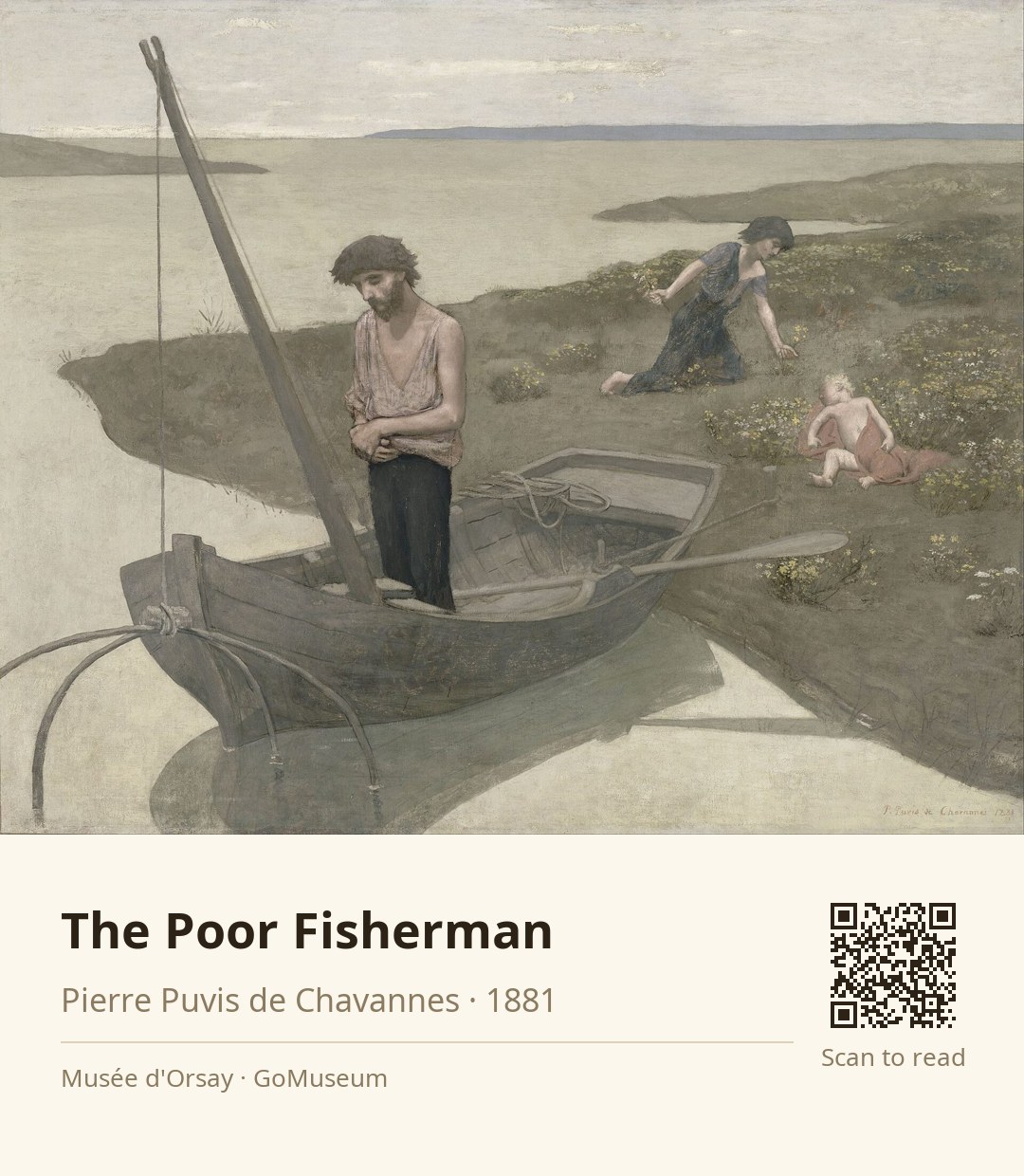
The Poor Fisherman
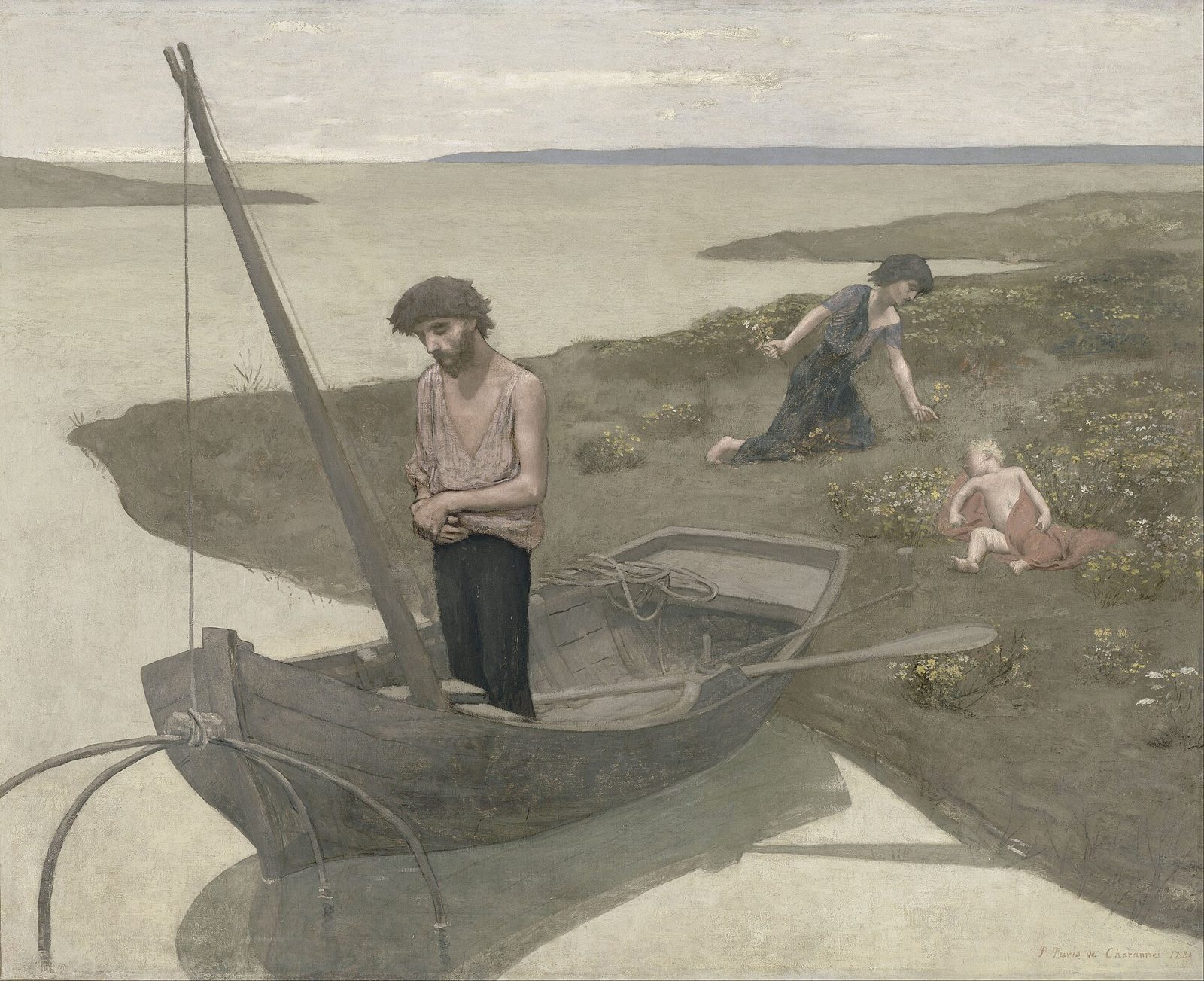
🎧 This work has audio narration — listen in the appTake a moment to really look at "The Poor Fisherman" by Pierre Puvis de Chavannes. Notice the fisherman standing in his boat, eyes closed and hands crossed, as if he’s lost in thought. His tattered gray robes tell a story of hardship, while the serene river surrounding him reflects a deep sense of waiting and hope.
Why does this matter? This painting isn’t just about a man fishing; it’s a poignant symbol of poverty and resilience. The fisherman embodies the struggle of many, and his meditative pose invites you to ponder the weight of his dreams and disappointments. The woman nearby, perhaps his wife or daughter, collecting flowers, contrasts his stillness with a sense of action and survival, hinting at the fragile balance of hope amidst hardship.
Created in 1881, this work marked a significant moment in Puvis de Chavannes's career, as it was one of the first pieces to be acquired by a national museum, signaling his rise in the art world. It’s a piece that resonates with the themes of faith and rebirth, central to the Symbolist movement of the time.
As you stand here, consider: what dreams might the fisherman be holding onto, and how does that reflect our own hopes in the face of life’s challenges?
Pierre Puvis de Chavannes, born on December 14, 1824, in Lyon, emerged as a pivotal figure in 19th-century French painting, often celebrated as "the painter for France." His artistic journey began after a transformative trip to Italy, leading him to abandon his initial pursuit of engineering. He studied under notable artists like Eugène Delacroix and Thomas Couture but ultimately forged an independent path.
Puvis's work is characterized by a symbolist style, blending allegory with a unique decorative aesthetic. His murals, commissioned for public and private institutions, reflect a deep engagement with the evolving identity of France during the Third Republic. Notable works include the cycles at the Musée de Picardie and the Panthéon in Paris, where he tackled themes of national identity and cultural heritage.
Despite initial struggles at the Salon, Puvis gained recognition with his allegorical pieces, which resonated with the political and cultural discourse of his time. His ability to navigate various ideologies allowed him to create art that appealed to a broad audience. As a co-founder of the Société Nationale des Beaux-Arts, he influenced a generation of artists, leaving a lasting legacy in the world of mural painting and symbolist art. Puvis de Chavannes passed away on October 24, 1898, but his contributions to French art continue to be celebrated.
The painting quickly garnered attention, becoming one of the first works by Pierre Puvis de Chavannes to be acquired by a national museum, specifically the Musée du Luxembourg in 1887, thanks to the influential art dealer Paul Durand-Ruel. It remained there until 1929 before moving to the Louvre, and finally, in 1986, it found its home at the Musée d'Orsay. The painting was initially met with mixed reviews; while it was celebrated by the emerging Symbolist movement for its emotional depth, it faced criticism for its perceived lack of realism, a stark contrast to the prevailing artistic norms of the time.
As you gaze at 'The Poor Fisherman,' take note of the way Puvis de Chavannes employs color and light to evoke emotion. The muted gray tones of the fisherman’s robes contrast sharply with the vibrant hues of the flowers being collected by the woman, creating a visual dialogue between despair and hope. The brushwork feels deliberate yet fluid, guiding your eyes across the canvas. Notice how the composition is anchored by the central figure of the fisherman, standing in his boat, embodying stillness amidst the flowing river. The expansive background, with its soft, undefined horizon, enhances the sense of waiting and contemplation. This choice of scale invites you to reflect on the vastness of the fisherman’s struggle against the backdrop of nature, emphasizing both his isolation and his connection to the world around him.
Its influence rippled through the art world, inspiring a generation of artists who sought to convey emotion and allegory over realism. The fisherman, with his meditative pose, embodies not just a struggle for survival but a universal human condition, prompting viewers to reflect on their own lives. This work was celebrated by young Symbolists, marking a shift away from the dominant styles of the time, and it became the first of Puvis' works to enter a national collection, solidifying his legacy as a pioneer of modern art. Remember this: Puvis didn't just paint a scene; he painted a feeling, a moment of stillness in the chaos of life.
Interestingly, there are multiple versions of 'The Poor Fisherman.' After the original was acquired by the state, Puvis de Chavannes created a second, vertical version to compensate the collector Émile Boivin, who had owned the first. This new version features a child inside the boat and omits the woman, showcasing how the artist reinterpreted his own work based on the circumstances surrounding its sale.
In the second, vertical version of 'The Poor Fisherman,' a child is depicted inside the boat, while the woman is omitted, showcasing how Puvis de Chavannes adapted his composition based on the circumstances of its sale.
While the emerging Symbolist movement celebrated the emotional depth of 'The Poor Fisherman,' it faced criticism from traditionalists who viewed its lack of realism as a departure from established artistic norms.
Paul Durand-Ruel played a crucial role in the painting's journey to national recognition by facilitating its purchase for the Musée du Luxembourg, marking a significant moment in Puvis de Chavannes's career.