A Studio at Les Batignolles
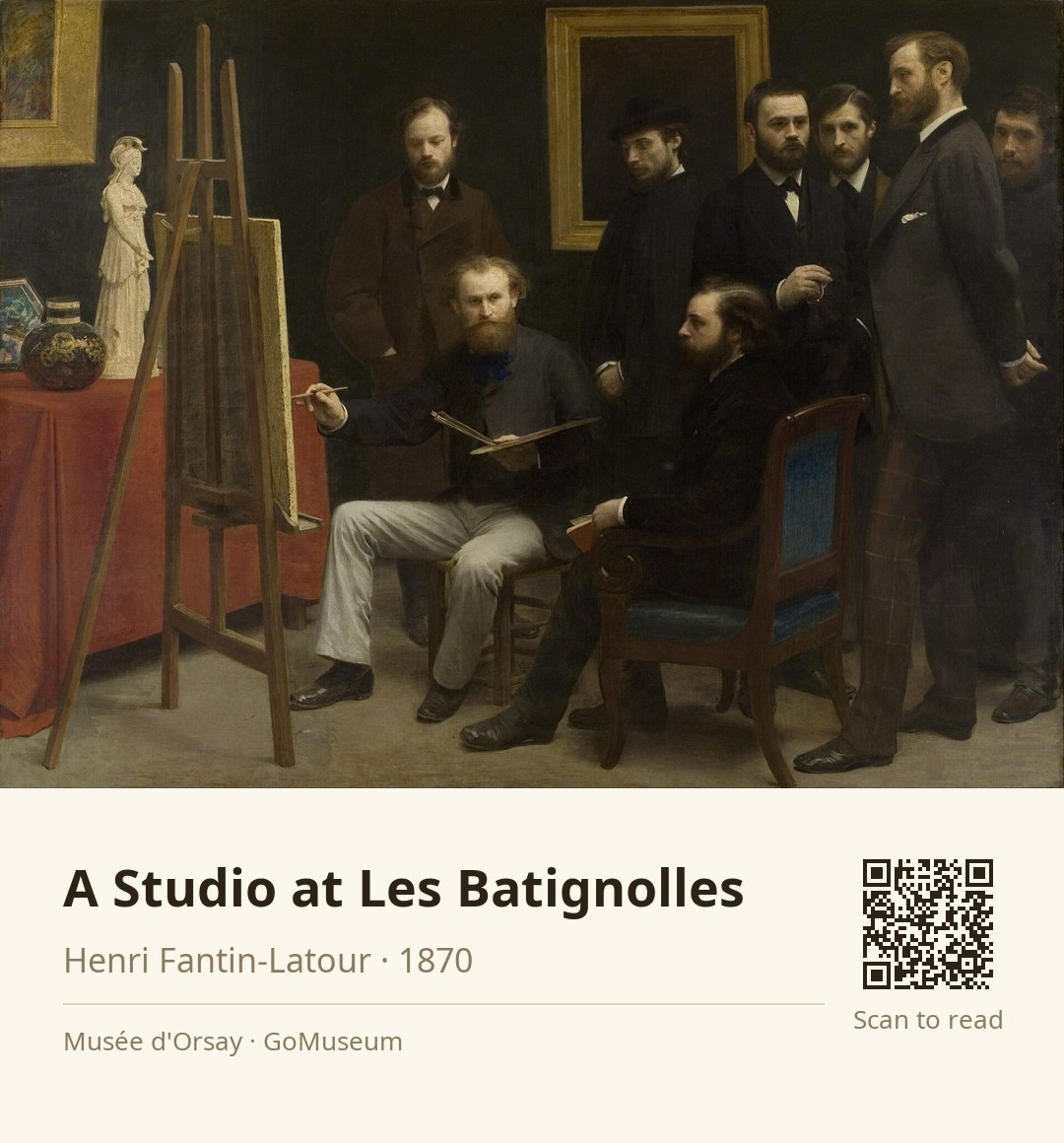
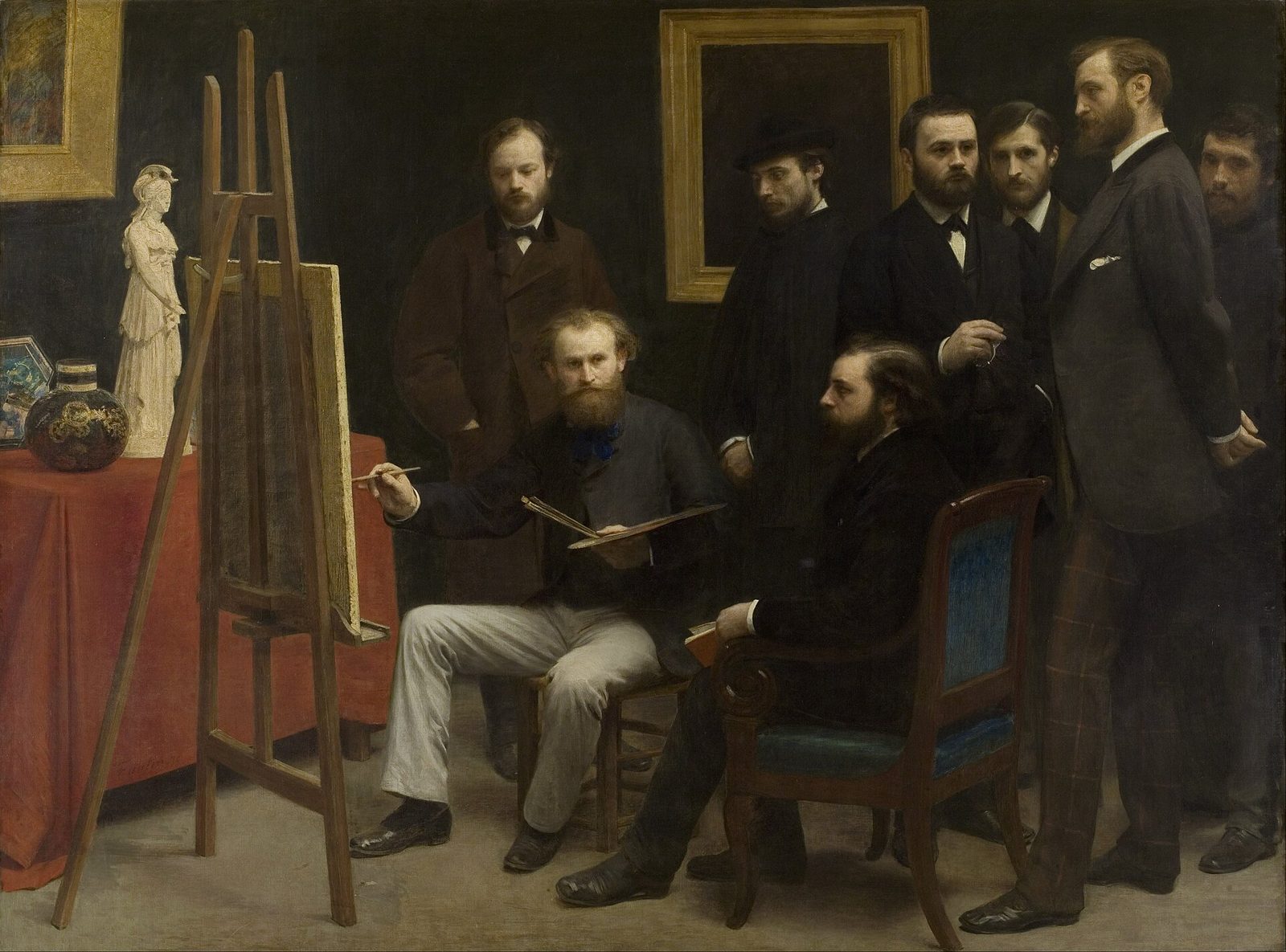
🎧 This work has audio narration — listen in the appAs you stand before "A Studio at Les Batignolles," take a moment to soak in the lively atmosphere captured by Henri Fantin-Latour in 1870. Look closely at the figure of Édouard Manet, seated at the easel, his face illuminated as he paints the likeness of Zacharie Astruc. Notice how the other artists lean in, their expressions a mix of admiration and camaraderie. This isn’t just a gathering; it’s a snapshot of a pivotal moment in art history.
These details matter because they reveal the deep connections among the Batignolles Group, a collective of artists who would shape the future of Impressionism. Manet’s central position signifies his influence, while the attentive gazes of Renoir and the others highlight the respect they held for him. Fantin-Latour wasn’t merely painting friends; he was documenting a revolutionary artistic community that thrived on collaboration and shared vision.
Created during a time when traditional art was being challenged, this painting serves as a tribute to the friendships that fueled creativity. Fantin-Latour himself was part of this circle, having studied alongside many of these figures.
So, as you take in this vibrant scene, consider: what does it mean to be part of a creative community? How do friendships shape the art we love?
Ignace Henri Jean Théodore Fantin-Latour, born on January 14, 1836, in Grenoble, was a notable French painter and lithographer renowned for his exquisite flower paintings and group portraits of contemporary artists and writers. His artistic journey began under the guidance of his father, a painter, and continued in Paris, where he studied at the École des Beaux-Arts alongside future Impressionists like Edgar Degas and Alphonse Legros. Despite his connections to the avant-garde, Fantin-Latour's style remained rooted in realism and tradition.
In the 1860s, he gained acclaim for his still lifes, particularly in England, where his works were celebrated for their vibrant colors and textures. Encouraged by James McNeill Whistler, he embraced this genre, which was often undervalued in the hierarchy of art. His still lifes, characterized by their simplicity and focus on form, defied academic conventions and showcased his mastery of color.
Fantin-Latour's contributions to collective portraiture, such as "A Studio at Les Batignolles," positioned him as a bridge between Romanticism and Impressionism. Despite being overshadowed by his contemporaries, his legacy endures, with his works held in prestigious museums and a lasting influence on subsequent generations of artists. He passed away on August 25, 1904, leaving behind a rich artistic heritage that continues to be appreciated today.
Henri Fantin-Latour's "A Studio at Les Batignolles" was painted in 1870 and first exhibited at the Salon des artistes français in Paris that same year. This painting captures a moment in the vibrant artistic community of the Batignolles Group, a collective that included notable figures like Édouard Manet and Pierre-Auguste Renoir. Following its exhibition, the painting faced a tumultuous path; discussions for its purchase by the French state were abruptly halted due to the outbreak of the Franco-Prussian War. It later changed hands several times, starting with Edwin Edwards in 1871, and eventually found its home at the Musée d'Orsay in 1986, where it remains today. This painting stands as a testament to the friendships and artistic alliances that shaped a pivotal moment in art history.
As you gaze at "A Studio at Les Batignolles," take note of the composition and how Fantin-Latour orchestrates the figures within the space. Manet's prominent position at the easel draws your eye, illuminated by light that seems to spotlight his creative process. The brushwork is deliberate yet fluid, capturing the lively atmosphere of the studio. Fantin-Latour employs a rich palette, with dark tones that contrast sharply against the vibrant reds of the drapery and the warm skin tones of the artists. This choice not only enhances the depth of the scene but also evokes a sense of intimacy among the figures. The arrangement of the artists, leaning in towards Manet, creates a dynamic tension, suggesting a shared moment of inspiration and dialogue. Notice how the empty frame encircling Renoir's head adds a layer of symbolism, hinting at the potential for future masterpieces. Each brushstroke feels intentional, as if Fantin-Latour is weaving a narrative of camaraderie and artistic ambition.
Created in 1870, it captures the camaraderie of the Batignolles Group, a collective of artists that included the likes of Édouard Manet, Claude Monet, and Pierre-Auguste Renoir. This work stands as a testament to the friendships and alliances that fueled the birth of Impressionism. By portraying these influential figures in a shared space, Fantin-Latour not only honors their individual contributions but also highlights the collaborative spirit that was essential to their artistic evolution. This painting helped shift the narrative in art from solitary genius to community, influencing how future generations of artists would view collaboration and support in their creative endeavors.
Interestingly, this painting was created as a companion piece to Fantin-Latour's earlier work, "Homage to Delacroix," which celebrated the Romantic painter's legacy. While "A Studio at Les Batignolles" focuses on the camaraderie of contemporary artists, it also reflects Fantin-Latour's deep respect for the artistic traditions that preceded him, creating a bridge between the Romantic and Impressionist movements.
On the left side of the painting, there is a statuette of Athena, a Japanese-style ceramic pot created by Laurent Bouvier, and a multicolor lacquered tray. These objects not only showcase Fantin-Latour's admiration for antique traditions but also hint at the influence of Japanese art on the Impressionists.
After its exhibition at the Salon in 1870, discussions for its purchase by the French state were abruptly halted due to the outbreak of the Franco-Prussian War, which significantly impacted its early reception and acquisition.