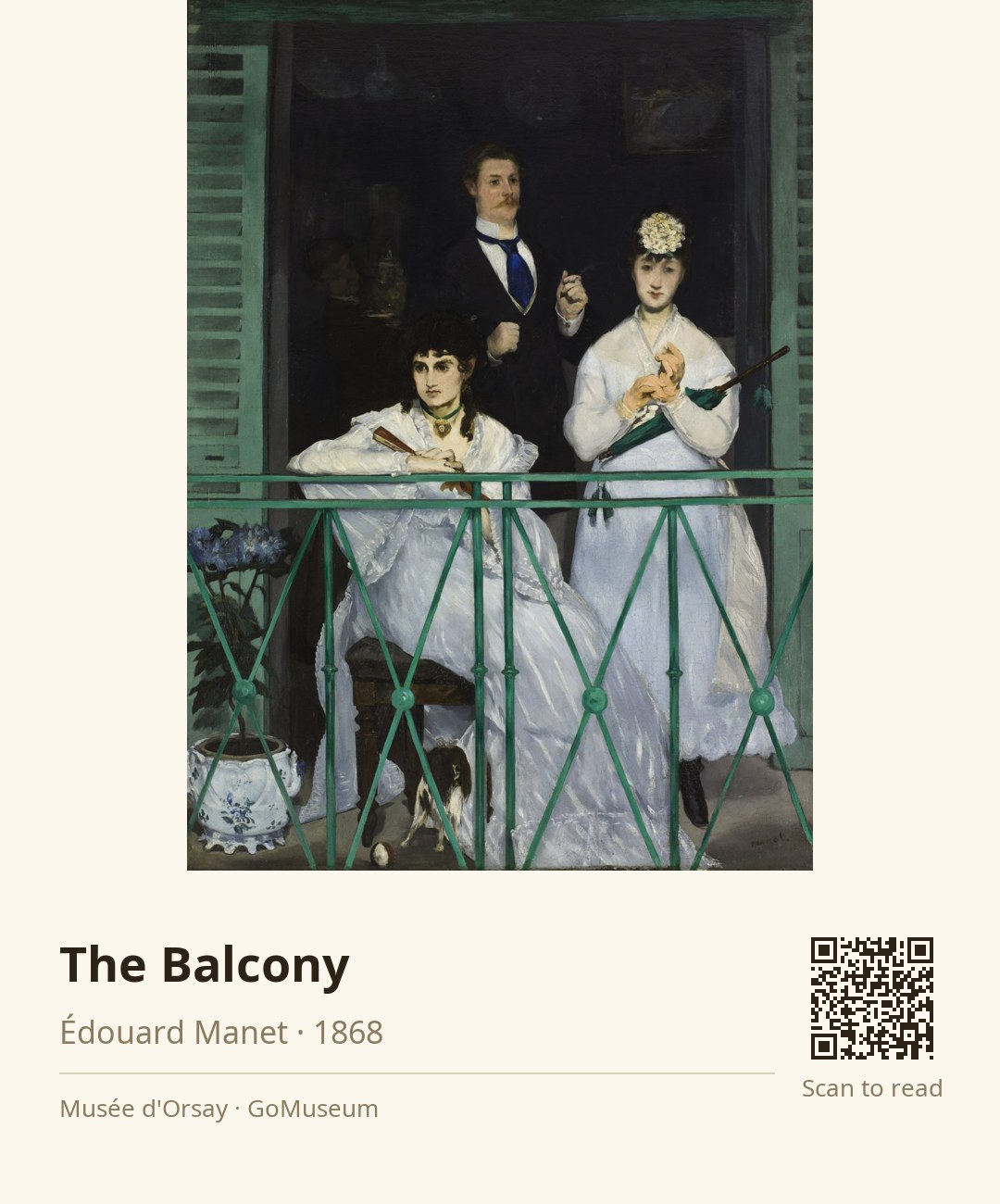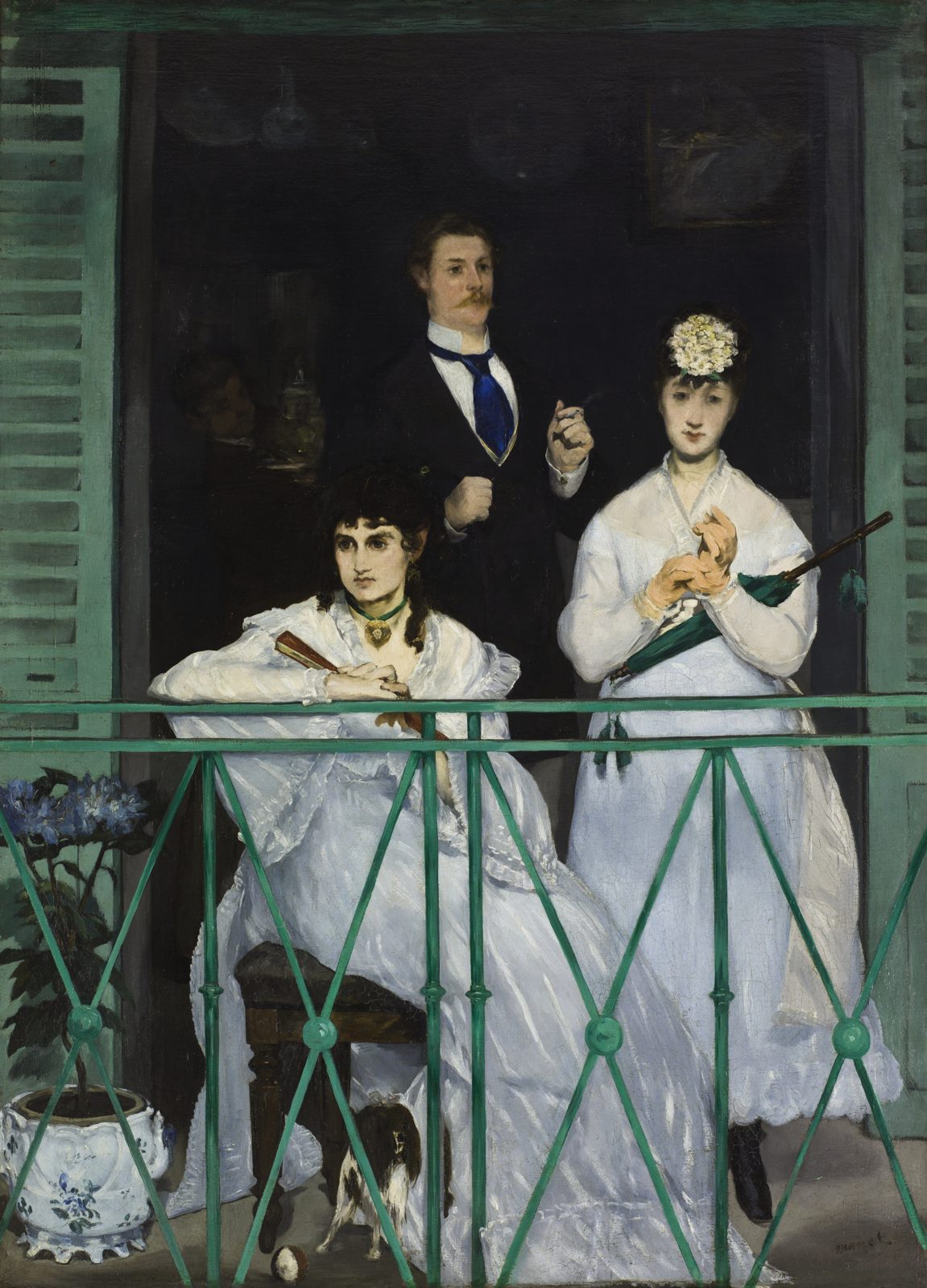
Take a moment to really look at "The Balcony" by Édouard Manet. Notice how the figures seem almost disconnected from one another, each lost in their own world. On the left, Berthe Morisot, with her fan, looks like a romantic heroine, while the others—Fanny Claus and Antoine Guillemet—appear indifferent, as if they’re in a different realm altogether. Here, they’re more like objects in a still life, which adds an intriguing layer of mystery. The bold green of the balcony railings, a color that shocked critics at the time, draws your eye and heightens that sense of disconnection. Created in 1868, this work was part of Manet's exploration of modern life, inspired by Goya’s earlier depictions of women on balconies. It was a radical departure from the norms of the day, and while it faced harsh criticism at the 1869 Salon, it has since become a celebrated piece of modern art. As you stand here, think about the emotions these figures evoke. What stories do you imagine are unfolding behind their detached expressions?
Édouard Manet, born on January 23, 1832, in Paris, emerged as a pivotal figure in 19th-century art, bridging Realism and Impressionism. From an affluent family, he initially faced pressure to pursue a naval career but instead dedicated himself to painting, influenced by his uncle and the Old Masters. His early works, including "The Luncheon on the Grass" and "Olympia," sparked controversy and challenged traditional artistic norms, marking him as a revolutionary force.
Manet's style, characterized by loose brushwork and a focus on contemporary life, diverged from the meticulous techniques of his predecessors. He often depicted modern Parisian scenes, capturing the essence of leisure and social dynamics. Despite initial rejection from the art establishment, he gained recognition among progressive artists and became a mentor to the Impressionists.
Throughout his life, Manet formed connections with influential figures like Baudelaire and Zola, who defended him against critics. His later works, such as "A Bar at the Folies-Bergère," showcased his evolving style and mastery of color. Manet's contributions to art history are profound; he is celebrated not only for his innovative techniques but also for elevating still life and modern subjects to the forefront of artistic expression. He passed away on April 30, 1883, leaving behind a legacy that continues to inspire artists today.
Édouard Manet's "The Balcony," painted in 1868, faced a tumultuous reception at the 1869 Paris Salon. Initially, critics were harsh, labeling it as 'discordant' and a reflection of bad taste. The bold green of the balcony railings drew particular ire, with one critic suggesting that the painting contributed to Manet's reputation for eccentricity. Despite this, the work remained in Manet's possession until his death in 1883. It was sold to Gustave Caillebotte in 1884 for 3,000 francs, and Caillebotte later bequeathed it to the French state in 1894. Today, it resides in the Musée d'Orsay, a testament to its eventual acclaim.
When you look closely at "The Balcony," notice how Manet's brushwork feels both deliberate and spontaneous. The figures are painted with a restrained palette dominated by whites, greens, and blacks, creating a striking contrast that enhances their isolation. The bold green railings are not just a shocking choice; they serve to frame the figures, almost like a theatrical set, emphasizing their detachment. Manet's technique involves layering paint to achieve depth, while the stark black background adds an air of mystery. Each subject is rendered with a distinct approach—Morisot's romantic pose contrasts sharply with the indifference of Guillemet and Claus, making them feel like still-life objects rather than interconnected beings.
He painted each of the four figures multiple times—Guillemet alone was painted as many as fifteen times! This dedication to capturing the essence of his friends shows not just his artistic commitment but also the depth of his relationships with them. Imagine the conversations and laughter shared in the studio as he worked on this piece, blending their personalities into one cohesive scene.
The hydrangea, placed just behind the balcony railings, adds a touch of domesticity and life to the otherwise stark scene. It serves as a subtle contrast to the emotional detachment of the figures, highlighting the tension between nature and the artificiality of their environment.