Pasteur's portrait by Edelfelt
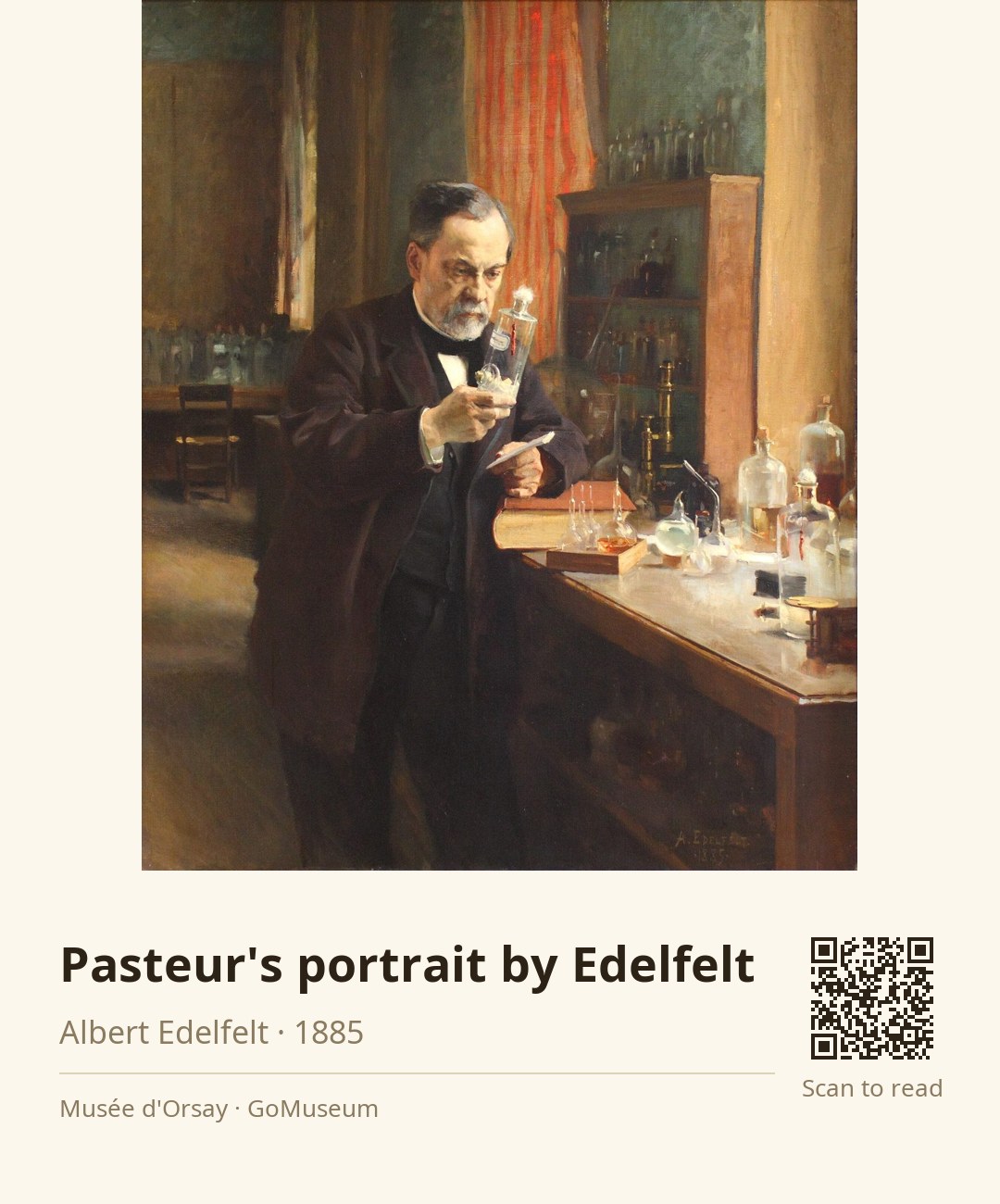
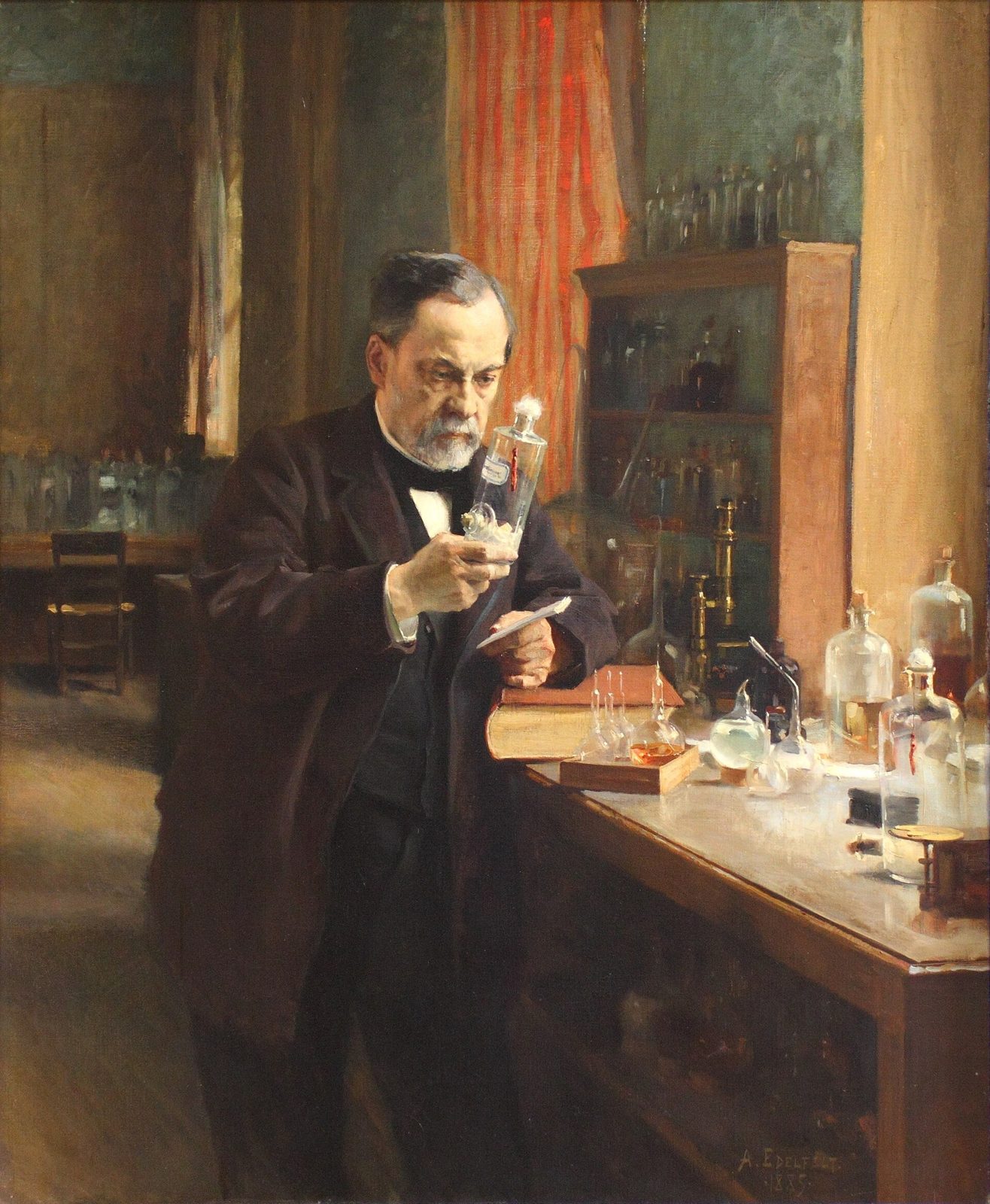
🎧 This work has audio narration — listen in the appTake a moment to really look at this portrait of Louis Pasteur by Albert Edelfelt. Notice how the light falls across Pasteur’s face, illuminating his thoughtful expression as he stands in his laboratory. The glass bottle he holds is not just any vessel; it contains the spinal cord of a rabbit infected with rabies, a detail that speaks volumes about his groundbreaking work in microbiology.
This isn’t just a painting; it’s a snapshot of a pivotal moment in scientific history. Pasteur, often hailed as the father of microbiology, is depicted here at the forefront of his research, surrounded by the very tools that helped him challenge the long-held belief in spontaneous generation. Edelfelt captures not only the man but the essence of his relentless pursuit of knowledge, a theme that resonates deeply even today.
Created in 1885, this portrait became one of the most recognized images of Pasteur, showcasing the artist's skill in blending realism with a sense of narrative. Edelfelt was a prominent figure in the art world, and this work earned him the Legion of Honor just a year later at the Paris Salon.
As you stand here, consider the legacy of Pasteur’s discoveries. How many lives have been saved because of his work? What might the world look like if he hadn’t pushed the boundaries of science? Let this portrait remind you of the power of curiosity and innovation.
Albert Edelfelt, born on July 21, 1854, in Porvoo, was a pivotal Finnish painter whose naturalistic style and Realist approach significantly shaped Finnish art. Orphaned early, he was raised by a determined mother, fostering a close bond that influenced his character and work. Edelfelt studied at the Drawing School of the Finnish Art Society and later at the Royal Academy of Fine Arts in Antwerp, where he excelled in history painting.
In 1874, he moved to Paris, immersing himself in the vibrant art scene and befriending notable artists like Jules Bastien-Lepage. His early works, rich in historical themes, evolved towards Impressionism, capturing the essence of everyday life and the play of light. His portrait of Louis Pasteur gained him international acclaim and the Legion of Honor, solidifying his status as a leading artist.
Edelfelt's contributions to the Golden Age of Finnish Art were profound, as he brought Finnish culture to the forefront of the European art world. His influence extended beyond his lifetime, inspiring future generations of Finnish artists and establishing Paris as a new artistic hub for Finland. He passed away on August 18, 1905, leaving behind a legacy that intertwined national identity with artistic innovation.
The painting was first exhibited at the Paris Salon in 1886, where it garnered significant acclaim, earning Edelfelt the prestigious Legion of Honor just a year later. This portrait became a defining image of Pasteur, showcasing him in his laboratory at rue d'Ulm, surrounded by the very tools of his revolutionary research. After its exhibition, the painting was acquired by the French state in 1887 and remained at the Sorbonne until 1922, before moving to the Musée du Luxembourg, then the Louvre, and finally settling at the Château de Versailles in 1929. It has been part of the Musée d'Orsay's collection since 1986, continuing to be a testament to both Edelfelt's artistry and Pasteur's monumental contributions to science.
Edelfelt's technique in this portrait is a masterclass in realism, capturing not just the likeness of Pasteur but the very essence of his scientific spirit. Notice how the light falls dramatically across Pasteur's face, creating a chiaroscuro effect that emphasizes his thoughtful expression. The brushwork is meticulous, with fine details in the textures of his clothing and the glassware surrounding him. The composition is carefully structured; Pasteur is centrally placed, drawing your eye to him as he holds the glass bottle, a focal point that symbolizes his groundbreaking work. The color palette is rich yet subdued, with earthy tones that ground the viewer in the laboratory setting, while the play of light adds a dynamic quality, almost as if the scene is alive with the energy of scientific discovery.
This painting not only immortalized Pasteur, often dubbed the 'father of microbiology,' but also set a standard for how scientists could be portrayed—intellectually engaged and surrounded by their work. Edelfelt's approach influenced future generations of artists, encouraging them to blend realism with contemporary themes. The portrait became emblematic, even gracing the cover of Pasteur's first critical biography, cementing its place in both the art world and the annals of science.
The portrait became an iconic representation of Pasteur, contributing to his status as a heroic figure in French culture. It was widely reproduced and even adorned the cover of his first critical biography, solidifying his legacy in the public consciousness.
Edelfelt's background as one of the first Finnish artists to gain international recognition in Paris allowed him to blend his realist training with the emerging Impressionist techniques, which he applied in this portrait to capture the essence of Pasteur's scientific spirit.