 Image: Phyrexian · Michel wal · Lomita
Nature Unveiling Herself Before Science (Orsay)
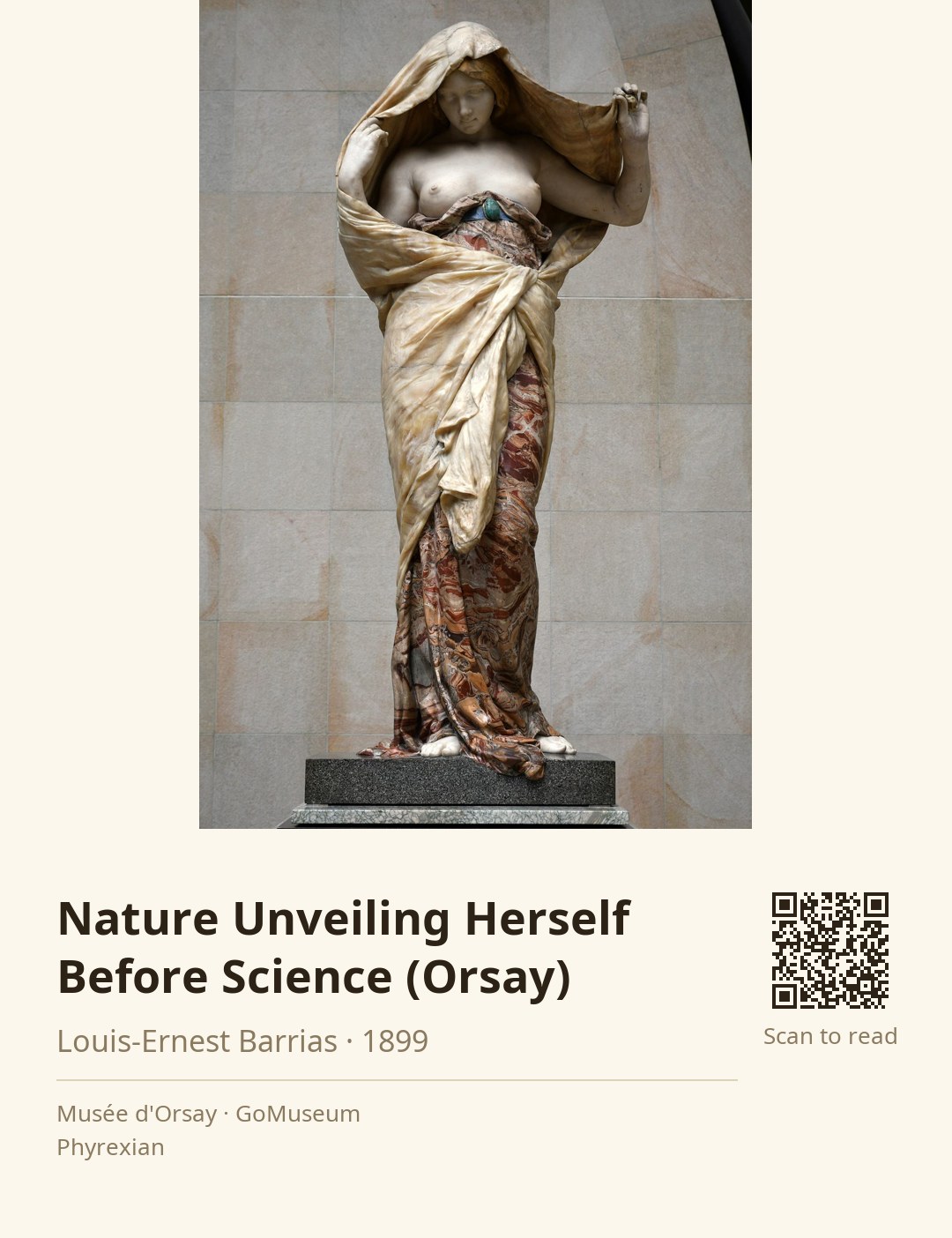
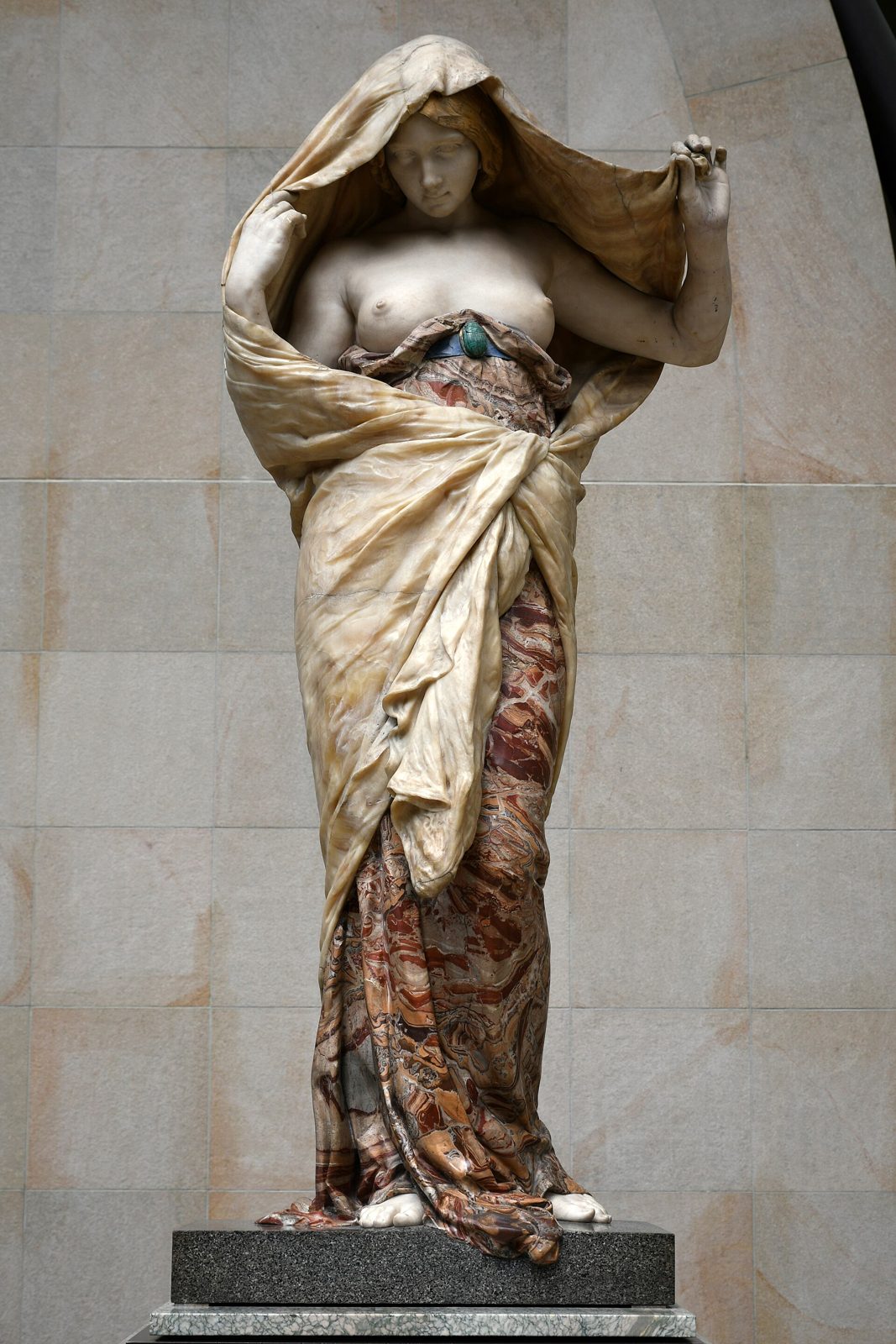
🎧 This work has audio narration — listen in the appThe graceful figure of a woman stands before you, her body partially draped in a flowing garment that cascades around her. The intricate carving of the fabric reveals a blend of cream and earthy tones, while her head is slightly bowed, creating a hood-like effect that adds an air of mystery. This delicate balance between the smoothness of her skin and the textured drapery showcases Louis-Ernest Barrias's masterful skill in manipulating marble and onyx.
Barrias's work, created in 1899, embodies the spirit of the Art Nouveau movement, where nature and femininity intertwine. The figure's pose, with her hands gently holding the edges of her garment, conveys a sense of introspection and grace, inviting viewers to contemplate the relationship between nature and science. The sculpture's title, "Nature Unveiling Herself Before Science," suggests a moment of revelation, where the mysteries of the natural world are laid bare, reflecting the era's fascination with discovery and enlightenment.
Barrias, a prominent French sculptor, was deeply influenced by Romantic realism and the Art Nouveau style, which flourished during the late 19th century. His career included significant contributions to the decoration of iconic Parisian landmarks, and he was recognized with numerous honors, including the Legion of Honour. This particular piece was exhibited at the 1899 Salon and the 1900 Exposition Universelle in Paris, marking it as a significant work in his oeuvre.
Louis-Ernest Barrias was a prominent French sculptor born on April 13, 1841, in Paris, into a family of artists. His father painted porcelain, and his brother was a recognized painter, which influenced his artistic journey. Initially a painter, Barrias shifted to sculpture under the guidance of Pierre-Jules Cavelier and later studied at the École nationale supérieure des Beaux-Arts. He gained significant recognition after winning the Prix de Rome in 1865, allowing him to study at the French Academy in Rome.
Barrias's work, characterized by a Romantic realist style, often drew inspiration from nature and literature, reflecting the Art Nouveau movement of his time. Notable pieces include "Nature Unveiling Herself Before Science" and "The Oath of Spartacus." His contributions to public art include decorations for the Paris Opéra and the Hôtel de la Païva. He was honored with the Legion of Honour and served as a professor at the École des Beaux-Arts, mentoring future artists.
Barrias's legacy endures in his dynamic sculptures that blend emotion and form, securing his place in the history of French sculpture. He passed away on February 4, 1905, leaving behind a rich body of work celebrated in various public collections.
Crafted from marble and onyx, Barrias's sculpture showcases his exceptional skill in manipulating these materials. The smooth, polished surfaces of the marble contrast beautifully with the intricate textures of the drapery, which appears almost alive. You can see how he carved the flowing garment with precision, allowing the fabric to cascade around the figure, enhancing the sense of movement. The subtle blending of cream and earthy tones adds depth, inviting you to appreciate the tactile quality of the materials. This attention to detail not only highlights the figure's form but also reflects the natural beauty that Barrias sought to capture.
Created in 1899, 'Nature Unveiling Herself Before Science' was first exhibited at the prestigious Salon of the same year, followed by the 1900 Exposition Universelle in Paris. Commissioned during a time when the Art Nouveau movement was at its peak, Barrias's work was well-received, celebrated for its embodiment of the era's fascination with nature and femininity. The sculpture quickly became a hallmark of his career, showcasing his ability to blend allegory with realism. Barrias, who had already earned acclaim for his other works and was a prominent figure in the Parisian art scene, continued to influence the artistic landscape until his death in 1905.
Interestingly, Barrias was not just a sculptor but also a teacher who shaped the next generation of artists. Among his students were notable figures like Josep Clarà and Charles Despiau, who would go on to make their own marks in the art world.
Barrias worked on the decoration of significant landmarks such as the Paris Opéra and the Hôtel de la Païva, showcasing his influence in public art.
Barrias taught several influential artists, including Josep Clarà and Charles Despiau, who later became prominent figures in the art scene.
Barrias was significantly influenced by the Romantic realist style of Jean-Baptiste Carpeaux, which is evident in his marble sculptures.