Empereor Napoléon III
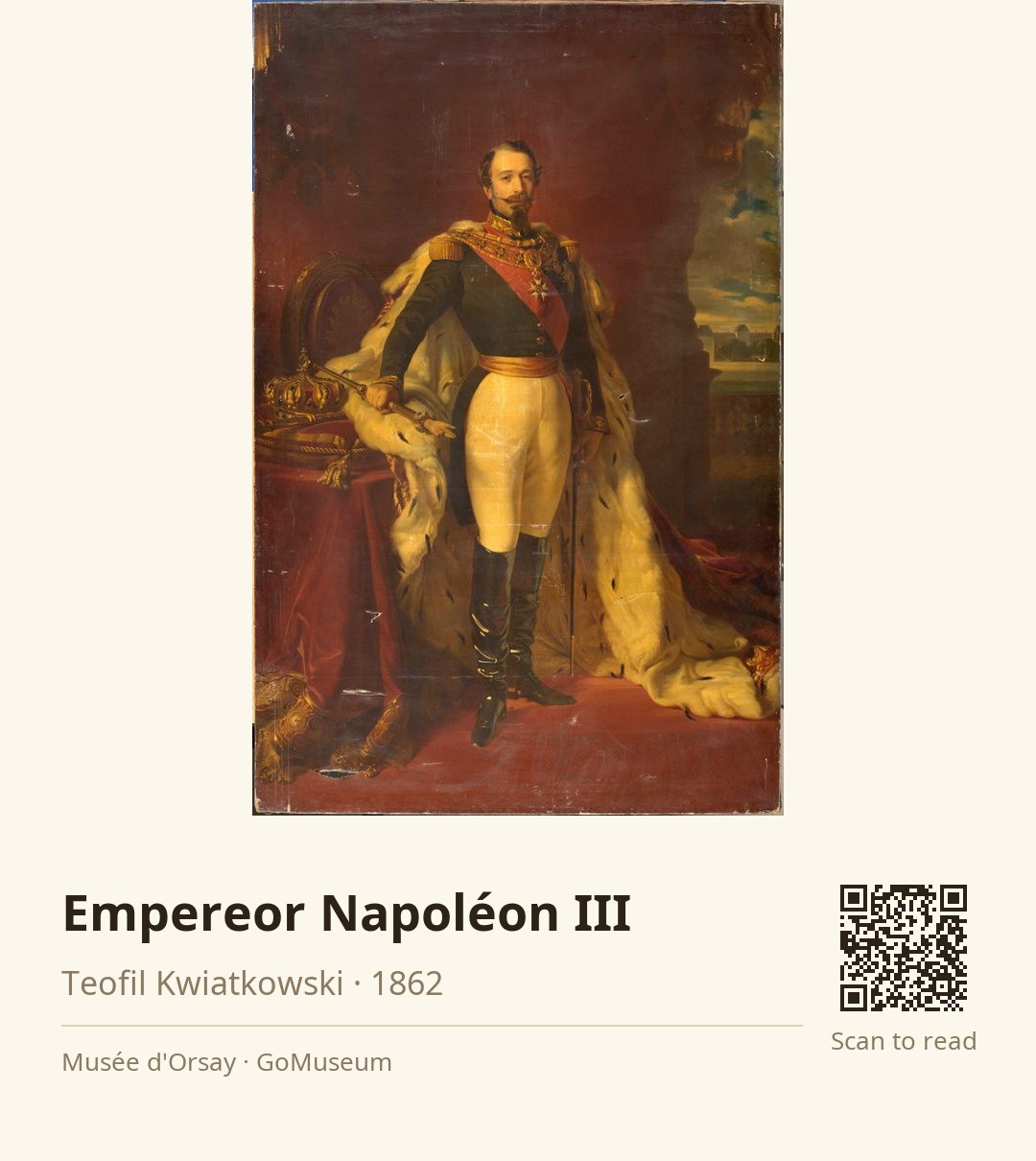
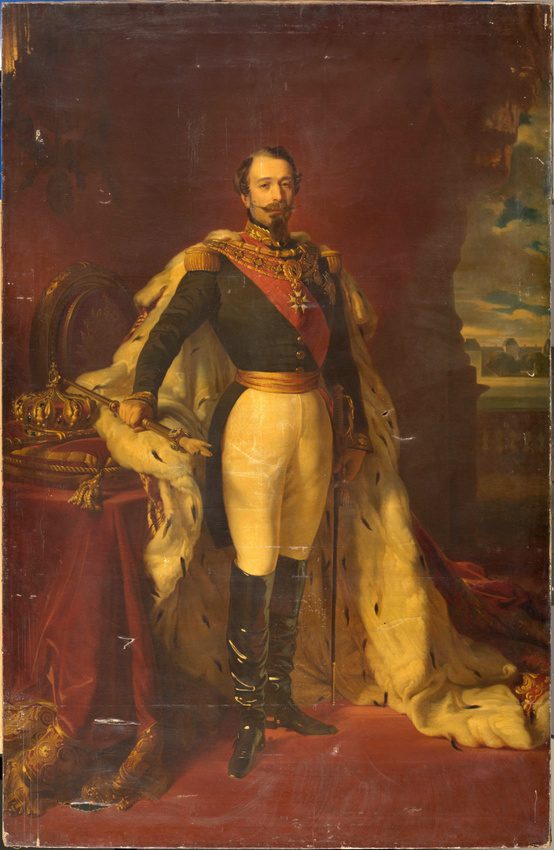
🎧 This work has audio narration — listen in the appTake a moment to really look at "Emperor Napoléon III." Notice how Kwiatkowski captures the emperor in such regal detail—his rich ermine cloak, the glint of his sword, and the proud way he holds his scepter. These elements aren’t just for show; they symbolize his power and authority during a time when France was navigating through political upheaval and ambition. Kwiatkowski painted this in 1862, a period when Napoleon III was at the height of his influence, and you can almost feel the weight of that history in the canvas. The artist himself was a Polish émigré, having fled his homeland after a failed uprising, and his connection to the themes of power and exile resonates through this portrait. As you stand here, think about the layers of identity and ambition wrapped up in this image. What do you think Kwiatkowski was trying to convey about leadership and legacy?
Teofil Antoni Jaksa de Griffon Kwiatkowski was a Polish painter born on February 21, 1809, in Pułtusk. His early life was marked by his involvement in the November 1830 Uprising against Russian rule, which led to his exile in France after the uprising's failure. Settling in Avallon, he studied painting under Léon Cogniet and became a prominent figure among Polish émigrés, befriending notable artists and intellectuals like Adam Mickiewicz and Frédéric Chopin.
Kwiatkowski's artistic legacy is closely tied to Chopin, as he created numerous portraits and illustrations inspired by the composer’s music. His works, including the famous "Bal at Hôtel Lambert" and poignant depictions of Chopin on his deathbed, reflect a deep emotional connection to his subjects. Kwiatkowski's contributions to the Paris Salon in the 1840s garnered attention, although his name was often mispronounced, overshadowing his talent.
In his later years, Kwiatkowski settled in Avallon, where he married and started a family. He continued to paint, capturing the picturesque landscapes of Burgundy. He passed away on August 14, 1891, leaving behind a rich legacy that intertwines Polish nationalism with the Romantic spirit of his time, securing his place in art history as a significant figure bridging music and visual art.
In 1862, Teofil Kwiatkowski painted 'Empereor Napoléon III', a striking portrait that captures the essence of the French emperor. Commissioned during a time when Napoleon III was solidifying his power, this work reflects both the artist's ambition and the political climate of the era. Kwiatkowski, a Polish émigré who had fled to France after participating in the November Uprising, found himself amidst a vibrant artistic community in Paris. His connections with notable figures like Adam Mickiewicz and Frédéric Chopin undoubtedly influenced his work. The painting, which measures an impressive 241 by 157 centimeters, showcases Napoleon III in full regalia, complete with the Order of the Legion of Honor. It has been featured in significant exhibitions, including those at the Louvre and Musée d'Orsay, and is documented in various catalogs, ensuring its place in art history. Kwiatkowski's portrayal of the emperor not only highlights his skill but also serves as a testament to the intertwining of art and politics in 19th-century France.
As you gaze at this painting, pay attention to Kwiatkowski's masterful brushwork. The way he layers oil paint creates a rich texture that brings the emperor's ermine cloak to life, making it almost feel tangible. Notice how the light plays across the surface, highlighting the intricate details of the sword and scepter, which serve to elevate Napoléon III's regal presence. The composition is structured with the emperor slightly turned, allowing for a dynamic view that draws the eye across the canvas. Kwiatkowski's choice of a three-quarter pose adds a sense of depth and movement, making the viewer feel as if they are standing in the same room, witnessing the emperor's commanding aura firsthand.
Interestingly, Kwiatkowski was not just a painter of political figures; he had a close friendship with the composer Frédéric Chopin. This connection led him to create several portraits of Chopin, capturing the essence of the musician in intimate settings.
After fleeing Poland due to the November Uprising, Kwiatkowski lived in a facility for Polish war refugees in Avallon until 1832. He later moved to Paris, where he became involved with the Polish artistic community and formed friendships with notable figures like Adam Mickiewicz and Frédéric Chopin.
Yes, Kwiatkowski was closely associated with Frédéric Chopin, creating several portraits of the composer that captured his essence in intimate settings. This friendship not only influenced Kwiatkowski's work but also contributed to Chopin's posthumous popularity.
Despite his talent, Kwiatkowski struggled with recognition due to his name being difficult to pronounce, which was noted by contemporary critics like Théophile Gautier. However, he did gain some acclaim by exhibiting at the Salon de Paris and producing popular works related to Chopin.