 Image: Sailko
Woman in Prayer at Saint Mark's in Venice
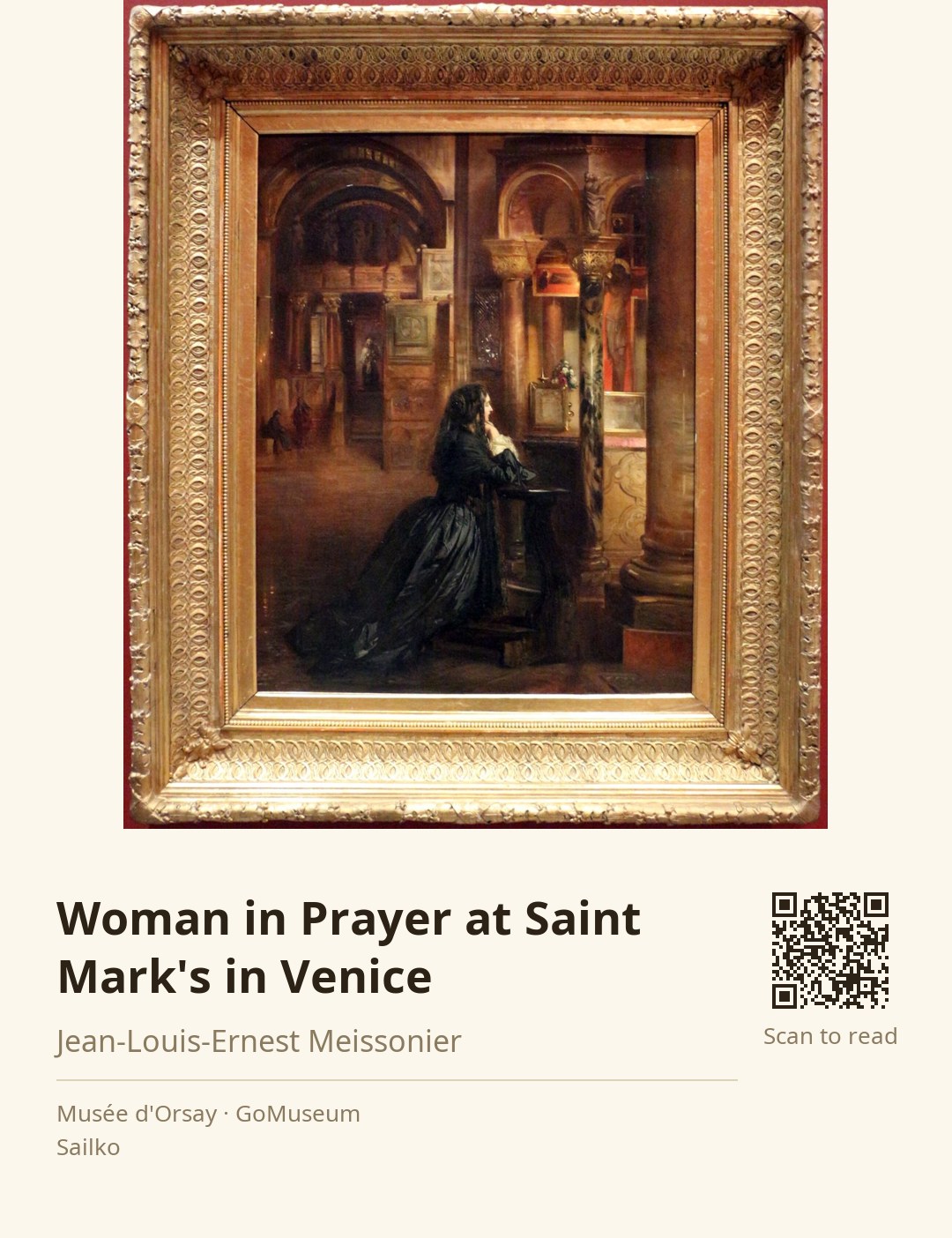
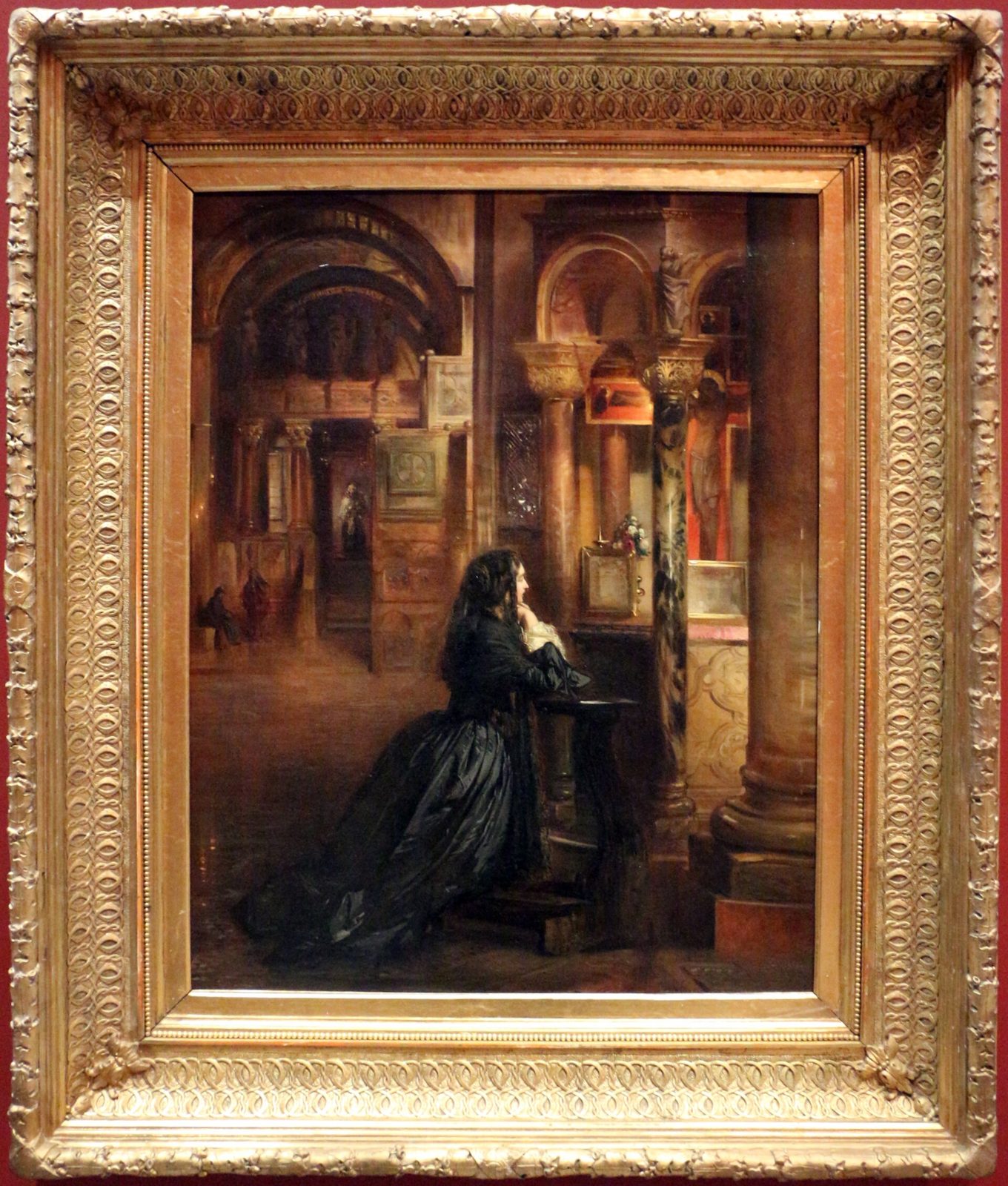
🎧 This work has audio narration — listen in the appKneeling in profile at a small dark prie-dieu, a woman in a long black dress with white cuffs lifts one hand to her chin and turns her gaze toward a side altar. Behind her, a crucifix stands against a red-orange ground, with a candlestick and small flowers set below it.
Look at how the warm browns and ochres of the interior close in around her, while the gilded capitals on the nearby columns catch the light and draw the eye upward.
Jean-Louis-Ernest Meissonier, born in Lyon in 1815, is best known for his military scenes and for intimate genre paintings of seventeenth- and eighteenth-century life, which he executed with extraordinary precision. This canvas belongs to a different side of his output, a view of a Venetian church interior, and it is painted in oil on canvas in the same smooth, carefully finished manner.
Jean-Louis-Ernest Meissonier was a prominent French academic painter and sculptor born on February 21, 1815, in Lyon. He developed a passion for painting early in life, eventually abandoning a career in his father's dye business to pursue art. Meissonier became renowned for his meticulous depictions of Napoleon and military scenes, characterized by extraordinary detail and craftsmanship. His works garnered immense acclaim, earning him a place among the most successful artists of the Second Empire alongside Gérôme and Cabanel.
Throughout his career, Meissonier focused on genre scenes from the seventeenth and eighteenth centuries, portraying everyday life with an emphasis on authenticity. His paintings, often featuring men engaged in leisurely activities, showcased his ability to capture intricate details, earning him comparisons to the Dutch master Gabriel Metsu. Despite his success, some critics later deemed his work lacking in spontaneity and life, with notable figures like Édouard Manet and Edgar Degas offering harsh assessments.
Meissonier's legacy is marked by his dedication to historical accuracy and the meticulous preparation of his works. He was honored with numerous accolades, including membership in the Académie des beaux-arts. His influence persisted beyond his death on January 31, 1891, as he played a crucial role in the art community, helping to establish the Société nationale des beaux-arts. Today, he is remembered as a significant figure in the academic tradition of French painting, particularly for his contributions to military art and genre scenes.