 Image: Sailko
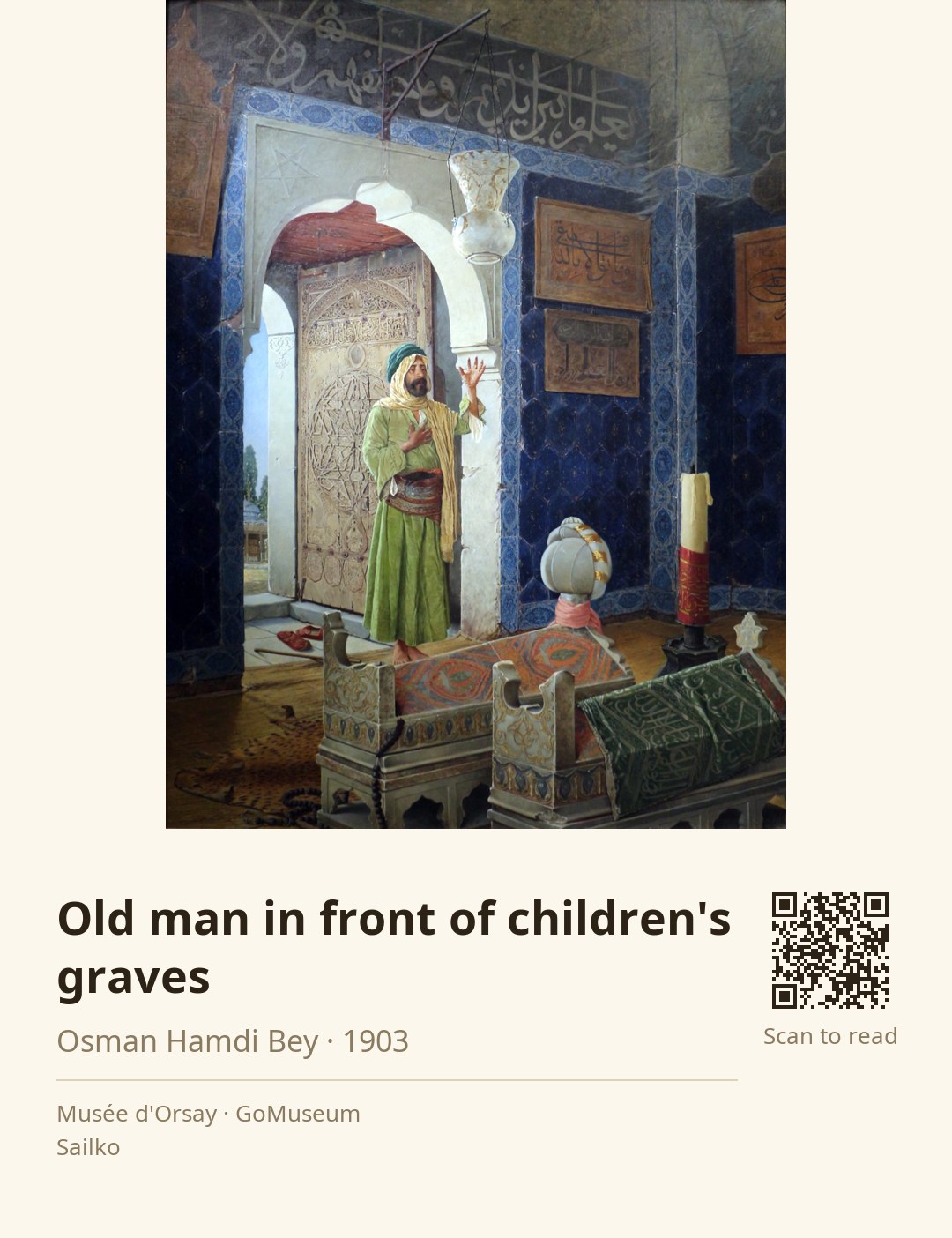
Old man in front of children's graves
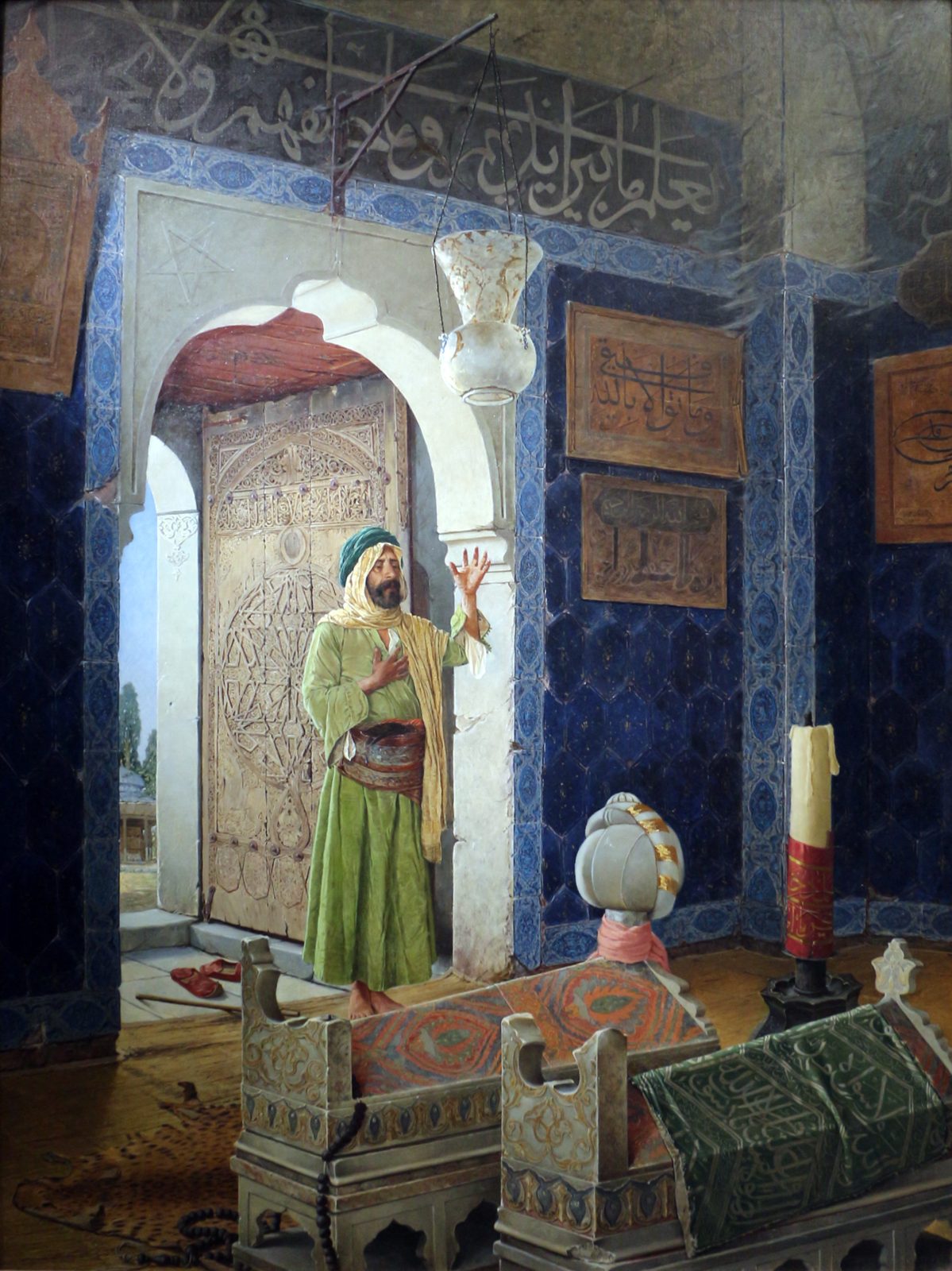
🎧 This work has audio narration — listen in the appThe old man in a green robe stands solemnly in front of two children's graves, his hands gesturing as if in prayer or deep contemplation. The ornate doorway behind him frames the scene, while the rich blue patterned walls and the large lamp hanging from the ceiling create a striking contrast with the earthy tones of his attire. Intricate wooden furniture and a patterned rug add layers of texture to this intimate setting.
This moment captures not just a personal act of remembrance but also reflects Osman Hamdi Bey's connection to the Ottoman heritage, as the man’s traditional attire predates significant cultural shifts in the empire. The figure may represent Hamdi himself, embodying the role of a guardian of memory, standing before the cenotaphs that symbolize loss and the preservation of history. The painting serves as a metaphor for Hamdi's own work as a museum director, where he fought against the cultural imperialism of the time by advocating for the protection of Ottoman artifacts.
Osman Hamdi Bey, a multifaceted figure in the Ottoman Empire, created this poignant work in 1903, a year that saw him deeply engaged in both artistic and archaeological pursuits.
Osman Hamdi Bey, born on December 30, 1842, in Constantinople, was a pivotal figure in the Ottoman Empire, renowned as a painter, archaeologist, and administrator. He was the son of a Grand Vizier and grew up in a culturally rich environment, which fostered his artistic talents. After studying law in Paris, he shifted his focus to painting, training under prominent French orientalist artists. His time in Paris coincided with significant cultural exchanges, influencing his artistic vision.
Hamdi Bey's career was marked by his dual roles in art and archaeology. As the first director of the Imperial Museum in 1881, he laid the groundwork for modern museology in Turkey, advocating for the preservation of antiquities and establishing archaeological expeditions. He founded the Istanbul Archaeology Museums and the Academy of Fine Arts, which trained a new generation of artists within the empire.
His paintings, while less known today, reflected his deep appreciation for Ottoman culture and history. He was instrumental in enacting laws to protect cultural heritage, combating the smuggling of artifacts. Hamdi Bey's legacy as a cultural pioneer remains significant in Turkish art history, embodying the fusion of Western influences with Ottoman tradition. He passed away on February 24, 1910, leaving behind a rich legacy in both the arts and archaeology.
Osman Hamdi Bey's painting, 'Old Man in Front of Children's Graves,' was created in 1903 and is a significant piece in his oeuvre. This artwork was first exhibited at the Paris Salon that same year under the title 'Derviche au turbey des enfants,' which translates to 'Dervish at the Children's Tomb.' It was well-received, showcasing Hamdi's ability to blend personal reflection with broader cultural themes. In 1909, a second version was displayed at the Royal Academy Exhibition in London, titled 'Le tombeau des enfants.' These exhibitions not only highlighted Hamdi's artistic prowess but also his commitment to preserving Ottoman heritage through art. The painting is now housed in the Musée d'Orsay in Paris, where it continues to be a focal point for discussions about Ottoman identity and memory.
The painting is a masterclass in oil technique, with Hamdi Bey employing rich, earthy tones contrasted against vibrant blues. The texture of the fabric in the man's green robe and the intricate patterns of the rug are rendered with meticulous brushwork, creating a tactile quality that invites you to feel the weight of the moment. The use of light is particularly striking; it bathes the figure in a soft glow, emphasizing his contemplative expression. The composition draws your eye through the ornate doorway, framing the man and the cenotaphs in a way that suggests a dialogue between the past and present. The scale of the painting, at over two meters tall, commands attention and immerses viewers in this intimate yet universal scene of remembrance.
Yes, the figure in the painting may actually be a self-portrait of Osman Hamdi Bey.
The man's costume is significant because it predates the Tanzimat reforms, which introduced Western dress styles and the fez.