The Romans of the Decadence
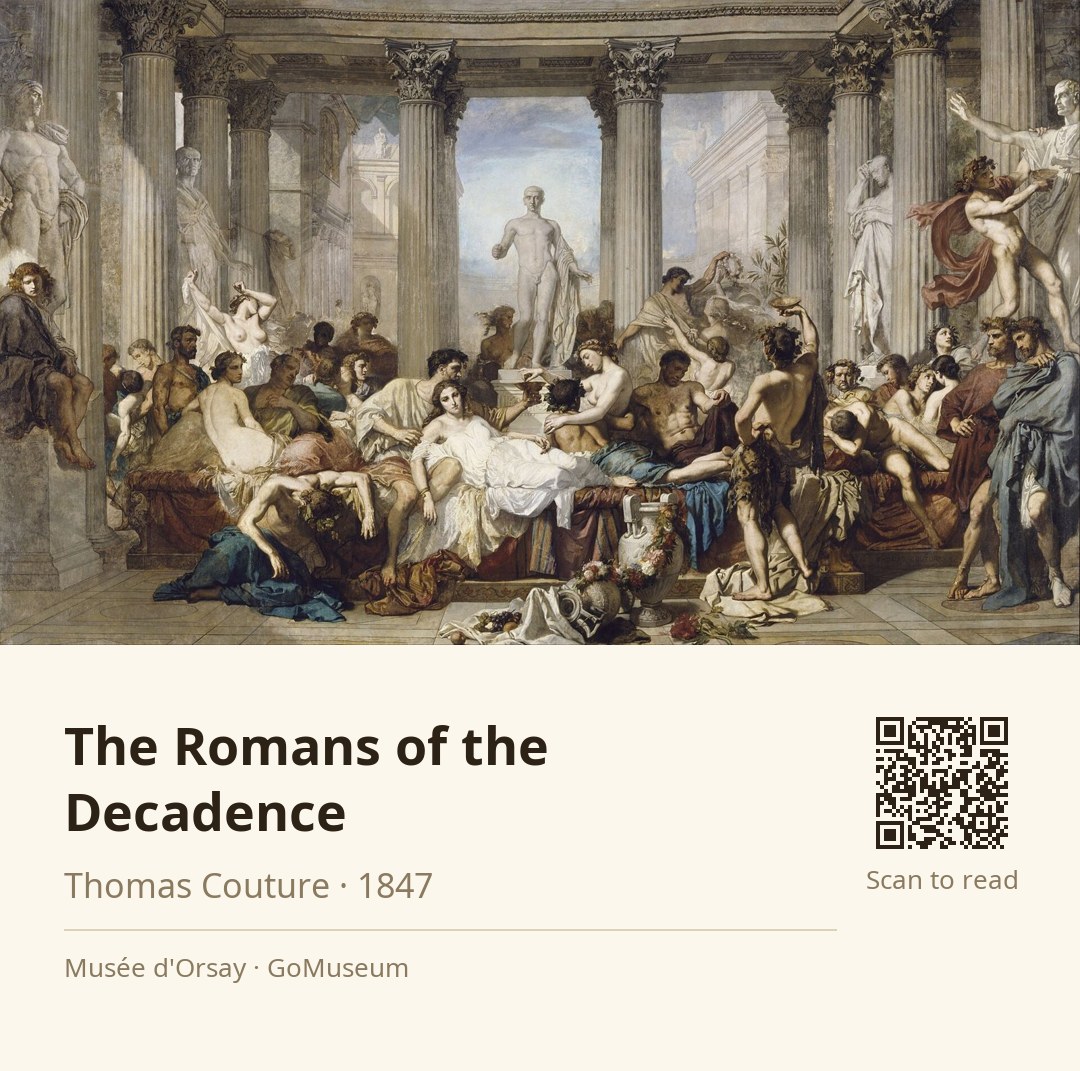
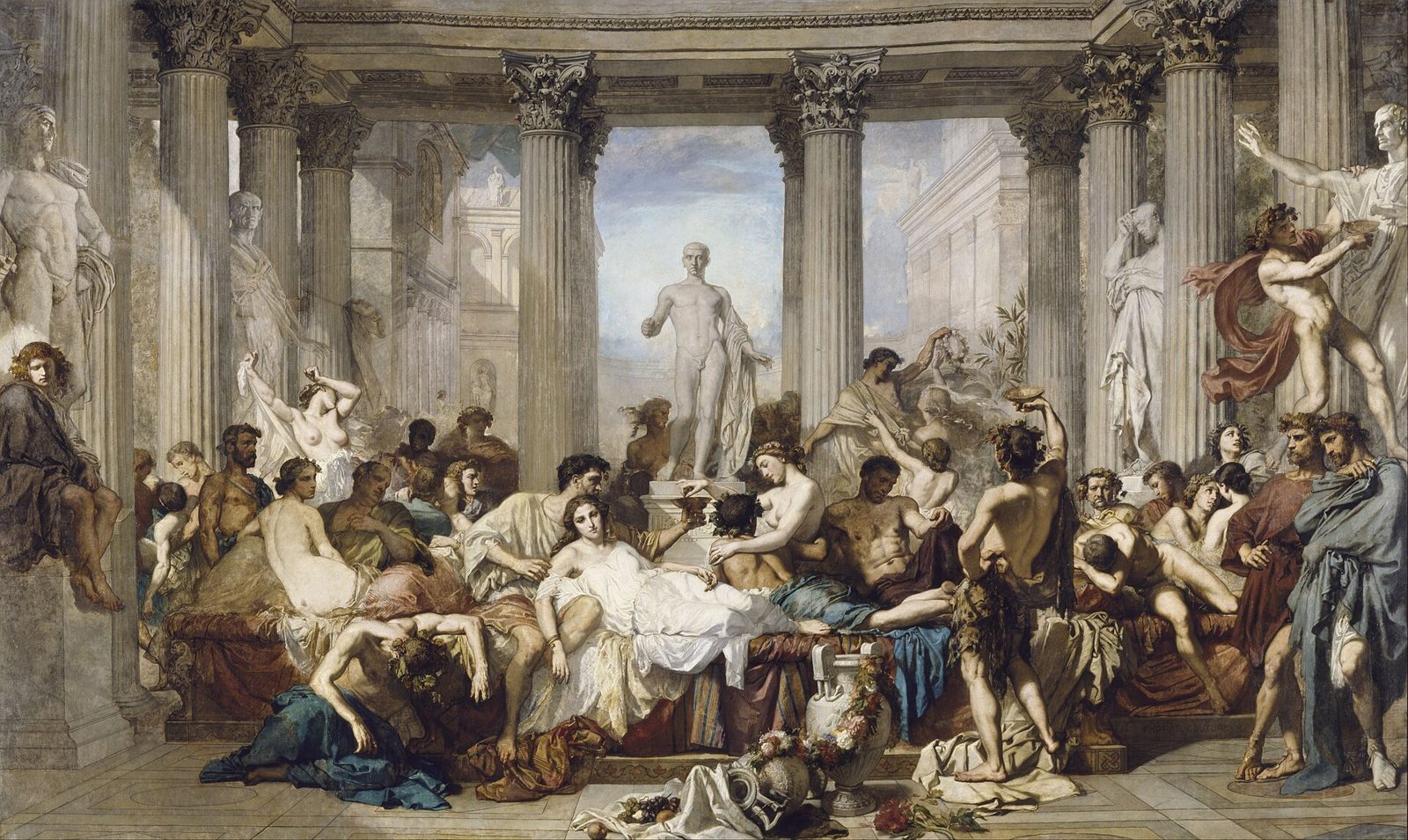
🎧 This work has audio narration — listen in the appTake a moment to really soak in the scene before you. Thomas Couture's "The Romans of the Decadence" is a vivid portrayal of excess and moral decay, capturing a raucous banquet that feels almost alive. Notice the figure on the right, drunkenly addressing a statue, his arm draped over it in a gesture of disrespect. And just to the left, a contemplative young boy sits apart from the chaos, a stark contrast to the revelry around him. These details matter because they tell a story of decline—Couture is not just depicting a party; he’s critiquing the very essence of a society lost to luxury and indulgence. The statues of gods and emperors loom over the scene, a reminder of a once-great civilization now reduced to this debauchery. It’s a powerful commentary on the dangers of excess, echoing the sentiments of the Roman poet Juvenal, who lamented the moral failings of his time. Created in 1847, just before the upheaval of the 1848 Revolution in France, Couture’s work reflects the anxieties of his own society, mirroring the decline he saw around him. This painting was celebrated at the Paris Salon, yet it also faced harsh criticism for its bold message. As you stand here, think about how this scene resonates today. What does it say about our own relationship with excess and indulgence? How do we balance pleasure with responsibility in our lives?
Thomas Couture was a prominent French history painter and educator born on December 21, 1815, in Senlis, France. He moved to Paris at a young age, where he studied at the École des Beaux-Arts under notable artists. Despite facing early setbacks, including six failures in the Prix de Rome competition, Couture eventually won the prize in 1837, marking the beginning of his successful career.
Couture gained recognition for his historical and genre paintings, particularly his masterpiece "Romans During the Decadence," which earned him several accolades at the Paris Salon. In 1848, he opened an independent atelier, mentoring many future luminaries of the art world, including Édouard Manet and Henri Fantin-Latour. His innovative techniques and commitment to teaching challenged the traditional academic norms of his time.
Despite his initial successes, Couture faced criticism for his later mural commissions, leading him to retreat from Paris in 1860 to continue teaching in Senlis. His 1867 publication, "Méthode et entretiens d'atelier," outlined his artistic philosophy, emphasizing the importance of personal expression in art. Couture passed away on March 30, 1879, leaving behind a legacy as a significant figure in 19th-century art, both as a creator and an educator. His influence is evident in the works of his students, who would go on to shape the future of modern art.
Thomas Couture's 'The Romans of the Decadence' was unveiled in 1847 at the Paris Salon, where it quickly became a sensation, capturing the attention of critics and the public alike. The work was celebrated for its audacity, yet it also faced backlash; Napoleon III saw it as a direct critique of his regime, leading to a harsh condemnation. Over the years, it was showcased at several prestigious exhibitions, including the 1855 Exposition Universelle and the 1880 Thomas Couture exhibition at the Palais de l'Industrie. Today, it resides in the Musée d'Orsay, a testament to its enduring legacy.
As you gaze at 'The Romans of the Decadence,' notice how Couture masterfully employs subdued colors to evoke a sense of decay and exhaustion. The brushwork is both meticulous and expressive, capturing the languid forms of the figures sprawled across the banquet scene. The composition is structured around a dynamic interplay of light and shadow, enhancing the drama of the moment. The statues of gods and emperors stand sentinel, their stoic presence contrasting sharply with the chaos of the revelers. Couture's choice to depict the human body in various states of repose and activity adds a layer of realism, inviting you to feel the weight of indulgence and the consequences of excess. This painting is not just a visual feast; it's a visceral experience that pulls you into the heart of its narrative.
Debuting at the Paris Salon in 1847, it was hailed for its bold representation of moral decay, echoing the sentiments of the time just before the 1848 Revolution. The way Couture juxtaposed the revelry of the Roman elite with the grandeur of classical architecture challenged viewers to reflect on their own society's vices. It remains a powerful commentary on decadence, reminding us that the allure of luxury can lead to downfall—a theme that resonates through art history even today.
When it debuted at the Paris Salon in 1847, it was hailed as one of the most acclaimed works of the year. But it also caught the ire of none other than Napoleon III, who saw it as a direct critique of his regime. Couture's vivid depiction of excess and moral decay in ancient Rome was interpreted as a reflection of contemporary French society, making it a hot topic of discussion and debate. Imagine the tension in the air as viewers pondered the implications of this artwork during a time of political upheaval!
The painting was one of the most critically successful works at the 1847 Paris Salon, celebrated for its audacity, but it also faced harsh criticism, particularly from Napoleon III, who viewed it as a direct critique of his regime.
Couture taught several prominent artists, including Édouard Manet and Henri Fantin-Latour, who would go on to shape the future of art, suggesting that Couture's influence extended beyond his own works.