 Image: Pierre Auguste Renoir (1841 - 1919) – Painter (French) Born in Limoges. Died in Cagnes-sur-Mer. Details on Google Art Project
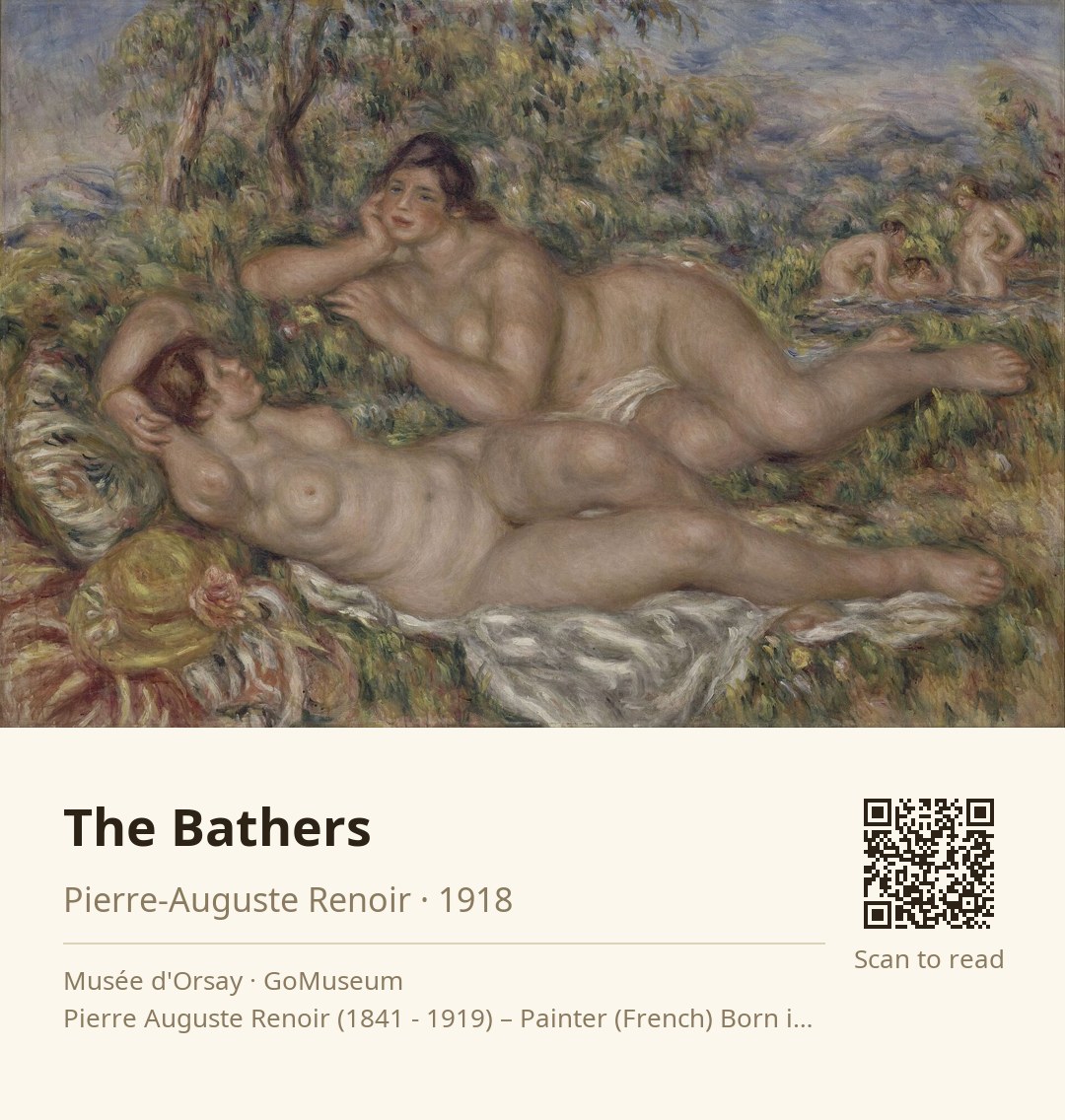
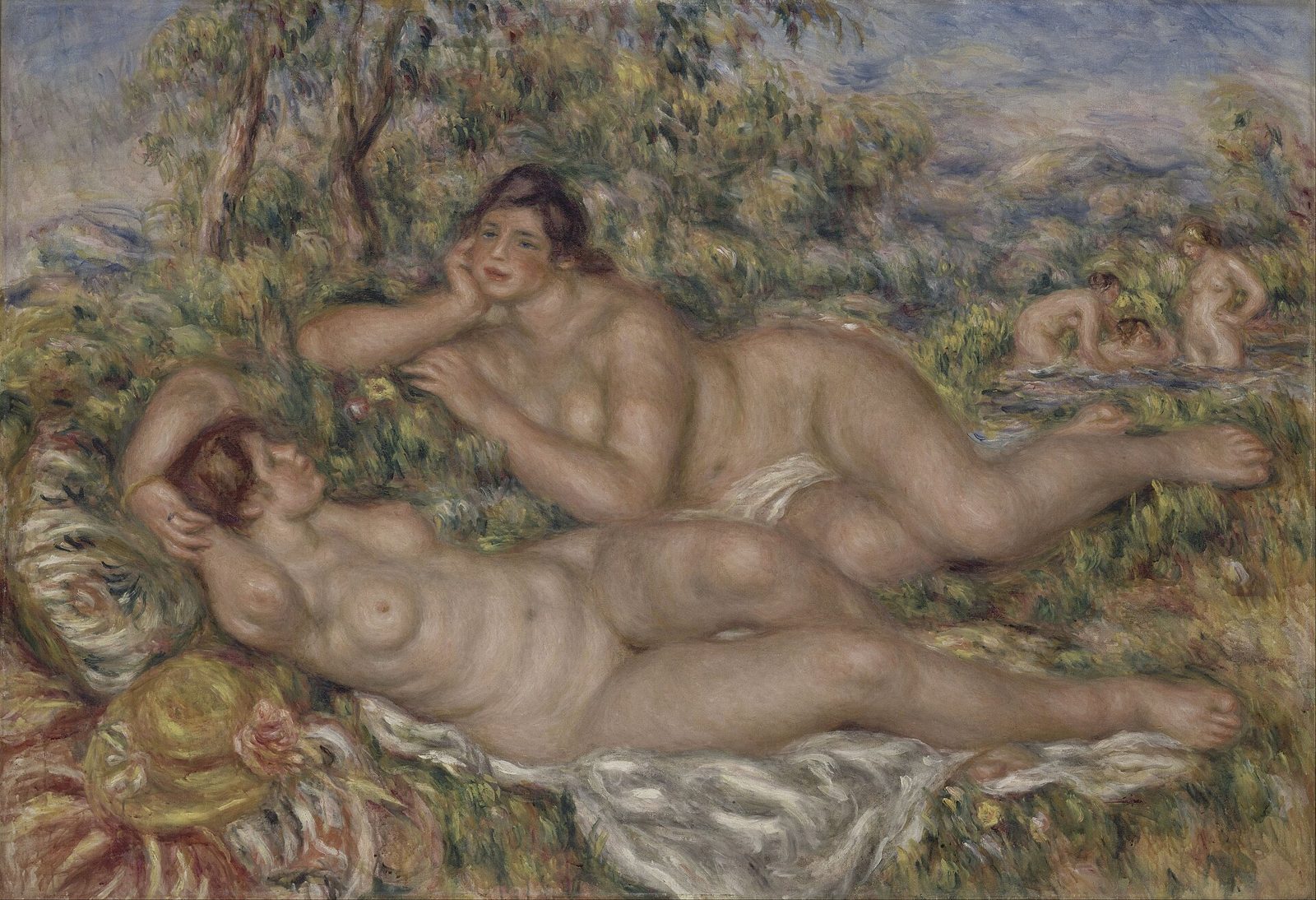
Take a moment to soak in the vibrant scene before you in Renoir's "The Bathers." Notice how the two women in the foreground seem to melt into the lush greenery around them, their bodies almost merging with the surrounding nature. Look closely at the way the sunlight dances on their skin, casting soft shadows that highlight the curves and contours of their forms. These details matter because they reflect Renoir's deep appreciation for the beauty of the human body and its connection to the natural world. Painted in 1918, this piece captures a sense of freedom and tranquility, a celebration of life at a time when the world was grappling with turmoil. The women here are not just bathers; they embody a timeless spirit of joy and liberation, inviting you to step into their serene moment. Renoir, a leading figure of Impressionism, created this work during his later years, a period marked by a desire to escape contemporary chaos and embrace the simplicity of beauty. The models, including Andrée Hessling, who would later become his daughter-in-law, add a personal touch to this idyllic scene. As you stand here, think about the sense of peace that this painting evokes. What does it mean to you to find beauty in nature and the human form? Let that question linger as you take in the warmth of the sun and the lushness of the surroundings, just as Renoir intended.
Pierre-Auguste Renoir, born on February 25, 1841, in Limoges, France, emerged as a pivotal figure in the Impressionist movement. His early life in a modest family led him to Paris, where he honed his artistic skills amidst the masterpieces of the Louvre. Initially apprenticed in a porcelain factory, Renoir's passion for painting flourished, particularly after studying under Charles Gleyre, where he befriended fellow artists like Monet and Sisley.
Renoir's work celebrated feminine beauty and vibrant social scenes, exemplified in iconic pieces like "Dance at Le Moulin de la Galette." Despite facing criticism early on, he gained recognition, especially after participating in the first Impressionist exhibition in 1874. His style evolved over the years, transitioning towards realism influenced by classical masters like Raphael.
Throughout his life, Renoir balanced personal struggles, including health issues, with a prolific output, reportedly creating around four thousand works. He became a beloved figure in art history, known for his warm palette and expressive brushwork. Renoir passed away on December 3, 1919, leaving a legacy that continues to inspire artists and art lovers alike.
Renoir's "The Bathers" was painted between 1918 and 1919, during a time when the artist was seeking solace from the chaos of the world around him. This piece is one of his last works, a testament to his lifelong love for the beauty of the human form and nature. The painting was gifted to the French state by Renoir's three sons in 1923, and it now resides in the Musée d'Orsay, a fitting home for this iconic piece. It was exhibited at the Grand Palais in Paris in 1985, where it was well-received, showcasing the enduring appeal of Renoir's work even decades after his passing.
As you gaze at "The Bathers," take a moment to appreciate Renoir's masterful brushwork. The way he applies paint creates a sense of movement and life, almost as if the figures are breathing within the lush greenery. Notice how he uses light to sculpt the forms of the women, with soft highlights and gentle shadows that enhance their curves. The composition is structured yet fluid, guiding your eye from the foreground to the background, where more bathers are nestled among the trees. The vibrant colors, particularly the greens and the warm skin tones, evoke a sense of harmony and tranquility. Renoir's choice to eliminate any modern elements allows the scene to feel timeless, inviting you to escape into this serene moment. The scale of the painting, at 110 by 160 centimeters, envelops you, making you feel as if you could step right into the garden.
One intriguing aspect of 'The Bathers' is its connection to Renoir's family. The model for the two women in the foreground is Andrée Hessling, who would later become the first wife of Renoir's son, Jean.
The natural setting depicted in the painting is actually the large garden of Renoir's own home in Cagnes-sur-Mer, which he cherished as a personal retreat and source of inspiration.
Upon its exhibition, the painting received criticism for the perceived 'enormousness' of the women's limbs and the unconventional pinkish tones of their skin, highlighting the challenges Renoir faced in his later career.