A Modern Olympia
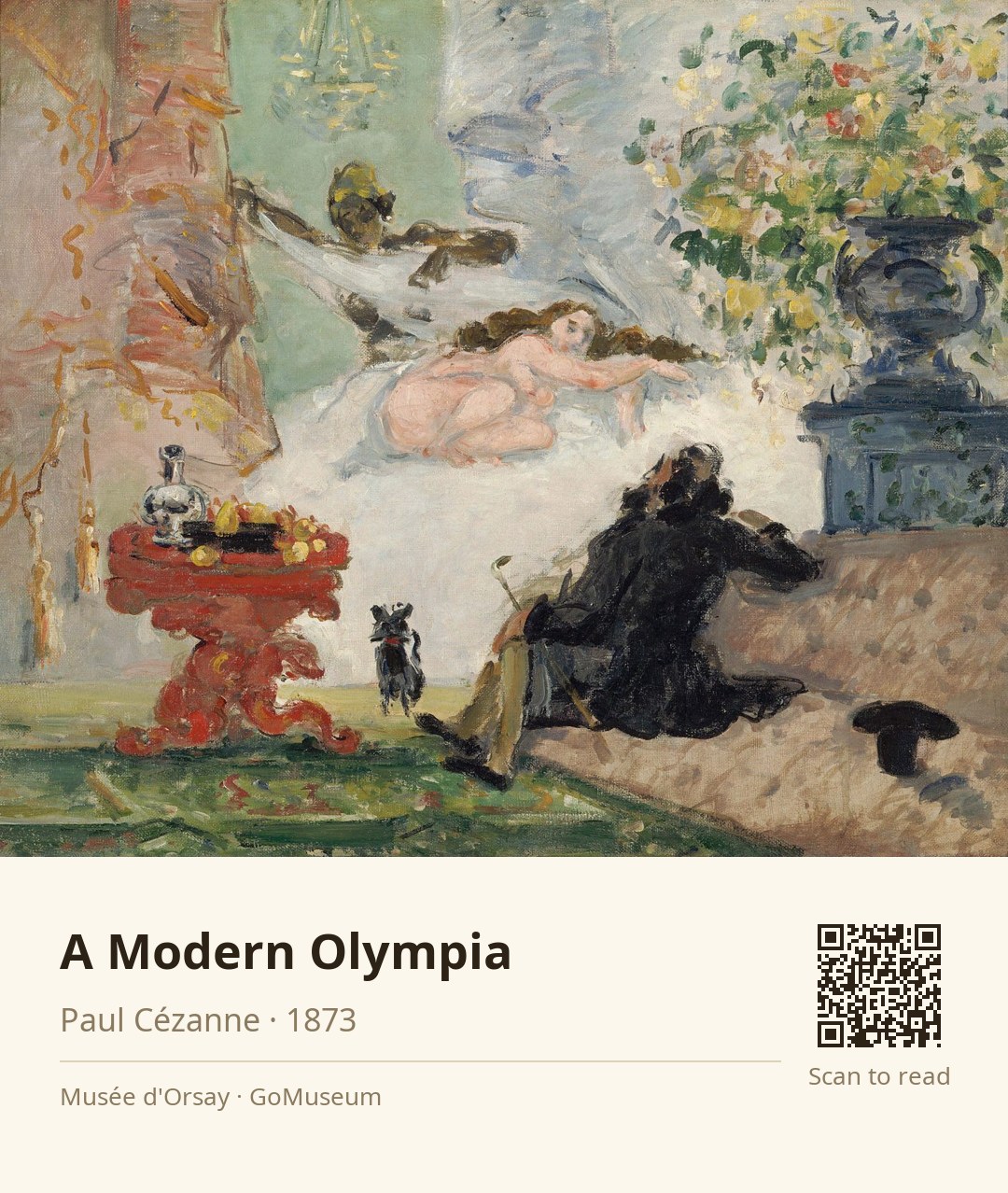
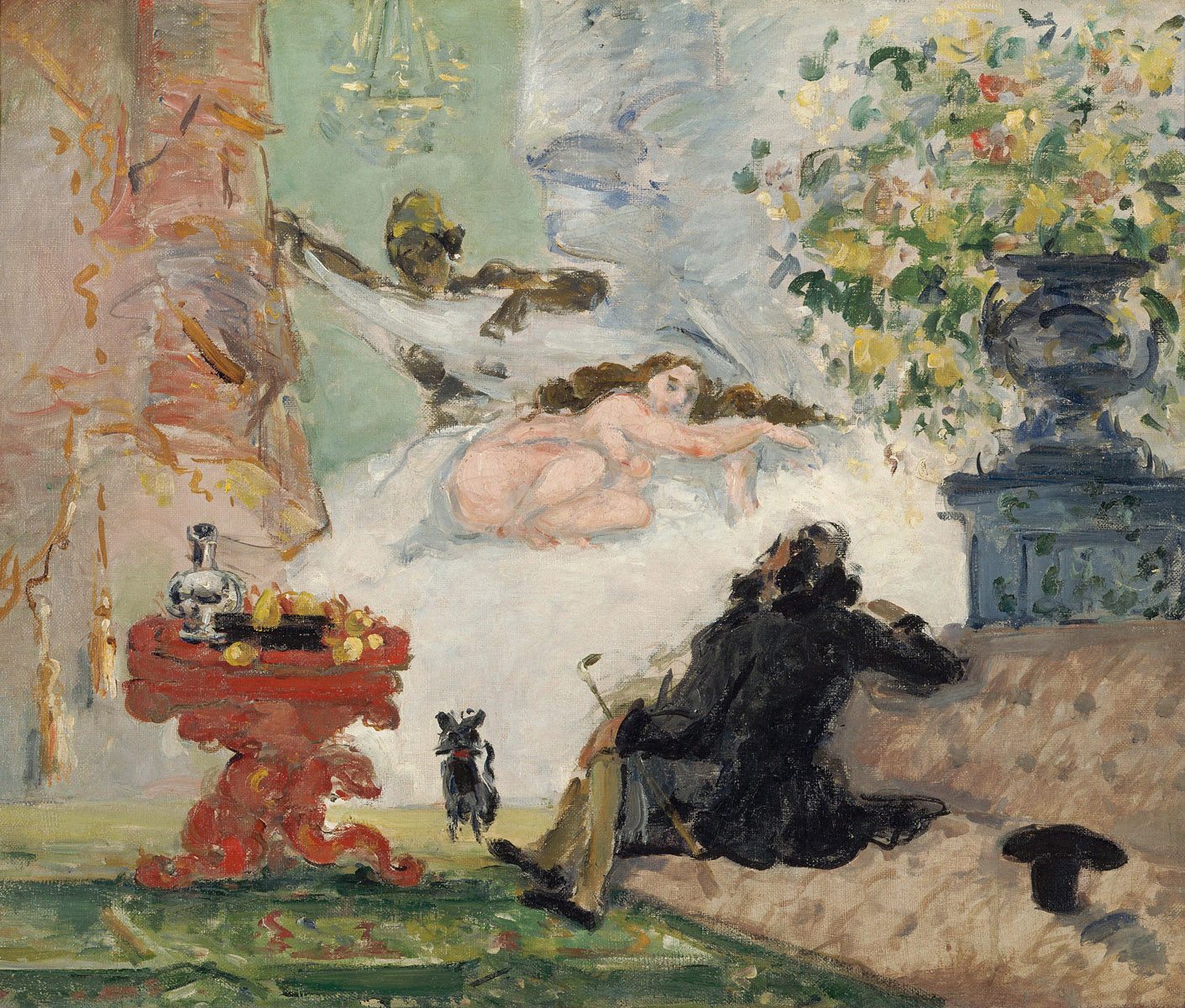
🎧 This work has audio narration — listen in the appTake a moment to really look at Paul Cézanne's "A Modern Olympia." Notice how the woman reclines, her body relaxed yet assertive, while the man in the background, possibly a self-portrait of Cézanne himself, gazes at her. The contrast between their positions is striking—she is the focus, yet he is present, a reminder of the societal roles at play.
This detail is crucial because it flips the narrative established by Édouard Manet in his original "Olympia." Here, Cézanne not only pays homage but also challenges the viewer to reconsider the dynamics of power and representation in art. The bold brushstrokes and vibrant colors breathe life into the scene, hinting at the emotional depth that would later influence the Expressionist movement.
Cézanne created this piece in 1873, inspired by a conversation with Dr. Paul Gachet, who encouraged him to respond to Manet's provocative work. It was a bold move for an artist still finding his voice, and this painting marked a significant step in his journey.
As you stand here, think about how this painting not only reflects the past but also speaks to ongoing conversations about gender and power. What does it say to you today?
Paul Cézanne was a French Post-Impressionist painter born on January 19, 1839, in Aix-en-Provence. His innovative approach to color and form bridged the gap between Impressionism and the emerging Cubism of the early 20th century. Initially influenced by Romanticism and Realism, Cézanne developed a unique style that emphasized the underlying structure of objects, using repetitive brushstrokes and planes of color to create depth and complexity in his work.
Despite facing ridicule and misunderstanding from critics during his early career, Cézanne garnered support from fellow artists like Camille Pissarro and the art dealer Ambroise Vollard, who recognized his talent. His first solo exhibition in 1895 marked a turning point, leading to greater appreciation of his contributions to art. Cézanne's legacy is profound; both Henri Matisse and Pablo Picasso acknowledged him as a foundational figure in modern art, dubbing him "the father of us all." He passed away on October 22, 1906, leaving behind a transformative body of work that continues to influence artists today.
Paul Cézanne's 'A Modern Olympia' was painted in 1873, during a pivotal time in his artistic journey. This work was inspired by a conversation with Dr. Paul Gachet, an eccentric physician and art enthusiast who encouraged Cézanne to respond to Édouard Manet's controversial 'Olympia.' Gachet's challenge spurred Cézanne to create his homage, which he initially painted in a more muted palette before embracing vibrant colors in this version. The painting was first exhibited at the inaugural Impressionist Exhibition in Paris in 1874, where it faced mockery from critics and visitors alike. Despite its small size, it drew more derision than any other piece at the show. Gachet was not only the first owner but also lent the painting back to Cézanne for the exhibition, marking a significant moment in the artist's career as it was the first painting he ever sold. The work later became part of the collection at the Musée d'Orsay in Paris, where it remains today.
When you look at 'A Modern Olympia,' notice how Cézanne's brushwork feels both bold and restless. He employs broad strokes that create a dynamic texture, giving life to the figures and the space around them. The colors are strikingly bright, especially compared to his earlier, more muted version of the same subject. This choice not only enhances the emotional intensity of the scene but also aligns with the Impressionist ethos of capturing light and atmosphere. The composition is carefully structured; the reclining woman is framed by the man in the background, drawing your eye to the contrast between their postures. The use of color, particularly the reds and greens, creates a vibrancy that pulls you into the painting, while the placement of the dog and decorative elements adds layers of interest. The scale of the painting, though modest, invites a personal engagement, making the viewer feel almost part of the intimate moment.
At the inaugural Impressionist Exhibition in 1874, 'A Modern Olympia' faced significant mockery and derision from critics and visitors, more so than any other piece in the show, highlighting the controversial nature of Cézanne's approach.
Despite its cat-like appearance, the dog in 'A Modern Olympia' is indicated by its red collar, which serves as a subtle reminder of the artist's attention to detail and the playful contrasts within the composition.