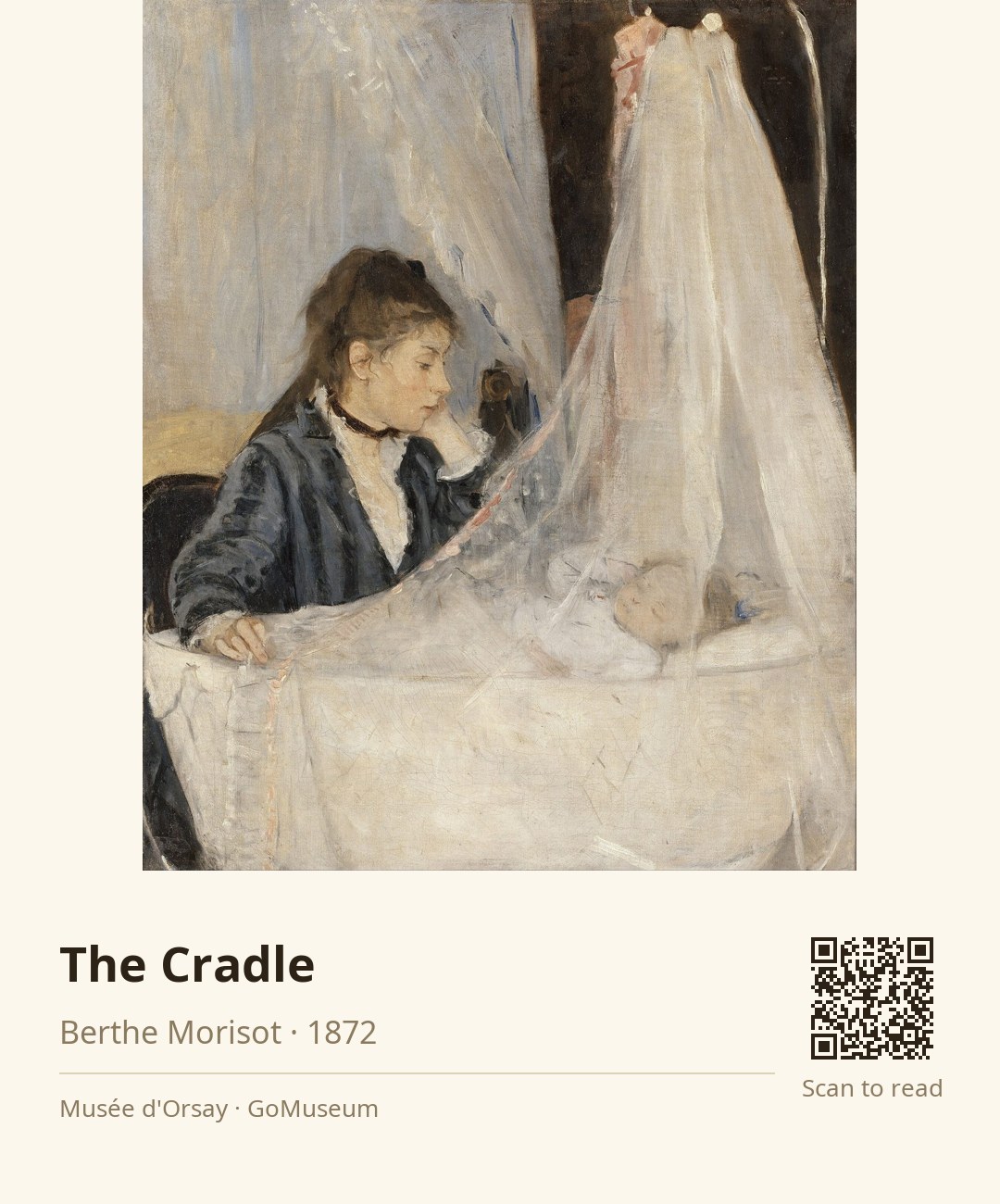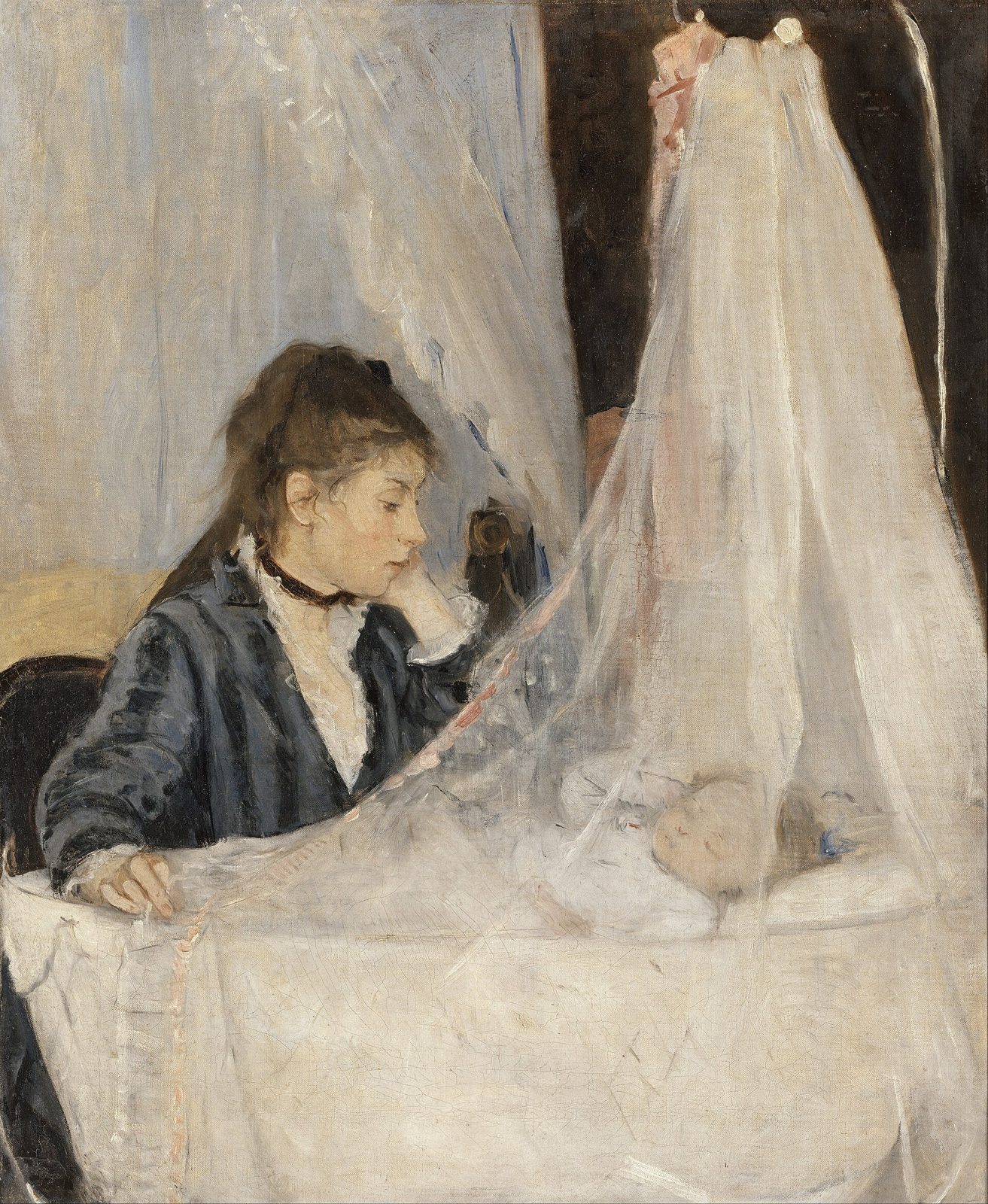
Take a moment to really look at "The Cradle" by Berthe Morisot. Notice how the soft, flowing brushstrokes create a sense of intimacy between the mother and her sleeping child. The way the mother leans forward, her arm gently resting, almost cradling the air around her baby, speaks volumes about the tenderness of motherhood.
This detail is crucial because it captures a moment of quiet love and protection, a theme that Morisot would explore throughout her career. By focusing on this intimate scene, she invites us into a private world, contrasting the often chaotic public life of the 19th century.
Painted in 1872, this piece was part of the first Impressionist exhibition in 1874, where it was initially overlooked. Yet, Morisot's work stands out for its emotional depth and subtlety, setting a precedent for how motherhood could be depicted in art.
As you stand here, think about the connection between the artist and her sister, who modeled for the painting, and the little girl who slept in that cradle—Blanche, Morisot's niece. What stories do you think this painting could tell if it could speak?
Berthe Morisot was a pioneering French painter born on January 14, 1841, in Bourges. Coming from an affluent family, she received a private art education alongside her sisters, fostering a deep passion for painting. Morisot first exhibited her work at the Paris Salon in 1864 and became a key figure in the Impressionist movement, participating in nearly all of its exhibitions from 1874 to 1886. Her innovative approach, characterized by light brushwork and a focus on domestic life and women’s experiences, distinguished her in a male-dominated art world. Married to Eugène Manet, brother of fellow artist Édouard Manet, she maintained close relationships with prominent Impressionists like Monet and Renoir. Art critic Gustave Geffroy recognized her as one of the three great ladies of Impressionism, alongside Mary Cassatt and Marie Bracquemond. Morisot's legacy endures as she broke barriers for women in art, leaving an indelible mark on the Impressionist movement before her death on March 2, 1895.
Berthe Morisot's "The Cradle" was painted in 1872 and first exhibited at the inaugural Impressionist exhibition in 1874. The event took place in the former studio of the photographer Nadar on Boulevard des Capucines in Paris. Although some critics praised its grace, it was largely overlooked, and Morisot struggled to sell it, pricing it at 800 francs. The painting remained within her family, eventually passed down to her niece, Blanche Portillon, who was also the model for the sleeping child. In 1930, the French state acquired it for the Louvre, and it later found its home at the Musée d'Orsay after the museum's establishment in 1986.
In "The Cradle," Morisot employs a fluid brushwork that creates an intimate atmosphere, drawing the viewer into the tender moment between mother and child. The composition is cleverly structured around a diagonal line formed by the mother's gaze and the crib's fabric, which is echoed by the bent arms of both figures. This visual connection enhances the emotional depth of the scene. Morisot's choice of a limited color palette, with soft whites and gentle pastels, contributes to the painting's serene quality. The brushstrokes are loose yet deliberate, allowing the viewer to feel the softness of the baby's features and the protective presence of the mother. The overall effect is one of warmth and closeness, a hallmark of Morisot's exploration of domestic life and motherhood.
She was the only female artist to exhibit in the first Impressionist exhibition, and her marriage to Eugène Manet, brother of Édouard Manet, further intertwined her life with the prominent figures of the movement. Despite facing societal pressures, Morisot remained committed to her art, often depicting the lives of women and children, which was a radical departure from the male-dominated themes of her contemporaries.
At the inaugural Impressionist exhibition in 1874, 'The Cradle' was largely overlooked, receiving only a few praises for its grace, which reflected the challenges Morisot faced in gaining recognition as a female artist in a male-dominated art world.
After failing to sell 'The Cradle', Morisot kept it within her family, and it eventually passed to her niece, Blanche Portillon, who was also the model for the sleeping child, before being acquired by the French state in 1930.
Morisot's use of fluid brushwork in 'The Cradle' not only creates an intimate atmosphere but also showcases her ability to evoke softness and tenderness, which was a significant departure from the more rigid techniques of her contemporaries.