Paysannes bretonnes
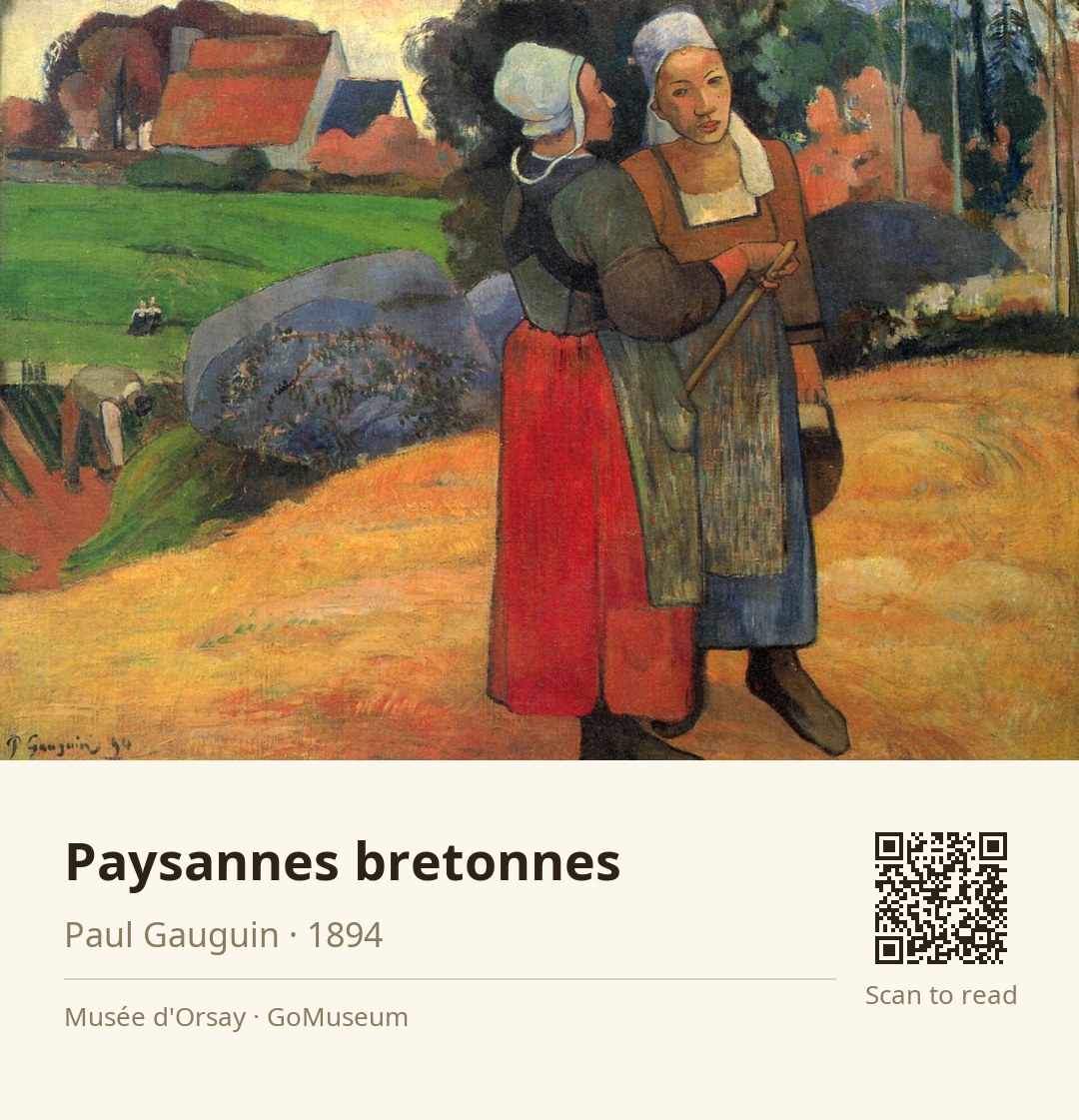
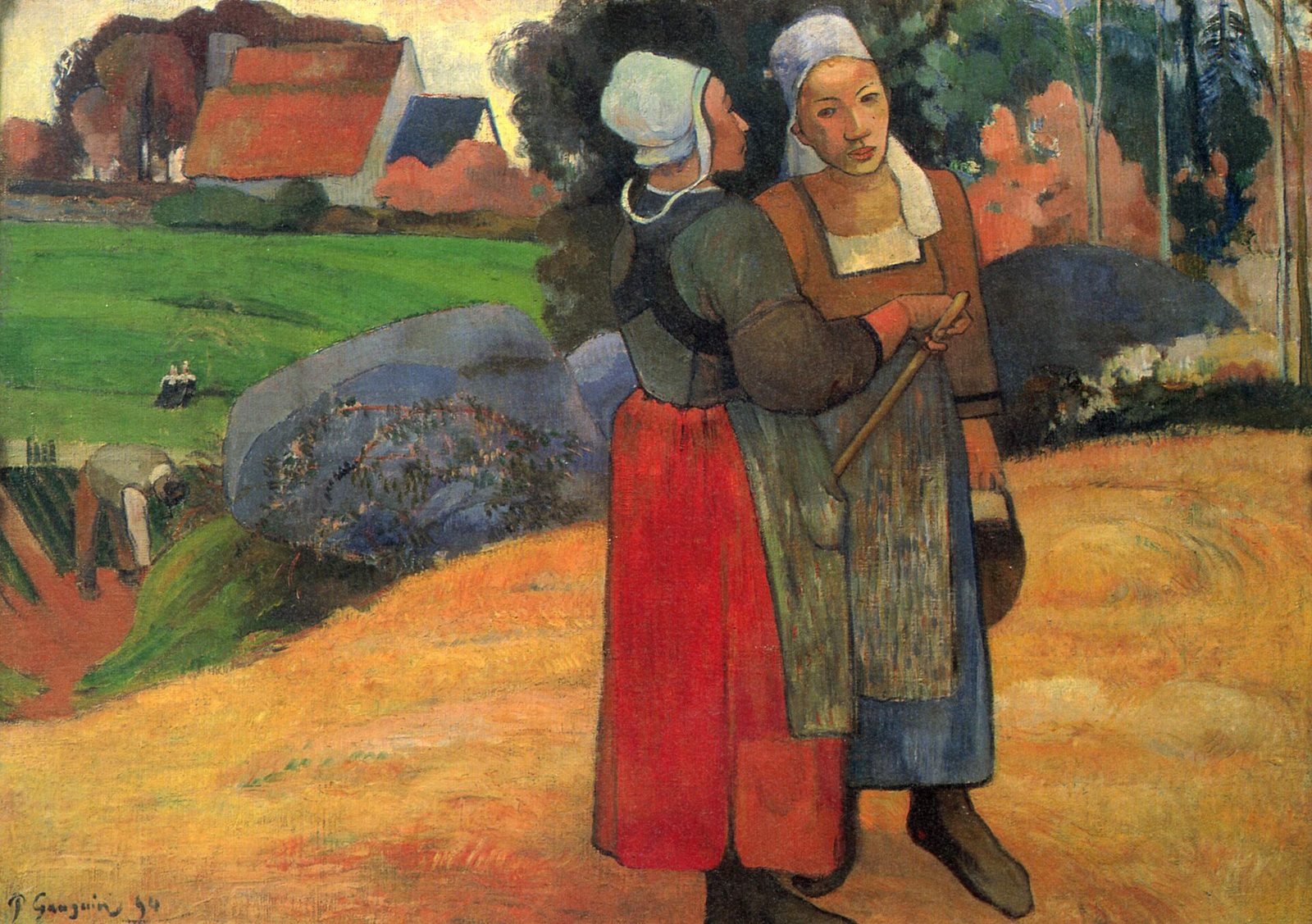
🎧 This work has audio narration — listen in the appLook closely at this painting, "Paysannes bretonnes," and you’ll see two women deeply engaged in conversation. Notice how their bodies lean toward each other, almost as if they’re sharing a secret. Their traditional Breton attire, with those striking white bonnets, isn’t just a fashion statement; it reflects their identity and the cultural heritage of Brittany.
These details matter because they reveal Gauguin’s fascination with the lives of ordinary people, elevating their everyday moments to something profound. He captures not just their appearance but the essence of their existence, a theme that resonates throughout his work.
Created in 1894, during a period when Gauguin was transitioning between his experiences in Brittany and Tahiti, this piece showcases his evolving style. The brushwork is bold, and the colors are rich, hinting at the emotional depth he sought to convey.
As you stand here, think about the stories these women might be sharing. What do you imagine their lives are like? What secrets might they hold? Let their conversation spark your own reflections on connection and community.
Eugène Henri Paul Gauguin was a French artist born on June 7, 1848, in Paris. His early life in Peru, where he experienced a privileged childhood, deeply influenced his artistic vision. Initially a stockbroker, Gauguin turned to painting full-time after a financial crisis in 1882. He was largely self-taught, drawing inspiration from his connections with artists like Camille Pissarro, who introduced him to Impressionism.
Gauguin's work evolved into a distinct style characterized by bold colors and symbolic themes, diverging from traditional Impressionism. His time in Brittany and later in Tahiti marked significant phases in his career, where he sought to capture the essence of native life and spirituality. Despite struggling with health and financial issues in his later years, his art gained recognition posthumously, largely due to the efforts of art dealer Ambroise Vollard.
Today, Gauguin is celebrated as a key figure in Post-Impressionism and a precursor to modern art, influencing artists like Picasso and Matisse. His exploration of color and form continues to resonate, securing his place in art history as a visionary who sought to transcend the confines of Western civilization.
In 1894, Paul Gauguin created 'Paysannes bretonnes,' a painting that reflects his deep connection to the rural life of Brittany. This piece was born during a pivotal time in Gauguin's career, as he was transitioning from his experiences in Brittany to his later explorations in Tahiti. The painting was first exhibited in 1938 at the Max Kaganovitch Gallery in Paris, where it was part of a selection of works from the 19th and 20th centuries. Over the years, it has traveled through various exhibitions, including a notable showing at the Tate Gallery in London in 1955. The painting's provenance traces back to the influential art dealer Ambroise Vollard, who played a crucial role in promoting Gauguin's work during his lifetime and posthumously. This connection to Vollard is significant, as it helped elevate Gauguin's status in the art world, leading to a lasting legacy that continues to resonate today.
As you gaze at 'Paysannes bretonnes,' take a moment to appreciate Gauguin's bold brushwork. The strokes are thick and expressive, almost as if he is sculpting the forms of the women rather than merely painting them. Notice how he employs a rich palette, with deep greens and vibrant reds that create a striking contrast against the more muted tones of the women's clothing. This choice of color not only captures the essence of the Breton landscape but also infuses the scene with emotional depth. The composition is carefully structured, drawing your eye toward the intimate interaction between the two women. Their bodies lean in, creating a sense of closeness that invites you to eavesdrop on their conversation. The scale of the painting, at nearly 66 by 92.5 centimeters, allows for a detailed exploration of these figures, making their presence feel almost monumental. Gauguin's technique here is a dance between realism and abstraction, where the essence of the moment is captured through a lens of vivid imagination.
Just before creating this piece in 1894, he had spent significant time in Tahiti, where the vibrant colors and exotic landscapes deeply influenced his style. Yet, here he returns to Brittany, capturing the essence of rural life. It's fascinating to think about how he blended his Tahitian experiences with the familiar landscapes of his homeland, creating a unique perspective that resonates in this painting.
Ambroise Vollard was a significant art dealer who played a crucial role in promoting Gauguin's work, including 'Paysannes bretonnes.' Vollard's efforts helped elevate Gauguin's status in the art world, ensuring that this painting and others gained recognition long after the artist's death.