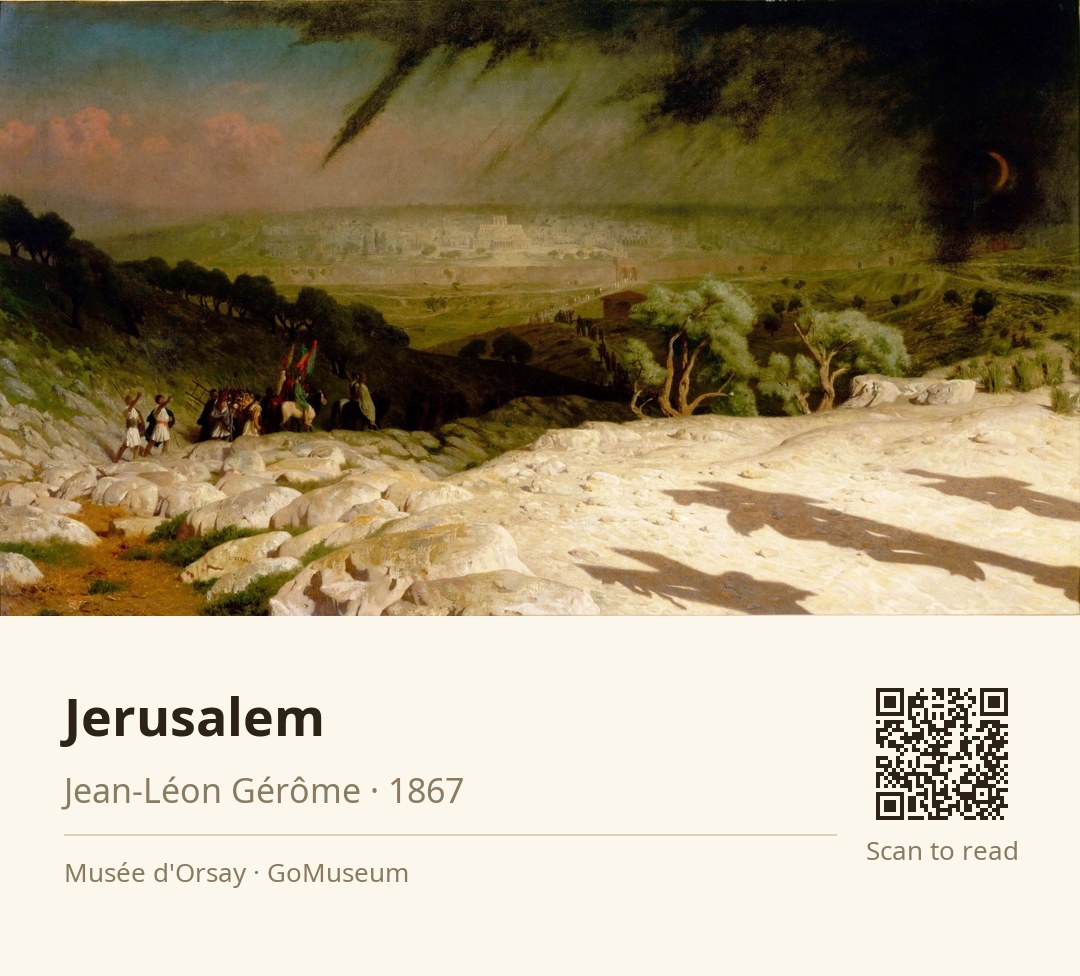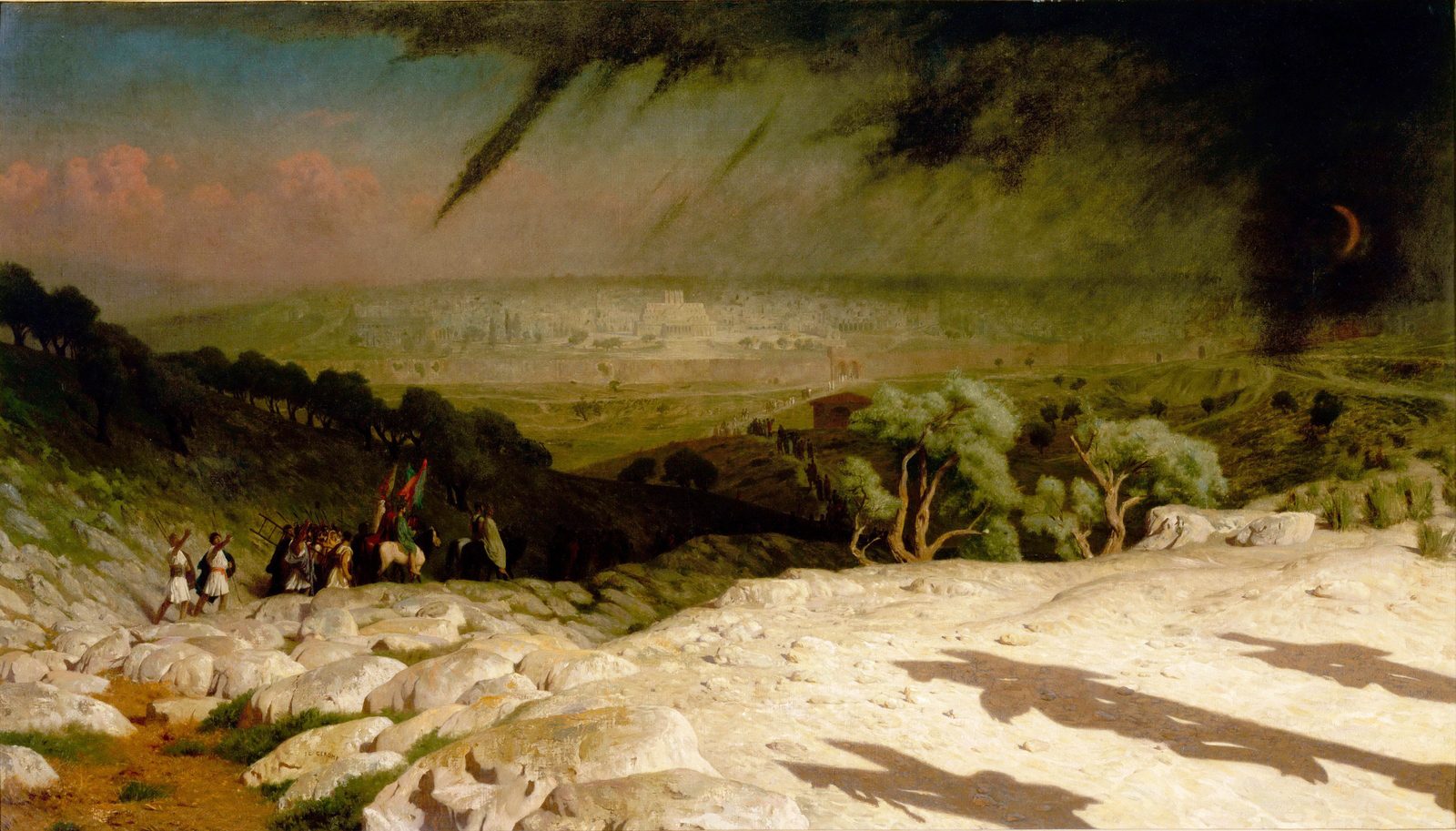
Take a moment to really absorb what you see in Jean-Léon Gérôme's "Jerusalem." Notice how the shadows of the three crucified figures dominate the foreground, their forms almost ghostly against the stark ground of Golgotha. Look at the crowd in the background, retreating through the vegetation, their faces obscured under a brooding sky.
These details matter because they shift the focus from the act of crucifixion itself to its aftermath, inviting you to ponder the weight of what has just occurred. Gérôme captures not just a moment of violence, but the lingering impact it has on the world around it. This approach was quite revolutionary for its time, moving away from traditional depictions of martyrdom to a more contemplative scene that engages viewers on a deeper level.
Created in 1867, this painting marked Gérôme's return to historical themes after a period of exploring Orientalism. Influenced by contemporary texts like Ernest Renan's "Life of Jesus," he chose to depict the scene in a way that feels almost cinematic, drawing you into the emotional gravity of the moment without showing the violence directly.
As you stand here, think about how this painting invites you to reflect on the nature of suffering and redemption. What feelings does it stir in you? What stories do you think the figures in the background might carry as they turn away from this pivotal moment in history?
Jean-Léon Gérôme, born on May 11, 1824, in Vesoul, France, was a prominent painter and sculptor known for his academic style. He gained fame in the mid-19th century, becoming arguably the most celebrated artist of his time. Gérôme's work spanned various genres, including historical, mythological, and Orientalist themes, showcasing his meticulous attention to detail and vibrant compositions. His early education in drawing laid the foundation for his artistic journey, which included studies under notable mentors in Paris.
Gérôme's career flourished after his debut at the Paris Salon in 1847, where his painting "The Cock Fight" garnered critical acclaim. He became a leading figure in the Neo-Grec movement and later embraced Orientalism after travels to Egypt and the Ottoman Empire. His works often depicted exotic scenes, blending accurate architectural details with idealized figures. As a teacher at the École des Beaux-Arts, he influenced a generation of artists, including Mary Cassatt and Thomas Eakins.
Despite his initial success, Gérôme's resistance to modern movements like Impressionism led to a decline in his reputation after his death on January 10, 1904. However, his art experienced a revival in the late 20th century, inspiring filmmakers and continuing to be celebrated for its technical prowess and historical significance. With around 600 paintings and numerous sculptures, Gérôme remains a key figure in the academic art tradition of the Second Empire.
Jean-Léon Gérôme's "Jerusalem," painted in 1867, was a significant work that marked his return to historical themes after a period focused on Orientalism. The painting was first shown at the Salon of 1868 in Paris, where it received mixed reviews, with critics noting its unconventional approach. It was later exhibited at the Royal Academy Exhibition of 1870 in London. The painting's journey continued as it changed hands several times, eventually being sold by Goupil & Cie to the New York firm Knoedler for a hefty 30,000 francs in 1871. By 1990, it was auctioned at Christie's in New York and subsequently acquired by the Musée d'Orsay, where it remains today.
Gérôme's technique in "Jerusalem" is strikingly innovative for its time. Instead of depicting the violence of the crucifixion directly, he focuses on the aftermath, using shadows to convey the presence of the crucified figures. The brushwork is meticulous, creating a stark contrast between the dark shadows of the crosses and the lighter tones of the ground. The composition is divided into three planes: the foreground with the shadows, the middle ground featuring the retreating crowd, and the background showcasing the city of Jerusalem under a brooding sky. This layering invites viewers to engage with the painting on multiple levels, almost as if they are part of the scene, witnessing the emotional weight of the moment. The cinematic quality of the composition draws you in, making you feel the gravity of the event without showing the act of violence itself.
An intriguing tidbit about "Jerusalem" is that it was initially met with severe criticism at its debut. Critics were baffled by Gérôme's choice to depict only the shadows of the crucified figures, which diverged sharply from the traditional iconography of the crucifixion.
At its debut at the Salon of 1868, 'Jerusalem' faced severe criticism, with many viewers baffled by Gérôme's unconventional choice to depict only the shadows of the crucified figures, which strayed from traditional iconography.
Despite its initial criticism, 'Jerusalem' later became a source of inspiration for filmmakers and artists, showcasing Gérôme's cinematic approach to composition that engaged viewers in a narrative without direct violence.
Gérôme's painting is notable for its three-plane composition, which layers the shadows of the crucified figures in the foreground, a retreating crowd in the middle ground, and the city of Jerusalem in the background, creating a dynamic sense of depth and engagement.