A Burial at Ornans
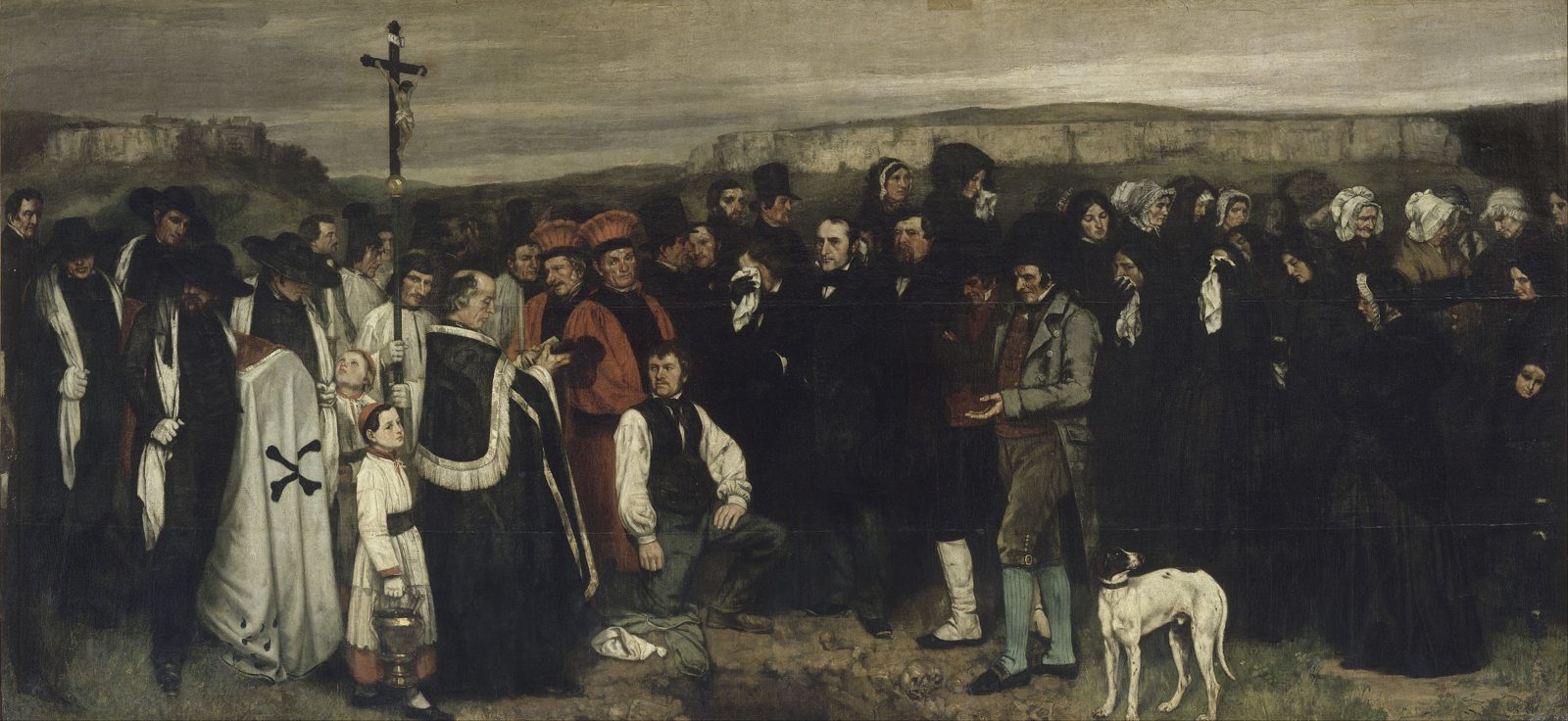
🎧 This work has audio narration — listen in the appAs you stand before "A Burial at Ornans," take a moment to really absorb the scene. Look closely at the faces of the mourners—each one tells a story of grief and community. Notice how they’re arranged in a loose but deliberate formation, almost like a living tapestry of sorrow. What’s striking here is the sheer scale of the painting. Courbet chose to depict an ordinary provincial funeral on a monumental canvas, a size typically reserved for grand historical or religious events. This was revolutionary for its time! By elevating a simple rural funeral to such heights, Courbet was making a bold statement about the dignity of everyday life and the importance of common people, challenging the art world’s norms. Created in 1841, this piece reflects not just personal loss—Courbet was likely inspired by the funeral of his grandfather—but also the social upheaval of 19th-century France. What does it say about the way we honor our loved ones? How does it reflect the community ties that bind us, even in moments of sorrow? Let this painting linger in your mind as a reminder of the beauty found in the ordinary.
Gustave Courbet, born on June 10, 1819, in Ornans, France, was a pioneering painter who championed the Realism movement in 19th-century art. Rejecting the conventions of academic painting and the idealism of Romanticism, he focused on depicting the world as he observed it, often portraying unidealized peasants and workers in monumental compositions. His early works gained recognition, notably "After Dinner at Ornans," which won him a gold medal at the Salon of 1849, allowing him to exhibit without jury approval.
Courbet's commitment to realism was revolutionary; he believed that art should stem from personal experience rather than historical or mythological themes. His bold approach often sparked controversy, challenging societal norms and addressing social issues, which resonated with later movements like Impressionism and Cubism. Despite facing criticism and imprisonment for his political involvement during the Paris Commune, Courbet continued to create until his death on December 31, 1877, in Switzerland.
His legacy endures as a transformative figure in art history, whose unflinching depictions of everyday life laid the groundwork for modern artistic expression. Today, Courbet is celebrated for his vigorous and uncompromising work, which continues to engage audiences with its raw honesty and depth.
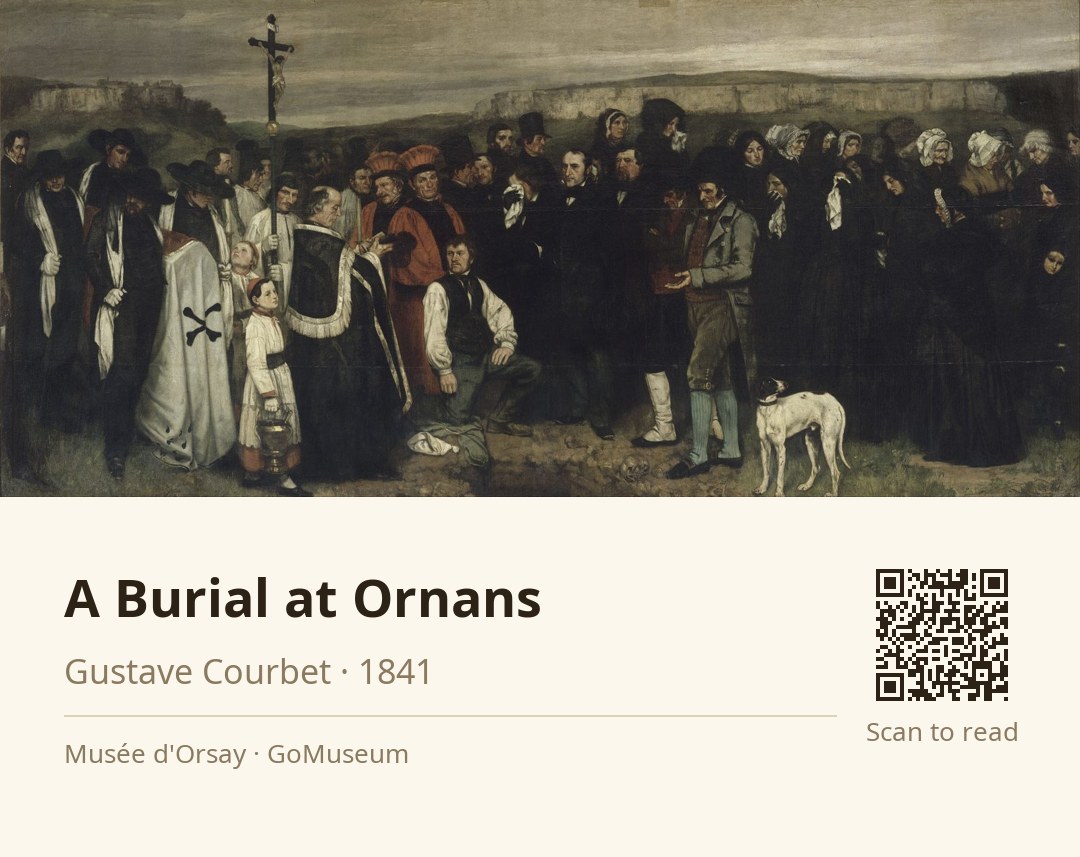
A Burial at Ornans, painted by Gustave Courbet between 1849 and 1850, is a monumental work that stirred a storm of controversy upon its debut at the Paris Salon in December 1850. At the time, Courbet was just 30 years old and had returned to his hometown of Ornans, a small town in France, to create this piece. The painting depicts a provincial funeral, a subject that was considered vulgar and trivial by critics of the era, who accused Courbet of portraying 'the ugly' and 'the ignoble.' This backlash only fueled the painting's notoriety, marking it as a defining work of realism and establishing Courbet as a leading figure in the movement. The painting was exhibited at the Salon des artistes français from 1850 to 1851, where it was assigned the number 661. After its explosive reception, it became a symbol of the artistic rebellion against the conventions of the time. Today, it resides in the Musée d'Orsay in Paris, where it continues to draw attention for its bold representation of ordinary life. The painting's provenance traces back to Courbet himself and later to Mlle Juliette, indicating its significance in the artist's legacy. It has been referenced in various catalogues, including those of the Louvre and Musée d'Orsay, highlighting its enduring impact on the art world.
In "A Burial at Ornans," Courbet employs a strikingly realistic style that captures the raw emotions of the funeral scene. The brushwork is bold and expressive, with a rough handling of paint that conveys the weight of the moment. Notice how the figures are arranged in a linear composition, creating a sense of depth and inviting the viewer to traverse the scene. The use of color is particularly notable; the somber blacks of the mourning attire contrast with the earth tones of the grave, emphasizing the gravity of death. Courbet's choice to depict the mourners at eye level, without hierarchies, reinforces the democratic nature of the painting. Each figure, from the priest to the villagers, is given equal importance, creating a collective experience of grief that resonates with the viewer. The unusual proportions of the canvas, much wider than tall, further enhance this sense of community, as if the scene extends beyond the frame.
Created between 1849 and 1850, this monumental work challenged the very conventions of its time by depicting a mundane provincial funeral with the same grandeur typically reserved for historical or religious subjects. This bold choice not only shocked audiences at its debut at the Paris Salon in 1850 but also marked a pivotal moment in the Realism movement. Courbet's portrayal of ordinary people, rendered with raw honesty, paved the way for future artists, including the Impressionists and even the Cubists, to explore the lives of common folk. The egalitarian composition, where every figure is given equal weight, speaks volumes about the social dynamics of the time, making it a powerful political statement. Remember this: 'A Burial at Ornans' didn't just capture a moment; it redefined what art could be, insisting that the lives of everyday people were worthy of the same reverence as the grand narratives of history.
One surprising aspect of "A Burial at Ornans" is that Courbet painted it using local townspeople as models, many of whom were his neighbors in Ornans. This choice not only grounded the painting in reality but also created a deep personal connection to the community. Interestingly, the figure of Courbet's grandfather can be identified among the mourners, adding a layer of intimacy and authenticity to the scene. This practice of using real people from his life was a hallmark of Courbet's approach, emphasizing his belief in painting what he could see and experience directly.
At the bottom center of 'A Burial at Ornans,' there is an open grave with a skull and bones along its edge, which starkly emphasizes the reality of death and the somber nature of the scene.
Courbet used local townspeople as models for the mourners, many of whom were his neighbors, which not only grounded the painting in reality but also created a deep personal connection to the community he depicted.
Courbet painted 'A Burial at Ornans' during a tumultuous period in France, following the 1848 revolution, which saw the establishment of the Second Republic and significant social upheaval, influencing his portrayal of ordinary life and community.