The Laundress
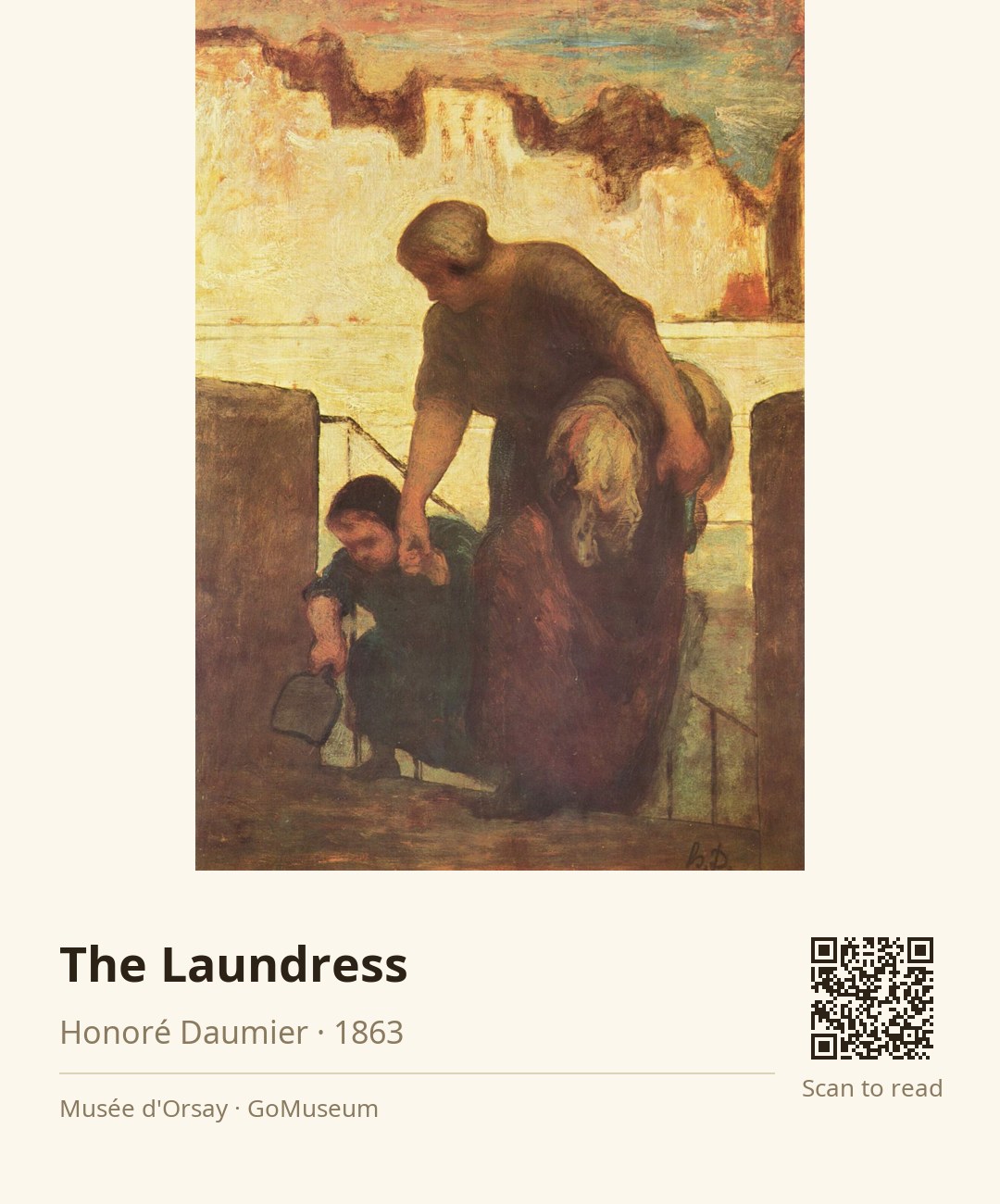
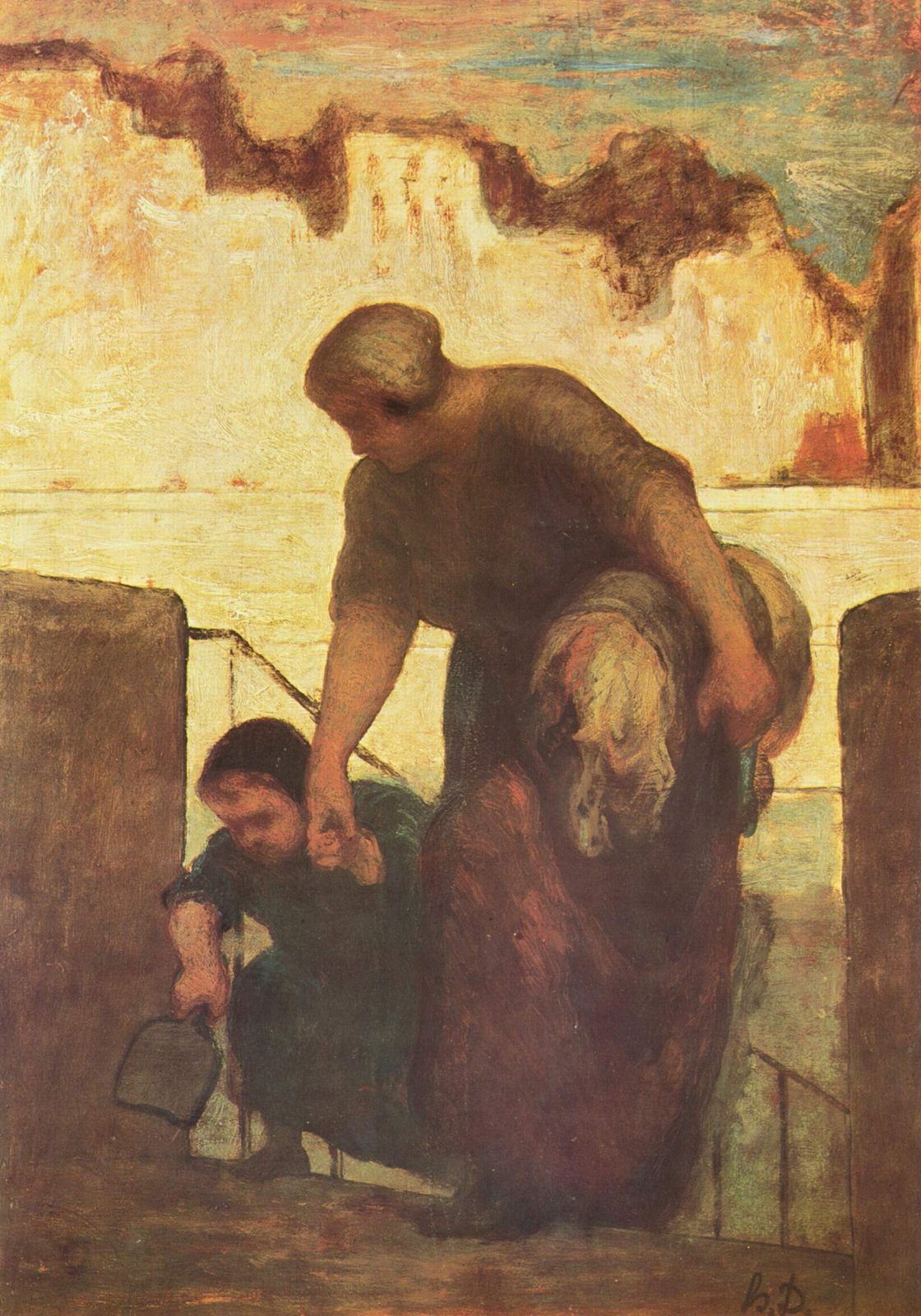
🎧 This work has audio narration — listen in the appTake a moment to really look at "The Laundress" by Honoré Daumier. Notice how the woman stands, her posture both weary and strong, a bundle of laundry balanced on her hip. The child at her side, perhaps a reflection of her daily struggles, adds a layer of intimacy to this scene.
These details matter because they capture the essence of the working-class experience in 19th-century France. Daumier, known for his keen observations of everyday life, elevates this laundress from a mere laborer to a symbol of resilience and dignity. The way he simplifies the forms and uses light creates a monumental quality, transforming a mundane task into an act of strength.
Painted in 1863, this work reflects Daumier's shift from caricature to painting, where he focused on the lives of the humble and overlooked. Living near the Seine, he often witnessed these women returning from the lavoir, their burdens heavy yet their spirits unbroken.
As you stand here, think about the stories this laundress could tell. What challenges did she face? What dreams did she hold onto while navigating her daily life? Let her strength resonate with you as you move through the museum.
Honoré-Victorin Daumier, born on February 26, 1808, in Marseille, was a pivotal French artist known for his incisive commentary on the social and political landscape of 19th-century France. A prolific lithographer, caricaturist, painter, and sculptor, Daumier's work often satirized the monarchy, the bourgeoisie, and human nature itself. He began his artistic journey at a young age, influenced by his family's struggles and his early exposure to the vibrant Parisian art scene.
Daumier's career took off after the July Revolution of 1830, when he became a prominent figure in political caricature, contributing to satirical publications like La Caricature and Le Charivari. His bold depictions of figures like King Louis-Philippe earned him both fame and imprisonment, reflecting his commitment to social critique. Despite facing financial hardships and a lack of recognition during his lifetime, he was admired by contemporaries such as Charles Baudelaire.
While Daumier produced thousands of lithographs, his paintings, though largely overlooked in his lifetime, would later be celebrated for their realism and emotional depth. His influence extended to later movements, including Impressionism, marking him as a significant figure in art history. Daumier passed away in February 1879, leaving behind a legacy that would reshape the understanding of political art.
Honoré Daumier painted 'The Laundress' in 1863, a significant year as it marked his transition from caricature to painting. However, it gained more visibility during the Exposition Universelle of 1900. The painting was acquired by the Louvre in 1927, and since 1986, it has been housed at the Musée d'Orsay. Daumier, living on the Île Saint-Louis in Paris, was deeply inspired by the washerwomen he observed daily, carrying heavy loads from the Seine.
As you gaze at 'The Laundress,' notice Daumier's masterful brushwork. The paint handling is both summary and deliberate, creating a monumental quality that elevates the subject beyond mere depiction. The contrast between the bright background and the figures draws your eye, emphasizing the weight of the woman's burden. The simplified forms and the way light falls across her body evoke a sense of both weariness and strength. The composition is intimate yet powerful, with the laundress standing tall despite her fatigue, her posture suggesting resilience. This technique not only captures the physicality of her labor but also conveys an emotional depth that resonates with the viewer, making the mundane act of laundry feel monumental.
Did you know that Daumier's 'The Laundress' is part of a larger conversation he had with the world around him? While he painted this piece in 1863, he had already been observing the lives of washerwomen for years, capturing their struggles and resilience. The painting is not just a portrayal of a woman doing laundry; it's a testament to the strength of working-class women in Paris, a theme he explored repeatedly. In fact, he created several versions of this subject, but critics agree that this one, now at the Musée d'Orsay, stands out as the best. It's fascinating to think how Daumier, a man who often satirized the elite, found beauty and dignity in the everyday lives of these women, elevating their stories to the canvas.
In addition to the version at the Musée d'Orsay, there are two other known versions of 'The Laundress': one at the Metropolitan Museum of Art in New York and another at the Albright-Knox Art Gallery in Buffalo, New York.
Daumier lived on the Île Saint-Louis in Paris, which provided him with ample opportunity to observe the washerwomen as they returned from the Seine, deeply influencing his portrayal of their strength and struggles in his artwork.
Despite Daumier's significant contributions to art, his paintings were largely overlooked and ignored by the French public and critics during his lifetime, although they were admired by fellow artists and intellectuals.