Camera Work: Winter - Fifth Avenue
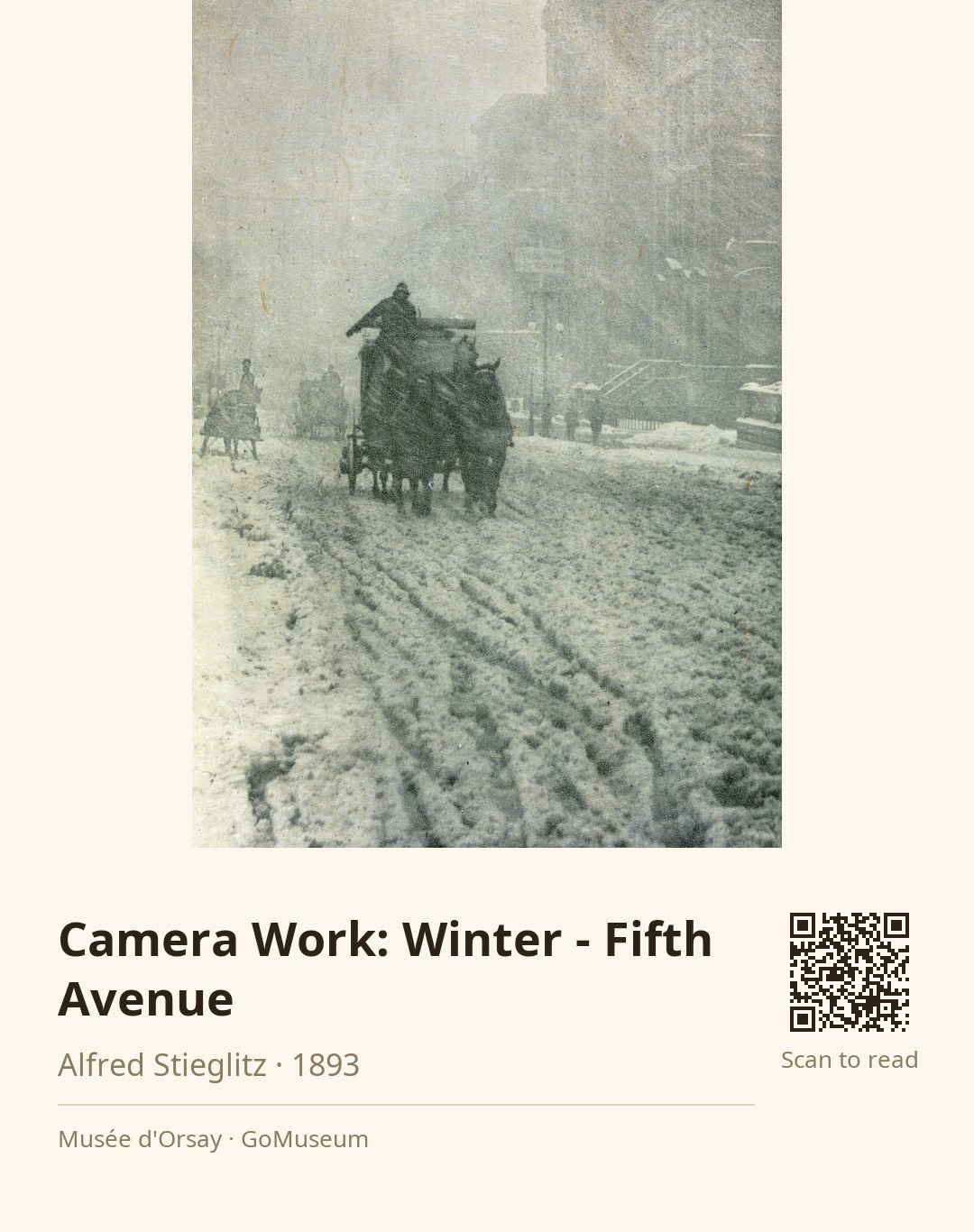
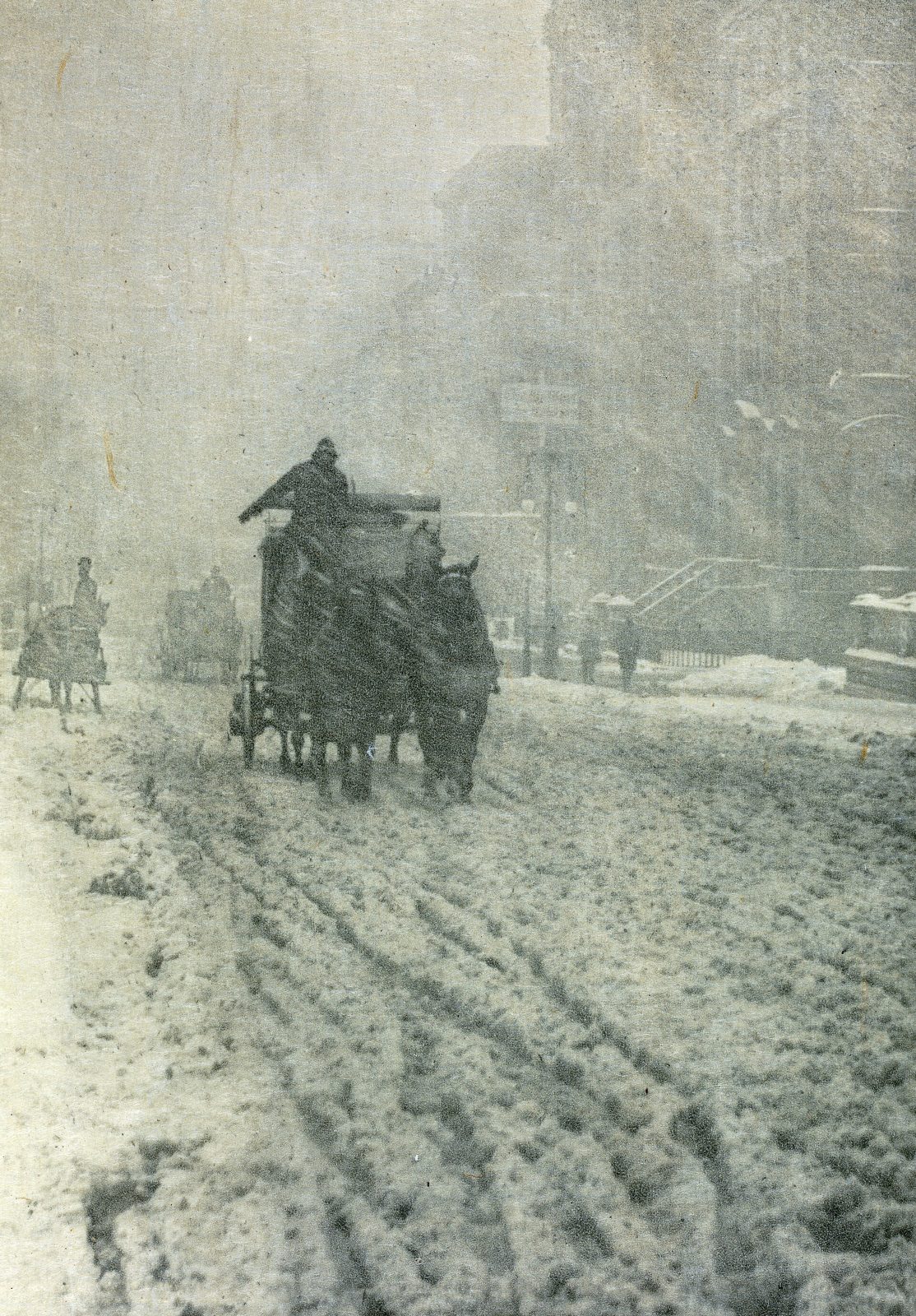
🎧 This work has audio narration — listen in the appTake a moment to really look at "Camera Work: Winter - Fifth Avenue" by Alfred Stieglitz. Notice how the swirling snow almost envelops the horse-drawn omnibus, creating a scene that feels both chaotic and serene. The blurred outlines of the carriage and the figures give it a dreamlike quality, don’t they?
Stieglitz stood at this very corner for three hours, waiting for the perfect moment to capture the struggle of the driver against the storm. That patience paid off, as he transformed a simple street scene into a powerful emotional experience, evoking the feeling of resilience amidst adversity.
Stieglitz was pioneering a new era in photography, using a hand camera instead of the bulky view camera that would have made this shot nearly impossible. His artistic vision was to convey atmosphere over mere documentation, believing that the essence of a scene lies in its mood rather than its details.
As you take in this image, think about what it means to capture a moment in time. How does this photograph resonate with your own experiences of winter? What stories does it evoke for you?
Alfred Stieglitz, born on January 1, 1864, in Hoboken, New Jersey, was a pioneering American photographer and a crucial figure in the promotion of modern art. His dedication over five decades transformed photography into a recognized art form. Stieglitz's early education in Germany fueled his passion for photography, leading him to explore its artistic potential. He began his career by winning awards for his photographs and writing influential articles on the medium.
Stieglitz founded several New York galleries, where he introduced avant-garde European artists to American audiences, significantly shaping the art scene of the early 20th century. His magazine, Camera Work, further established his role as a leading advocate for artistic photography. Stieglitz's personal life was marked by complexity, including a tumultuous marriage to painter Georgia O'Keeffe, which reflected his deep emotional and artistic struggles.
His innovative techniques and commitment to artistic integrity positioned him as a key figure in art history, bridging the gap between photography and fine art. Stieglitz passed away on July 13, 1946, leaving a lasting legacy that continues to influence photographers and artists today.
One memorable aspect of his journey is how he transitioned from using cumbersome view cameras to the more portable hand camera, which allowed him to capture fleeting moments like this one. This shift marked a pivotal point in his career, as he embraced spontaneity and the rawness of life, believing that true art lies in the emotion of the moment rather than in meticulous detail.
This photograph, taken in 1893, broke away from the rigid, documentary style of the time, introducing a more impressionistic approach that emphasized mood and atmosphere. Stieglitz's choice to capture the blizzard's swirling snow transformed a mundane city scene into a poetic expression of struggle and resilience. This work not only influenced his contemporaries but also paved the way for future photographers to explore emotional depth in their images, marking a significant shift in how photography was perceived and appreciated in the art world. Remember, this was more than just a photograph; it was a declaration that photography could evoke feelings just like painting.
Here's a surprising tidbit: when Stieglitz first developed the negative of 'Winter, Fifth Avenue,' a fellow photographer thought it was so poorly blurred that he advised Stieglitz to throw it away! But Stieglitz, with his artistic vision, saw beyond the technical imperfections. He believed that capturing the essence of the moment was far more important than achieving perfect sharpness.
When Stieglitz first developed 'Winter, Fifth Avenue,' a fellow photographer thought it was so poorly blurred that he advised him to discard it. This criticism highlights the divide between traditional expectations of sharpness in photography and Stieglitz's innovative approach to capturing emotion over technical perfection.
Stieglitz printed the photograph on rough-textured watercolor paper using the carbon print process, which enhanced the atmospheric quality of the image. This choice contributed to the overall mood and texture, making the snow and blizzard feel more immersive.
Stieglitz considered the driver battling against the storm a symbolic self-portrait, reflecting his own struggles as an artist in a challenging environment. This connection adds a layer of personal narrative to the photograph, intertwining his life experiences with the captured moment.