La belle Angèle
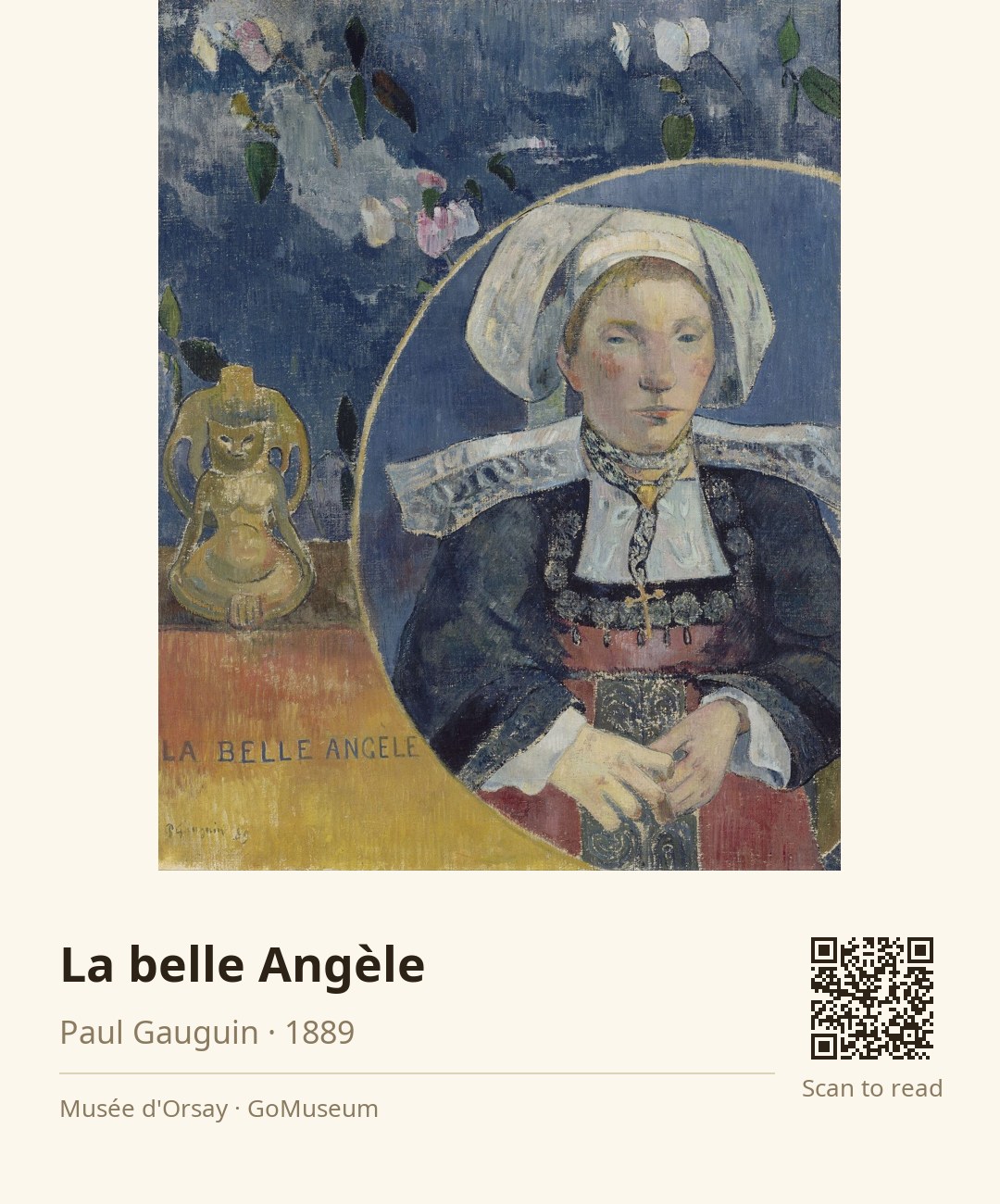
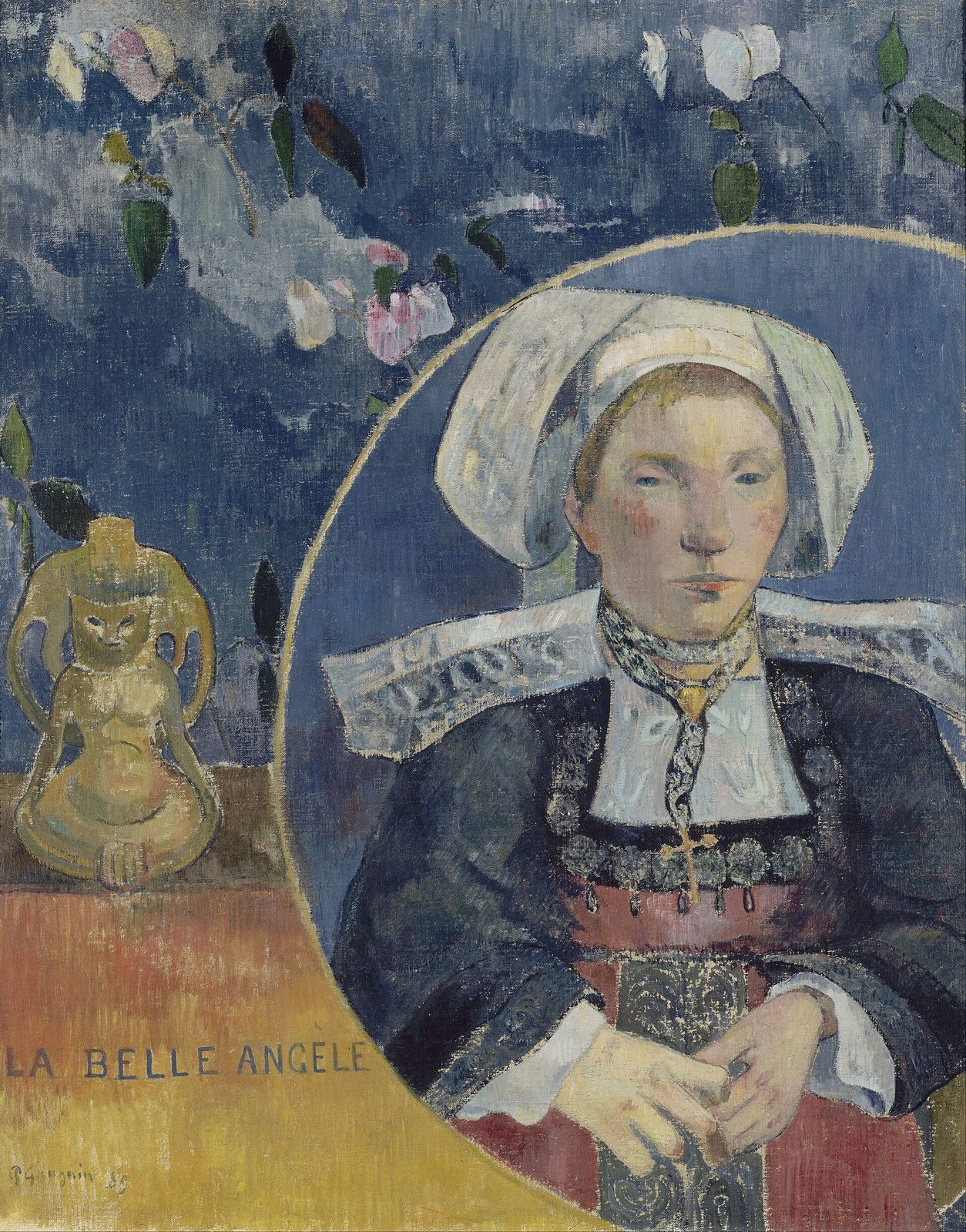
🎧 This work has audio narration — listen in the appTake a moment to really look at "La belle Angèle." Notice how the vibrant colors leap off the canvas, especially the deep blues and warm yellows that wrap around the figure of Angélique Marie Satre. Her expression is both inviting and enigmatic, drawing you into her world.
What’s fascinating here is how Gauguin captures not just a person, but a moment in time—a snapshot of life in Pont-Aven during the late 19th century. The influence of Japanese art is evident, particularly in the flatness of the composition and the bold outlines, which were all the rage in Paris at the time. This wasn’t just a stylistic choice; it reflects Gauguin’s desire to break away from traditional Western art and explore new ways of seeing beauty.
Created in 1889, this painting represents a pivotal moment in Gauguin's career, as he began to embrace a more symbolic and expressive style. Angèle was one of the famous innkeepers in Pont-Aven, a hub for artists seeking inspiration, and her presence in this work immortalizes the local culture and community.
As you stand here, think about what Angèle might have been feeling in that moment. What stories does her gaze hold? What does beauty mean to you in this context? Let those questions linger as you take in the painting’s rich details.
Eugène Henri Paul Gauguin was a French artist born on June 7, 1848, in Paris. His early life in Peru, where he experienced a privileged childhood, deeply influenced his artistic vision. Initially a stockbroker, Gauguin turned to painting full-time after a financial crisis in 1882. He was largely self-taught, drawing inspiration from his connections with artists like Camille Pissarro, who introduced him to Impressionism.
Gauguin's work evolved into a distinct style characterized by bold colors and symbolic themes, diverging from traditional Impressionism. His time in Brittany and later in Tahiti marked significant phases in his career, where he sought to capture the essence of native life and spirituality. Despite struggling with health and financial issues in his later years, his art gained recognition posthumously, largely due to the efforts of art dealer Ambroise Vollard.
Today, Gauguin is celebrated as a key figure in Post-Impressionism and a precursor to modern art, influencing artists like Picasso and Matisse. His exploration of color and form continues to resonate, securing his place in art history as a visionary who sought to transcend the confines of Western civilization.
La belle Angèle was painted in 1889, a time when Paul Gauguin was deeply immersed in the vibrant artistic community of Pont-Aven. Initially shown at the Boussod-Valadon gallery in Paris, it was part of Gauguin's own collection until it was sold at auction in 1891. The painting later passed through the hands of notable collectors, including Edgar Degas and the influential art dealer Ambroise Vollard.
As you gaze at La belle Angèle, take note of Gauguin's bold brushwork. The thick application of paint creates a tactile quality, almost inviting you to reach out and touch the surface. The vibrant colors, particularly the deep blues and warm yellows, are not just aesthetically pleasing; they evoke emotion and depth. The composition is structured yet fluid, drawing your eye to Angèle's enigmatic expression. Notice how the flatness of the background, influenced by Japanese art, contrasts with the dimensionality of Angèle herself, creating a striking focal point. This interplay of light and color enhances the painting's emotional resonance, making it feel alive and dynamic.
Interestingly, Gauguin's choice of subject, Angélique Marie Satre, was not just a random figure; she was a well-known innkeeper in Pont-Aven, a hub for artists. Her nickname, 'La belle Angèle,' speaks to her charm and presence in the community, making her an ideal muse for Gauguin as he sought to capture the essence of local life.
After a financial crisis in 1882, Gauguin left his job as a stockbroker to pursue painting full-time, which led him to immerse himself in the vibrant artistic community of Pont-Aven, ultimately shaping his distinctive style and subject matter.