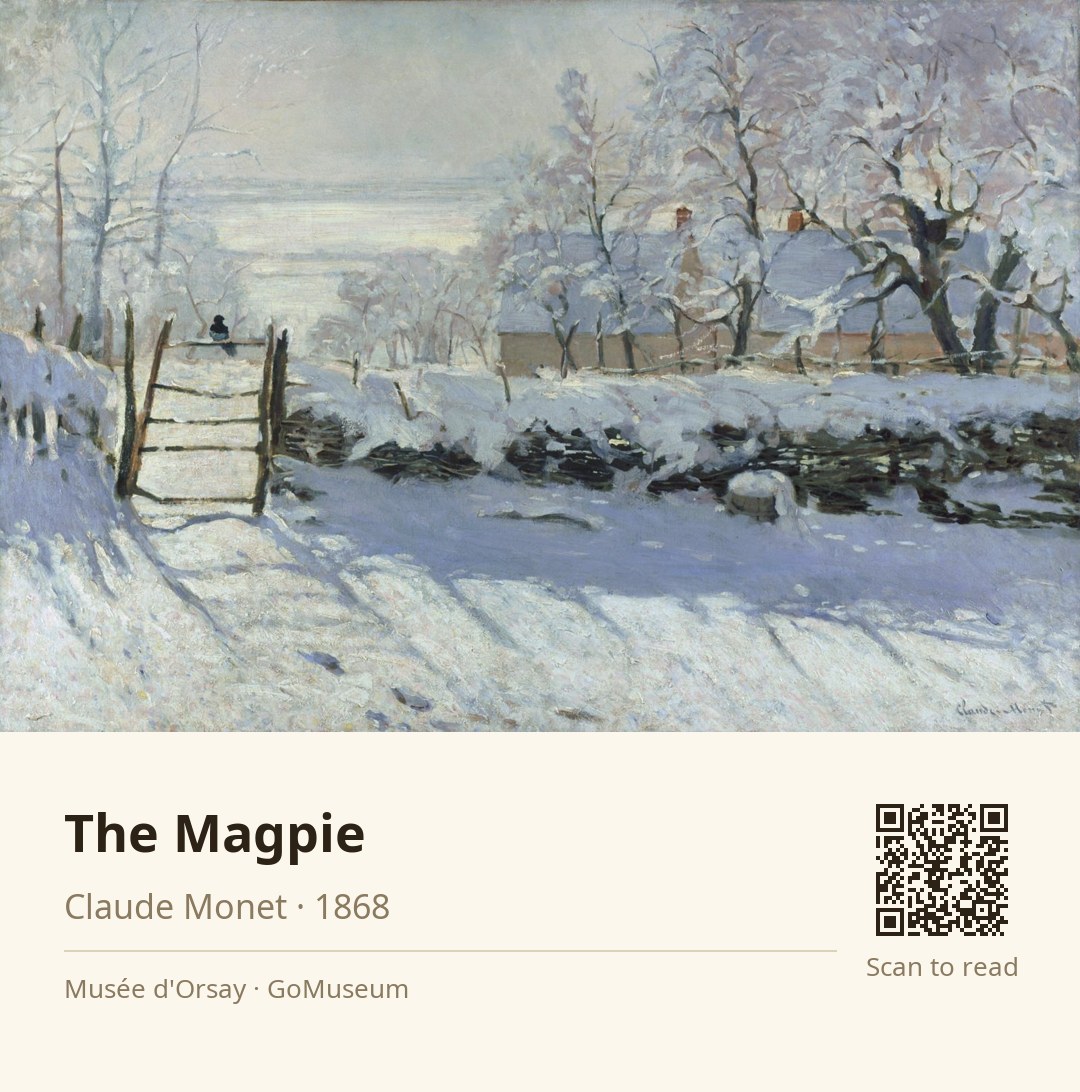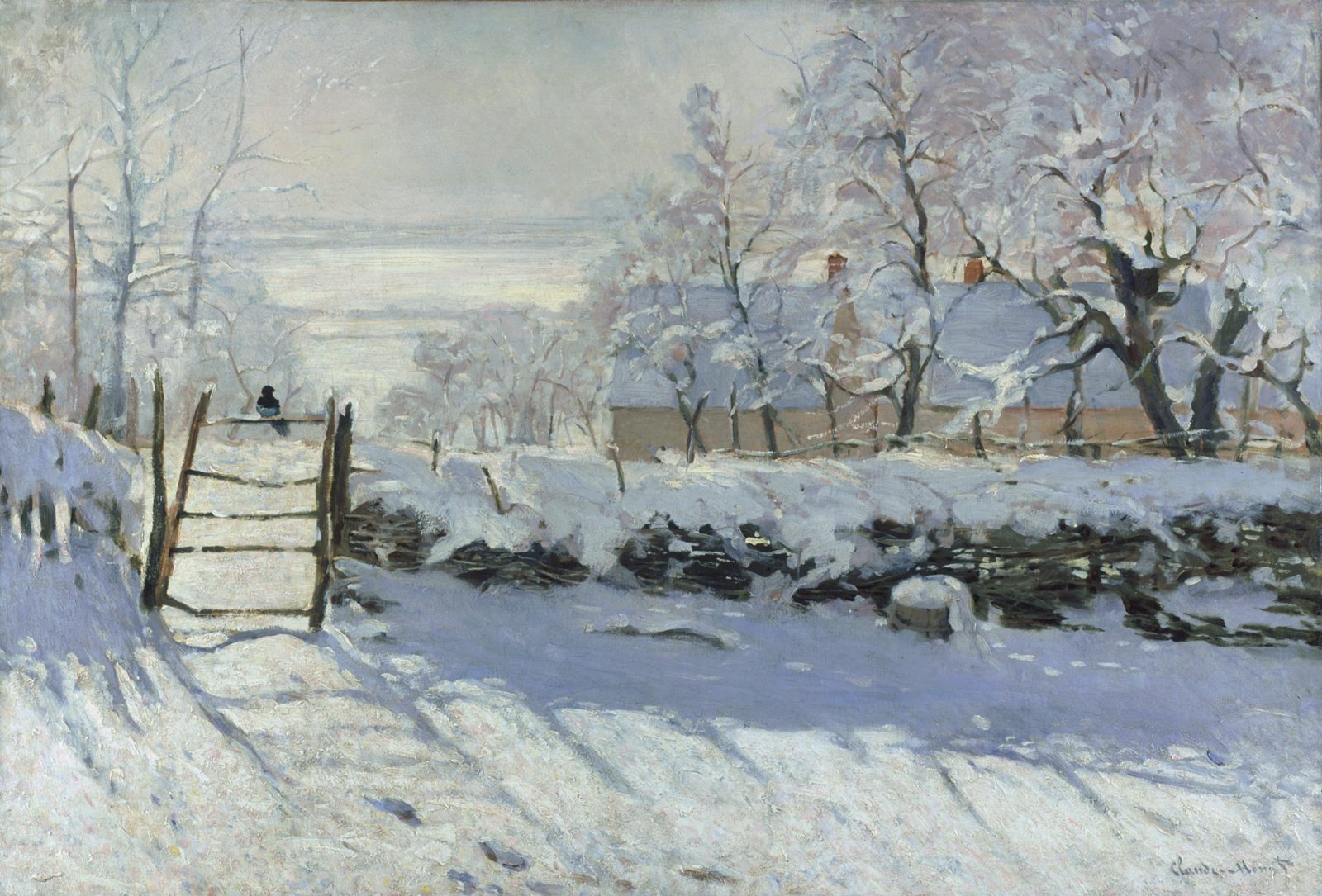
Take a moment to really look at "The Magpie." Notice how the solitary black bird perches on that rustic gate, surrounded by a blanket of freshly fallen snow. Can you see the way the sunlight dances across the snow, casting blue shadows that seem to shimmer? This isn’t just a pretty winter scene; it’s a groundbreaking moment in art history.
Monet's use of colored shadows here was revolutionary, challenging the traditional notion that shadows should be painted in dull blacks. Instead, he captures the vibrant hues of nature, reflecting the changing light and atmosphere. This technique would become a hallmark of the Impressionist movement, influencing countless artists to come.
Painted in 1868, during a particularly harsh winter in Normandy, this piece marked a significant period in Monet's life. He was grappling with personal struggles, yet found solace and inspiration in the snowy landscapes around Étretat.
So, as you stand here, think about the transformation happening in this painting. How does it make you feel about winter? Can you sense the quiet beauty and the innovative spirit that Monet captured?
Oscar-Claude Monet, born on November 14, 1840, in Paris, was a pioneering French painter and a founder of Impressionism, a movement that transformed the art world. Raised in Le Havre, he developed a passion for nature and painting early on, encouraged by his mother, while his father hoped he would pursue a business career. After his mother's death in 1857, Monet moved in with his aunt, who supported his artistic ambitions.
Monet's career began with caricatures, but he soon sought formal training, studying under Eugène Boudin, who introduced him to plein air painting. His breakthrough came in 1866 with "La Femme à la robe verte," which garnered attention at the Salon. The term "Impressionism" originated from his work "Impression, Sunrise," exhibited in 1874, marking a shift away from traditional art.
Throughout his life, Monet focused on capturing the essence of light and color in nature, creating series of paintings that depicted the same scenes under varying conditions, such as his famous haystacks and water lilies. He settled in Giverny in 1883, where he cultivated a beautiful garden that became his muse. Despite personal hardships, including the loss of loved ones and health issues, Monet's relentless dedication to his craft solidified his place in art history as a master of modernism, influencing countless artists and leaving a lasting legacy. He died on December 5, 1926, in Giverny, celebrated as one of the most significant figures in art.
In the winter of 1868, Claude Monet painted 'The Magpie' near Étretat, Normandy, during a particularly harsh season. This work was commissioned by his patron, Louis Joachim Gaudibert, who helped arrange a comfortable living situation for Monet and his family. Despite its beauty, the painting faced rejection at the Paris Salon of 1869, criticized for its boldness and innovative approach to light and color. Monet's struggles during this time were profound; he even attempted suicide due to financial difficulties. The painting remained privately held until it was acquired by the Musée d'Orsay in 1984, where it now stands as a testament to Monet's genius and resilience.
Take a closer look at how Monet constructs 'The Magpie.' The composition is a dance of lines—horizontal lines from the clouds and the rustic fence, vertical lines from the trees, creating a dynamic interplay. Monet uses a three-plane structure: the foreground with the magpie and gate, the middle with houses and trees, and the background fading into a misty sky. Notice the way he captures light; the snow isn’t just white—it’s a canvas of colors. The blue shadows and warm sunlight create a shimmering effect, reflecting the actual conditions of the scene. Monet's brushwork is both delicate and bold, allowing the viewer to feel the chill of winter while basking in the warmth of the sun’s rays. This innovative use of color and light was groundbreaking, pushing the boundaries of traditional painting.
Interestingly, 'The Magpie' is one of approximately 140 snowscapes Monet produced. His first foray into this genre was 'A Cart on the Snowy Road at Honfleur,' painted in either 1865 or 1867. This early work set the stage for his exploration of snow effects, which became a hallmark of his winter landscapes.
During the time he painted 'The Magpie', Monet was facing severe financial difficulties and even attempted suicide. This turmoil likely heightened his sensitivity to the beauty of the snowy landscape, allowing him to channel his emotions into the innovative techniques seen in the painting.
When 'The Magpie' was submitted to the Paris Salon in 1869, it was rejected, criticized for its bold use of color and light. This rejection was a turning point for Monet, as it underscored the divide between traditional art and the emerging Impressionist movement, ultimately motivating him to further develop his unique style.