Un coin de table
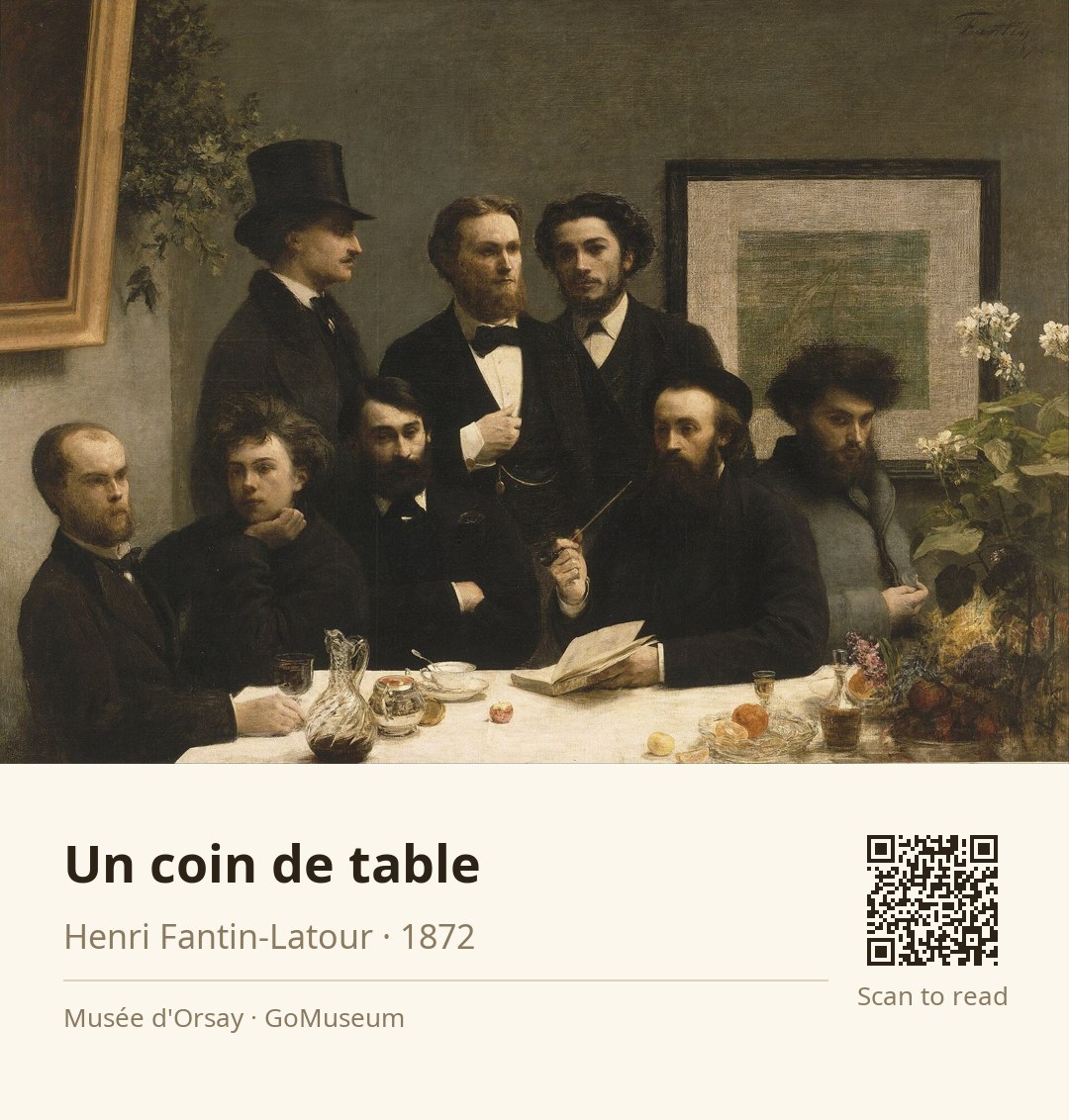
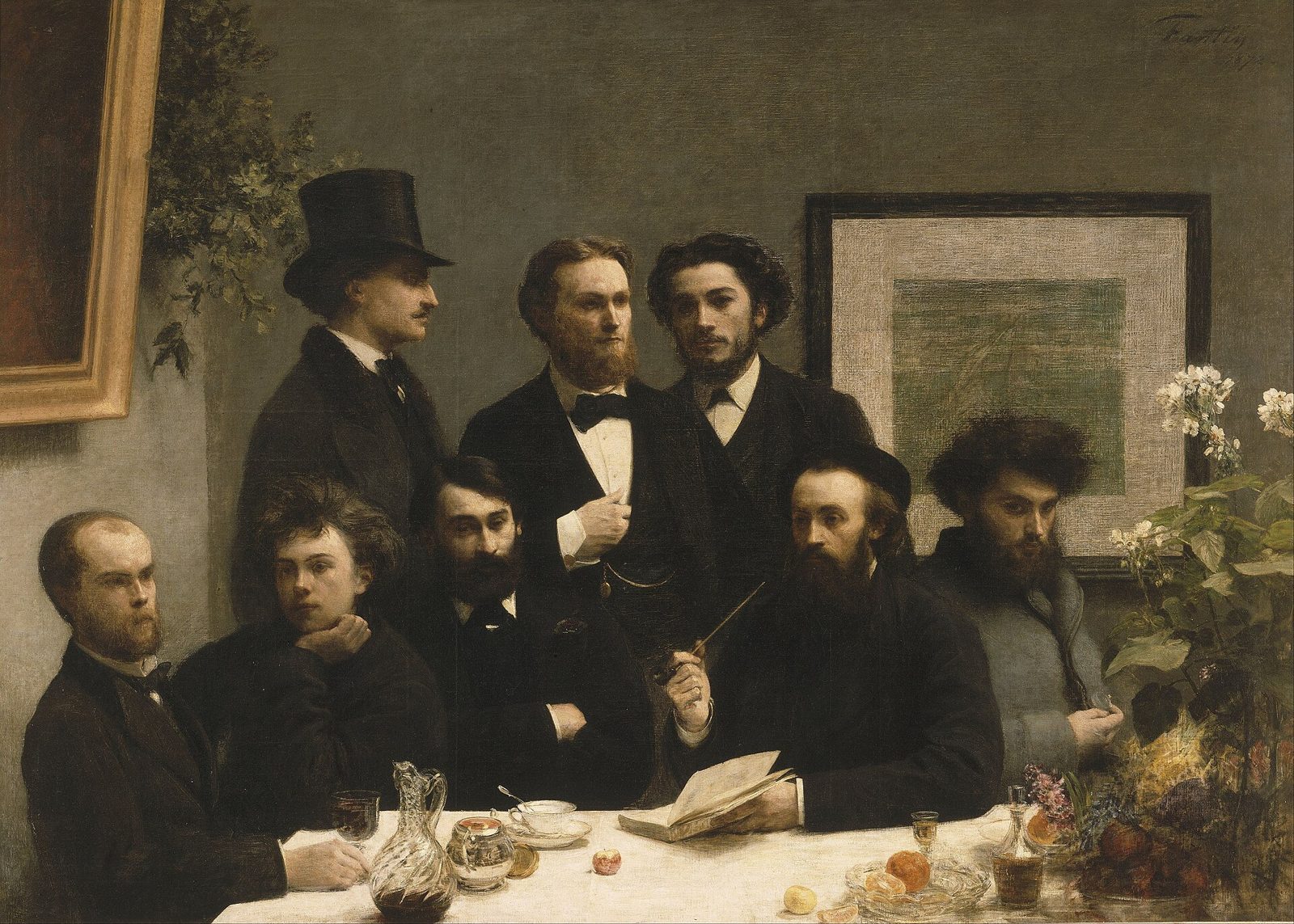
🎧 This work has audio narration — listen in the appTake a moment to really look at "Un coin de table" by Henri Fantin-Latour. Notice how the table is set with a rich array of objects—there’s a fruit bowl, a carafe of wine, and a bouquet of flowers. But what catches your eye? Perhaps it’s the way the light dances off the glassware or how the colors of the fruits pop against the white tablecloth.
These details matter because they create a sense of intimacy and warmth, inviting you into a moment shared among poets. The painting captures not just a meal, but a gathering of minds—Paul Verlaine, Arthur Rimbaud, and their contemporaries—each lost in thought or conversation, their black attire contrasting with the vibrant still life in front of them.
Fantin-Latour painted this in 1872 as part of a series celebrating artistic camaraderie, initially intending to honor the poet Charles Baudelaire.
As you stand before this work, think about the conversations that might have flowed around that table. What ideas do you think were exchanged? What dreams were shared? Let your imagination wander through this gathering of great minds.
Ignace Henri Jean Théodore Fantin-Latour, born on January 14, 1836, in Grenoble, was a notable French painter and lithographer renowned for his exquisite flower paintings and group portraits of contemporary artists and writers. His artistic journey began under the guidance of his father, a painter, and continued in Paris, where he studied at the École des Beaux-Arts alongside future Impressionists like Edgar Degas and Alphonse Legros. Despite his connections to the avant-garde, Fantin-Latour's style remained rooted in realism and tradition.
In the 1860s, he gained acclaim for his still lifes, particularly in England, where his works were celebrated for their vibrant colors and textures. Encouraged by James McNeill Whistler, he embraced this genre, which was often undervalued in the hierarchy of art. His still lifes, characterized by their simplicity and focus on form, defied academic conventions and showcased his mastery of color.
Fantin-Latour's contributions to collective portraiture, such as "A Studio at Les Batignolles," positioned him as a bridge between Romanticism and Impressionism. Despite being overshadowed by his contemporaries, his legacy endures, with his works held in prestigious museums and a lasting influence on subsequent generations of artists. He passed away on August 25, 1904, leaving behind a rich artistic heritage that continues to be appreciated today.
Henri Fantin-Latour's "Un coin de table" was created in 1872 as part of a series of four group portraits. Initially, Fantin-Latour aimed to honor the poet Charles Baudelaire on his 50th birthday, gathering prominent literary figures around him. However, many of the invited poets, including Victor Hugo, declined to participate. The painting was first exhibited at the Salon des artistes français in Paris in the same year and later showcased at significant exhibitions, including the centennial of French art in 1900 and a dedicated Fantin-Latour exhibition in 1906. The painting's journey continued as it changed hands, eventually being donated to the Louvre in 1910 by Émile Blémont. Since 1986, it has found its home at the Musée d'Orsay, where it continues to captivate audiences.
As you gaze at "Un coin de table," notice the meticulous brushwork that brings life to the scene. Fantin-Latour employs a rich oil medium, layering colors to create depth and texture. The light plays a crucial role, illuminating the glassware and fruits, making them almost shimmer against the white tablecloth. The composition is carefully structured; the table acts as a horizontal anchor, while the figures, dressed in dark attire, rise against a muted gray background. This contrast not only highlights their expressions but also draws your eye to the vibrant still life in the foreground. The arrangement of objects—fruits, a carafe, and flowers—creates a sense of abundance and intimacy, inviting you to imagine the conversations and camaraderie shared among these literary giants.
This painting not only immortalizes the faces of iconic poets like Paul Verlaine and Arthur Rimbaud but also reflects the intimate camaraderie and tensions of their gatherings. By presenting these figures in a casual, post-meal setting, Fantin-Latour breaks away from the grand, formal portraits typical of his time, inviting viewers into a moment of shared humanity. This approach influenced later artists to explore more personal and candid representations of their subjects, paving the way for modern portraiture. Remember, this isn't just a painting; it's a snapshot of a vibrant literary circle, forever etched in oil on canvas.
Interestingly, the vase of flowers in the painting symbolizes the absent poet Albert Mérat, who refused to pose alongside Rimbaud after a notorious incident during a dinner. This adds a layer of intrigue to the gathering, hinting at the complex relationships and rivalries among these literary figures.
Fantin-Latour originally intended to create a tribute to the poet Charles Baudelaire for his 50th birthday, gathering several prominent literary figures around him, but many declined to participate.
Unlike traditional portraits that often emphasized individual prominence, Fantin-Latour's composition integrates the still life elements with the figures, creating a harmonious balance that invites viewers into the intimate atmosphere of the gathering.