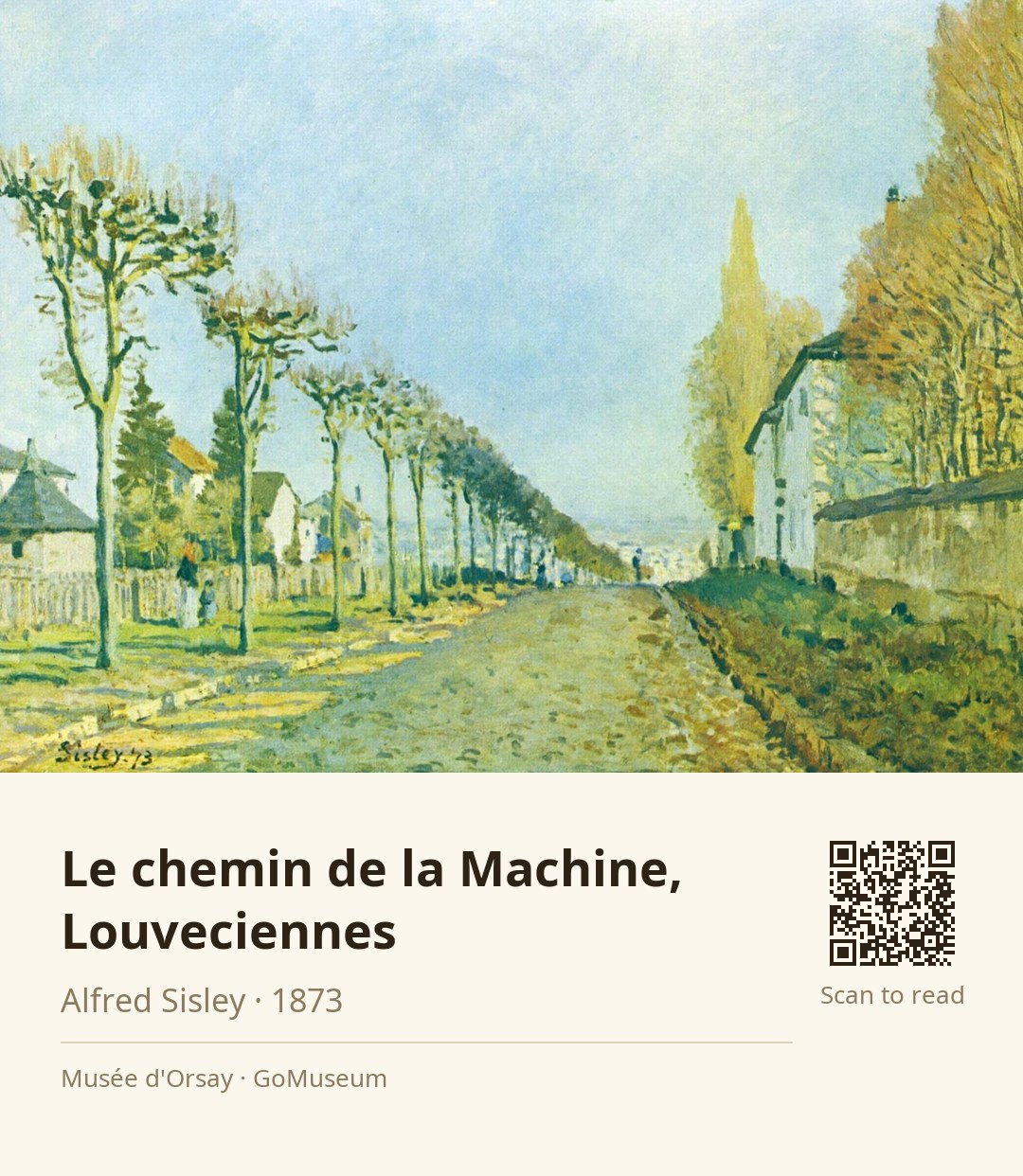
Le chemin de la Machine, Louveciennes
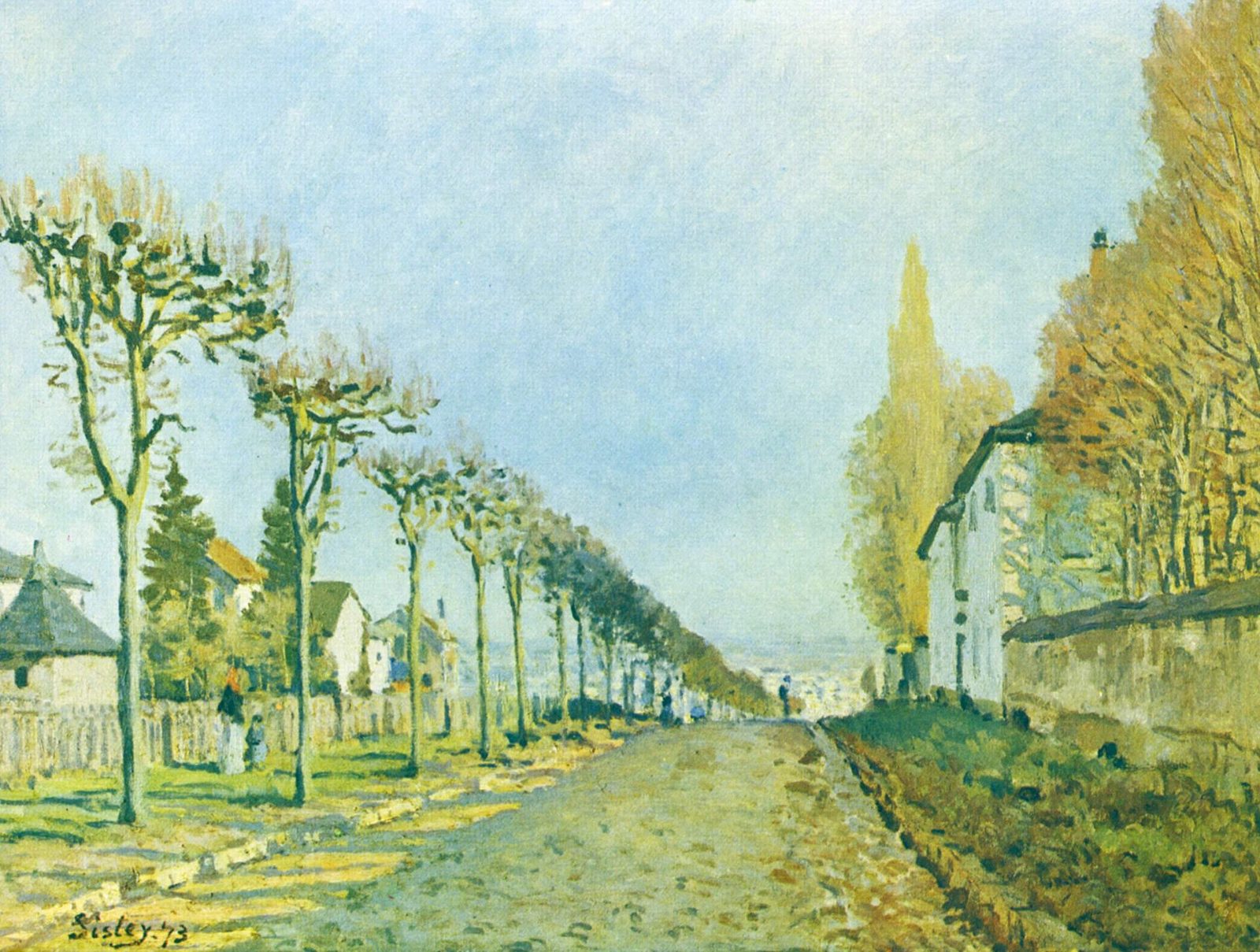
🎧 This work has audio narration — listen in the appTake a moment to really soak in "Le chemin de la Machine, Louveciennes." Notice how the road cuts through the canvas, drawing your eye into the scene. The way it curves creates a sense of movement, almost inviting you to walk down it. Look closely at the trees lining the path; their stark, leafless trunks contrast beautifully with the soft, pale sky above.
These details matter because they highlight Sisley’s masterful use of light and perspective. The oblique light casts long shadows, enhancing the three-dimensional feel of the landscape. This technique not only adds depth but also evokes the chill of a winter day, making you feel as if you could step right into the painting.
Created in 1873, during a pivotal time for the Impressionist movement, Sisley was deeply influenced by his surroundings in Louveciennes. He painted en plein air, capturing the essence of the moment rather than just the scene itself. This approach was revolutionary, as it focused on the fleeting effects of light and atmosphere.
As you stand here, think about how this painting connects to the broader themes of nature and human presence within it. What stories do you think the road could tell if it could speak?
Alfred Sisley was a British-born Impressionist landscape painter, born in Paris on October 30, 1839, to affluent expatriate parents. His dedication to painting outdoors, or en plein air, marked him as one of the most consistent figures within the Impressionist movement. Sisley’s work primarily focused on landscapes, with notable series depicting the River Thames, the floods at Marly-le-Roi, and the Gothic church at Moret-sur-Loing. Despite his talent, he struggled for recognition and financial stability throughout his life, often relying on the support of patrons and friends.
Sisley's artistic journey began in earnest after returning to Paris from London, where he had been sent to pursue a business career. Instead, he found his calling in art, studying at the École des Beaux-Arts and forming close friendships with fellow artists like Monet and Renoir. His personal life was marked by hardship, particularly after the Franco-Prussian War disrupted his family's financial support. He married Eugénie Lescouezec, and together they faced many challenges, including the loss of a child and Sisley’s ongoing financial instability.
Although Sisley’s work was largely overlooked during his lifetime, it has since gained significant appreciation, solidifying his place in art history as a key contributor to Impressionism and French landscape painting. His delicate depictions of nature continue to resonate, showcasing the beauty of the world around him. Sisley passed away on January 29, 1899, in Moret-sur-Loing, leaving behind a legacy that would flourish posthumously.
Alfred Sisley's 'Le chemin de la Machine, Louveciennes' was painted in 1873, a pivotal year for the Impressionist movement. This work was later exhibited at the Exposition Universelle in Paris in 1900, showcasing the evolution of French art. It entered the Louvre in 1918 from the collection of Joanny Peytel, a significant patron of the arts. By 1986, it found its home in the Musée d'Orsay, where it continues to be celebrated. Sisley, primarily a landscape painter, captured the essence of Louveciennes, where he painted directly from nature, a practice that was revolutionary at the time.
The brushwork is both delicate and assertive, with each stroke contributing to the sense of movement along the winding road. Notice how the oblique light creates long, dramatic shadows that add depth to the scene. The trees, stripped of their leaves, stand stark against the pale sky, emphasizing the chill of winter. The composition is cleverly structured; the road leads your eye into the painting, creating an inviting perspective that feels almost three-dimensional. Sisley’s choice of colors—muted browns for the ground contrasted with the cool blues of the sky—evokes a serene yet somber mood, perfectly encapsulating a winter's day. This interplay of light and shadow, along with the careful placement of the trees, enhances the painting's emotional resonance.
Painted in 1873, it embodies the essence of plein air painting, a technique that Sisley and his contemporaries championed. This work not only reflects Sisley's deep connection to the landscapes of Louveciennes but also serves as a bridge to the influences of earlier masters like Hobbema and Corot. By humanizing the landscape with small silhouettes, Sisley invites viewers to experience nature intimately, changing how landscapes were perceived in art. His dedication to capturing light and atmosphere influenced future generations of artists, solidifying his legacy within the Impressionist canon. Remember, Sisley’s landscapes are not just scenes; they are emotional experiences, inviting you to step into the moment he captured on canvas.
Did you know that Alfred Sisley's painting, Le chemin de la Machine, Louveciennes, was once misidentified? For many years, it was displayed under the title Route vue du chemin de Sèvres at the Louvre. This mix-up highlights how even the most celebrated pieces can have their identities obscured, much like the landscapes Sisley painted, often shifting in light and perception.