Charles Le Cœur
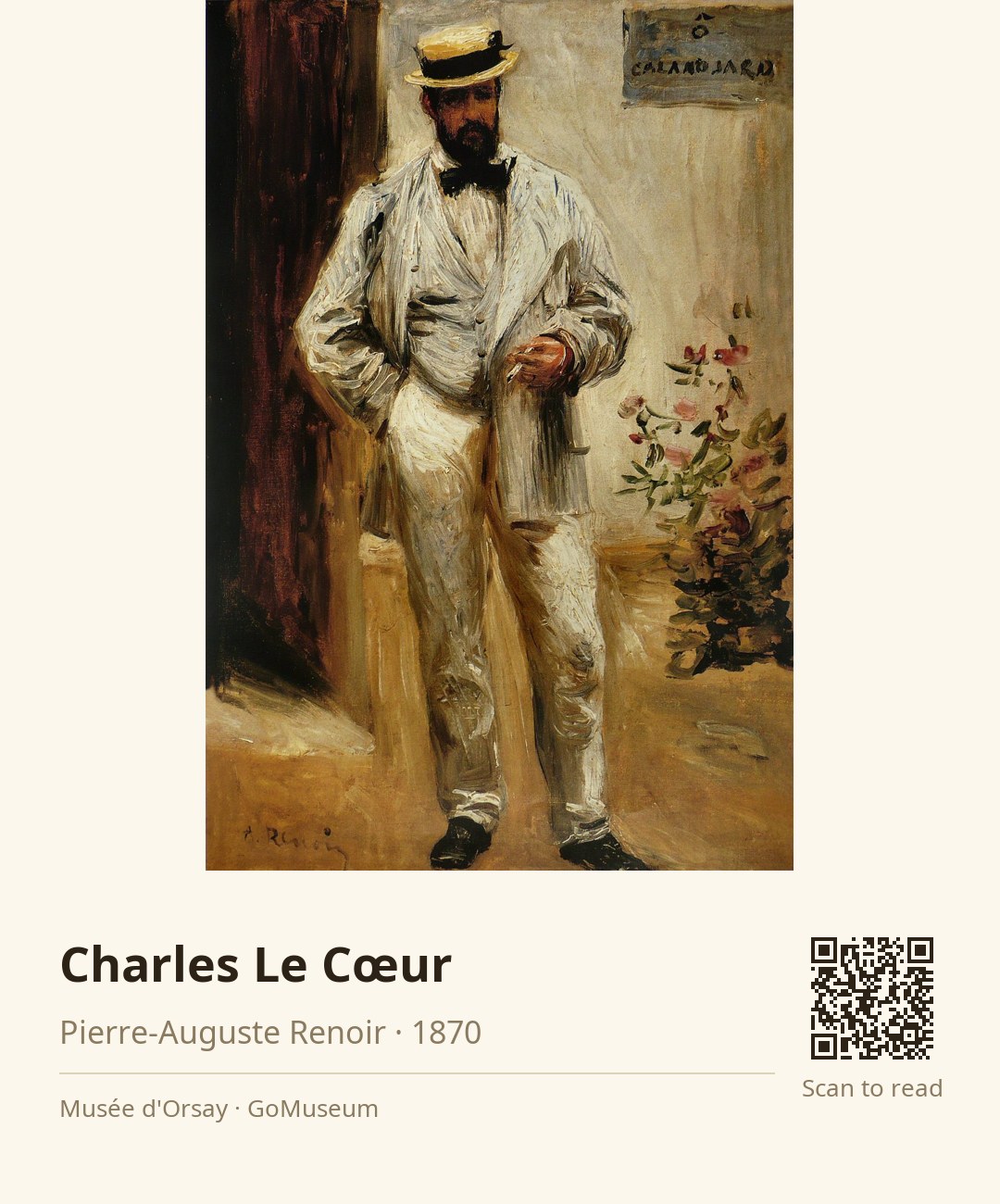
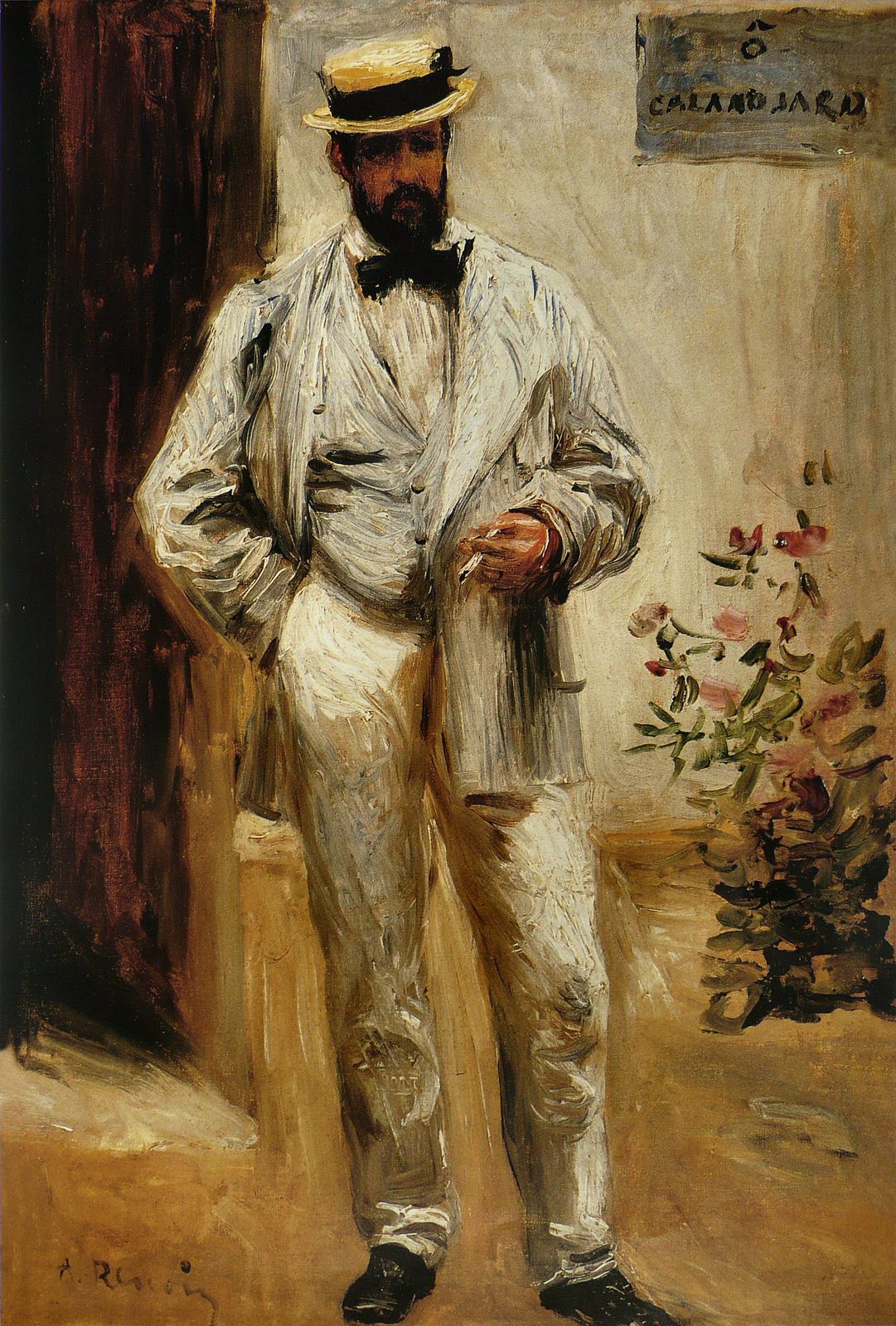
🎧 This work has audio narration — listen in the appCharles Le Cœur stands confidently against a wall, his light-colored, striped suit and straw boater hat giving him an air of casual sophistication. The cigarette held in his left hand adds a touch of nonchalance, while the partially visible sign behind him, "CALANDRARI," hints at a specific moment in time and place, grounding the portrait in a tangible reality.
Renoir's loose and expressive brushwork captures the warmth of the scene, with soft browns and creams enveloping Le Cœur, an architect, in a comforting embrace. The potted pink flowers to the right not only add a splash of color but also suggest a connection to the natural world, a recurring theme in Renoir's work. This portrait, painted in 1870, reflects the artist's evolving style, moving towards a more personal and intimate approach to his subjects, showcasing not just their likeness but also their character.
Renoir, a leading figure in the Impressionist movement, created this work during a time when he was establishing himself as a portrait artist, seeking commissions that would allow him to explore the nuances of human expression.
Pierre-Auguste Renoir, born on February 25, 1841, in Limoges, France, emerged as a pivotal figure in the Impressionist movement. His early life in a modest family led him to Paris, where he honed his artistic skills amidst the masterpieces of the Louvre. Initially apprenticed in a porcelain factory, Renoir's passion for painting flourished, particularly after studying under Charles Gleyre, where he befriended fellow artists like Monet and Sisley.
Renoir's work celebrated feminine beauty and vibrant social scenes, exemplified in iconic pieces like "Dance at Le Moulin de la Galette." Despite facing criticism early on, he gained recognition, especially after participating in the first Impressionist exhibition in 1874. His style evolved over the years, transitioning towards realism influenced by classical masters like Raphael.
Throughout his life, Renoir balanced personal struggles, including health issues, with a prolific output, reportedly creating around four thousand works. He became a beloved figure in art history, known for his warm palette and expressive brushwork. Renoir passed away on December 3, 1919, leaving a legacy that continues to inspire artists and art lovers alike.
The portrait of Charles Le Cœur was painted by Pierre-Auguste Renoir in 1870, during a transformative period for the artist. Renoir was establishing himself as a portrait painter, seeking commissions that would allow him to explore human expression. The painting was later exhibited in Paris in 1933, which helped to further solidify its place in the art historical narrative. Over the years, the painting changed hands several times, passing through the collections of notable patrons such as Hector Brame and Eduardo Mollard, before eventually reaching Enriqueta Alsop.
Renoir's technique in this portrait is a masterclass in capturing personality through paint. The loose brushwork creates a sense of immediacy, as if Le Cœur might step out of the canvas at any moment. Renoir's choice of a warm palette—rich browns, soft creams, and hints of pink—wraps the figure in a comforting embrace, enhancing the intimate feel of the piece. The vertical composition draws your eye directly to Le Cœur, while the background elements, like the partially visible sign and potted flowers, provide context without overwhelming him. The way Renoir handles the oil paint allows for a fluidity that mirrors the relaxed demeanor of his subject, making the viewer feel as though they are witnessing a candid moment rather than a posed portrait.
During this time, Renoir was establishing himself as a portrait artist and was actively seeking commissions to explore human expression.
Renoir's loose brushwork and warm palette create a sense of immediacy and intimacy, allowing the viewer to feel as though they are witnessing a candid moment.