Portraits at the Stock Exchange
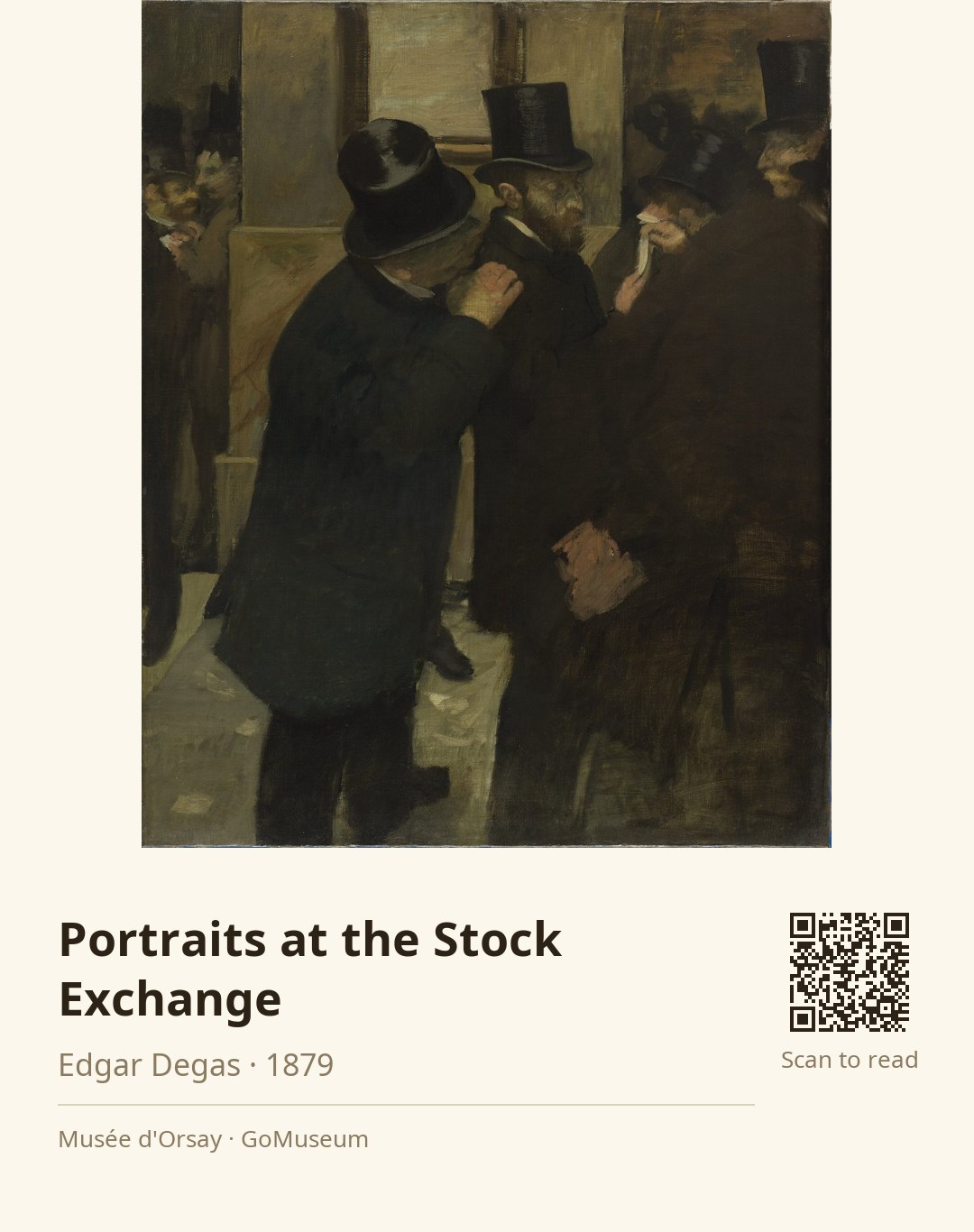
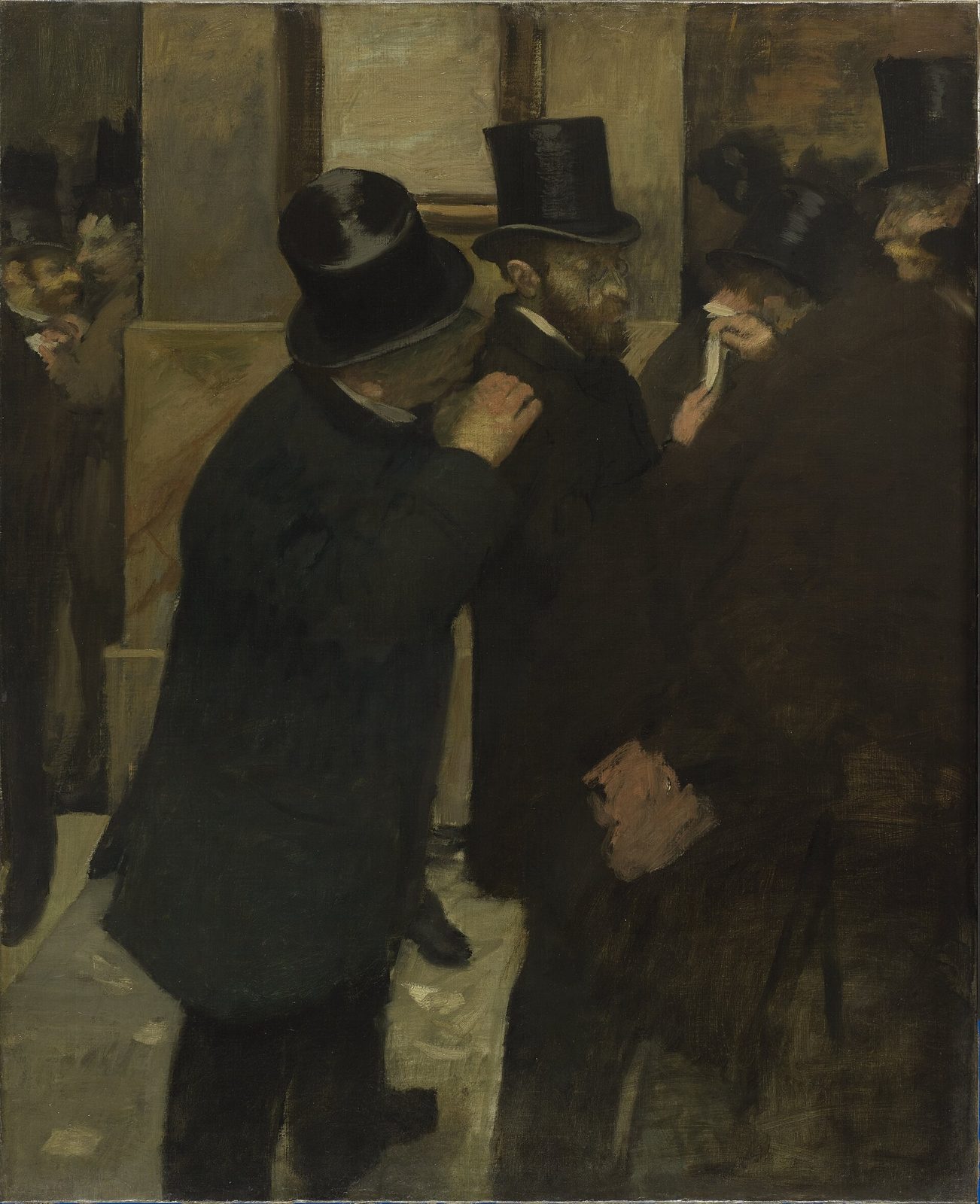
🎧 This work has audio narration — listen in the appTake a moment to really look at Edgar Degas’s "Portraits at the Stock Exchange." Notice how the figures seem almost caught in a snapshot of conversation, their postures and expressions revealing a world of tension and intrigue. The central figure, Ernest May, stands confidently in a top hat, while his colleague leans in, creating an intimate yet charged atmosphere.
These details matter because they pull you into the bustling life of the Paris Stock Exchange in the late 19th century, a time when finance was rapidly evolving and the stakes were high. Degas captures not just a moment, but the psychological weight of commerce and competition, reflecting the societal shifts of his time.
Created in 1879, this painting is more than just a depiction of men at work; it’s a commentary on the human experience within the modern world. Degas, often associated with dancers and ballet, here turns his keen eye to the business elite, showcasing his versatility as an artist.
As you stand here, think about the conversations happening in this very space today. What stories do you think these figures would tell if they could speak?
Edgar Degas, born on July 19, 1834, in Paris, was a pivotal figure in the Impressionist movement, though he preferred to be labeled a realist. Known for his exceptional skill in drawing, Degas focused on capturing movement, particularly in his depictions of dancers, which constitute over half of his oeuvre. His works also include racehorses and portraits that reveal psychological depth and human isolation.
Degas came from a cultured, affluent family; his mother was a Creole from New Orleans, and his father was a banker. After his mother's death, he pursued art against his father's wishes, studying at the École des Beaux-Arts and drawing inspiration from classical masters during his time in Italy. His early ambition to be a history painter shifted as he embraced contemporary subjects, influenced by artists like Édouard Manet.
Despite being a founding member of the Impressionists, Degas's approach diverged from his peers, as he often worked in his studio rather than en plein air. His innovative techniques and themes sparked debate among critics and continue to influence art history today. Degas passed away on September 27, 1917, leaving behind a legacy that challenges traditional boundaries in art.
Edgar Degas's 'Portraits at the Stock Exchange' was completed around 1879 and was already in the possession of French banker Ernest May, who likely commissioned the work. It was first showcased at the fourth Impressionist exhibition in Paris that same year, and again at the fifth exhibition in 1880. However, it didn't gain significant recognition until it was acquired by the Louvre in 1923. The painting captures a moment within the bustling Paris Stock Exchange, featuring May at the center, engaged in conversation with his colleague M. The work's early reception was mixed, with some art historians later interpreting it through various lenses, including accusations of antisemitism, which sparked debates about Degas's views and intentions. The painting's journey through exhibitions reflects the shifting perceptions of Degas's work over time, ultimately leading to its current home at the Musée d'Orsay in Paris.
In 'Portraits at the Stock Exchange,' Degas employs a technique that leans towards Impressionism, characterized by quick, sketchy brushstrokes that create a sense of immediacy. The figures are rendered with a psychological detachment, inviting viewers to observe rather than engage directly with the subjects. Notice how the light plays across the scene, illuminating the central figure of May while casting shadows that add depth and tension. The composition is structured with a triangular arrangement, drawing your eye to the interaction between May and Bolâtre, while the partially obscured third figure adds an element of intrigue.
This painting, completed in 1879, captures a moment in the bustling world of finance, reflecting the modern life of Paris. Its sketchy brushwork and psychological detachment reveal a new way of seeing—one that influenced future generations of artists. Remember, this isn't just a portrait; it's a lens into the changing world of the late 19th century, capturing the essence of a society in flux.
One surprising detail about 'Portraits at the Stock Exchange' is that it was not well-known until it entered the Louvre's collection in 1923, despite being exhibited in the late 19th century. This delayed recognition highlights how art can sometimes take years, even decades, to be fully appreciated, reflecting changing tastes and societal values over time.
The figures in 'Portraits at the Stock Exchange' are not just generic representations; they include specific individuals like Ernest May and M. Bolâtre, who were actual participants in the Paris Stock Exchange, adding a layer of historical context to the scene.