Lilas, Temps gris
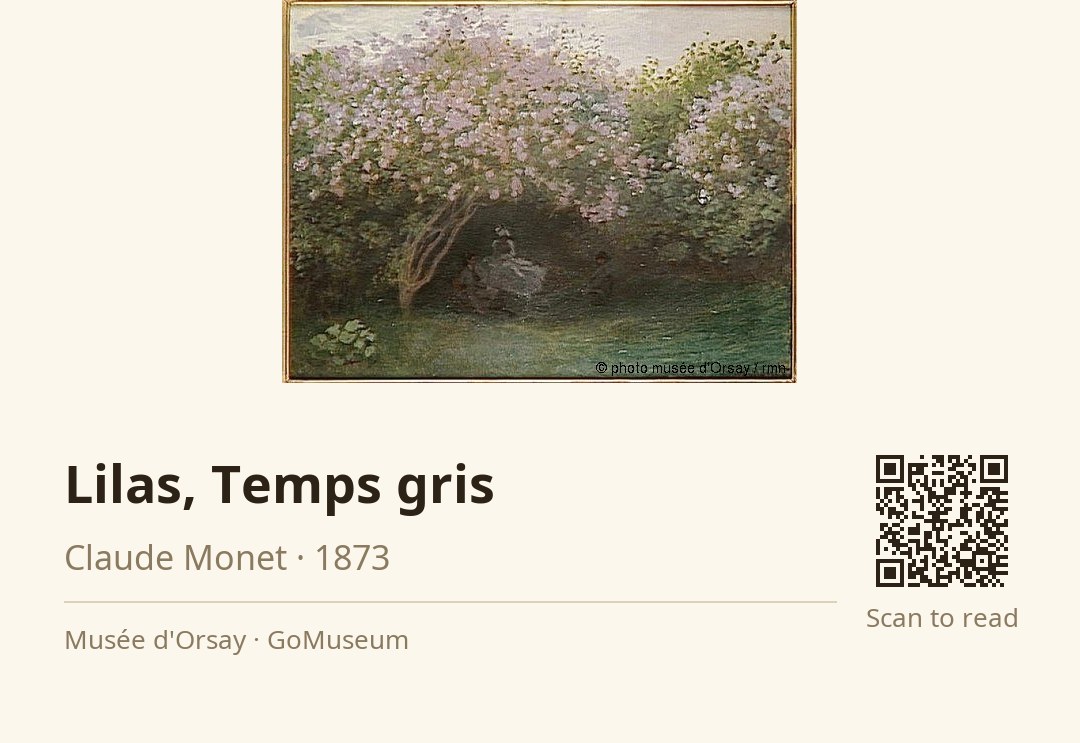
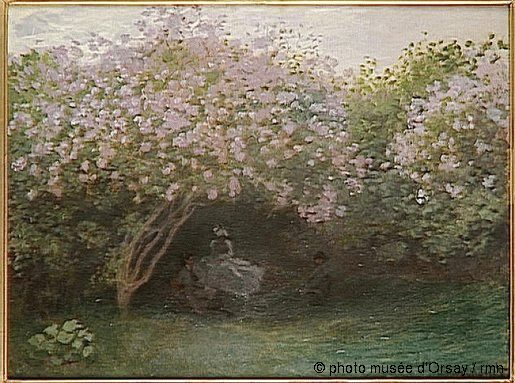
🎧 This work has audio narration — listen in the appTake a moment to really look at "Lilas, Temps gris" by Claude Monet. Notice how the lilac bush seems to almost envelop the figures resting beneath it, creating a cozy little world amidst the muted tones of the grey sky. The way Monet captures the soft, dappled light filtering through the leaves is a masterclass in impressionism, inviting you to feel the gentle breeze and the tranquility of the scene.
These details matter because they reflect Monet's deep connection to nature and his innovative approach to painting. By focusing on the interplay of light and shadow, he transports us to a moment in time, allowing us to experience the serenity he felt in his garden in Argenteuil. This painting, created in 1873, is part of a pair with "Lilac Bush in the Sun," showcasing his fascination with contrasting weather conditions and their effects on color and mood.
Monet was a pioneer of impressionism, striving to capture the essence of a scene rather than its exact likeness. His work invites us to see the world through his eyes, where every brushstroke is a fleeting moment of beauty. As you stand here, think about the quiet moments in your own life that resonate with this sense of peace. What does nature mean to you?
Oscar-Claude Monet, born on November 14, 1840, in Paris, was a pioneering French painter and a founder of Impressionism, a movement that transformed the art world. Raised in Le Havre, he developed a passion for nature and painting early on, encouraged by his mother, while his father hoped he would pursue a business career. After his mother's death in 1857, Monet moved in with his aunt, who supported his artistic ambitions.
Monet's career began with caricatures, but he soon sought formal training, studying under Eugène Boudin, who introduced him to plein air painting. His breakthrough came in 1866 with "La Femme à la robe verte," which garnered attention at the Salon. The term "Impressionism" originated from his work "Impression, Sunrise," exhibited in 1874, marking a shift away from traditional art.
Throughout his life, Monet focused on capturing the essence of light and color in nature, creating series of paintings that depicted the same scenes under varying conditions, such as his famous haystacks and water lilies. He settled in Giverny in 1883, where he cultivated a beautiful garden that became his muse. Despite personal hardships, including the loss of loved ones and health issues, Monet's relentless dedication to his craft solidified his place in art history as a master of modernism, influencing countless artists and leaving a lasting legacy. He died on December 5, 1926, in Giverny, celebrated as one of the most significant figures in art.
In 1873, Claude Monet created 'Lilas, Temps gris', an oil painting that captures a serene moment under lilac bushes in his garden in Argenteuil, a suburb of Paris. This work was part of a pair, alongside 'Lilac Bush in the Sun', showcasing the duality of light and mood in his beloved outdoor space. The painting's provenance traces back to Moreau-Nélaton Etienne, a notable figure in the art world. Monet's journey as an artist was marked by struggles and triumphs, and this piece reflects his evolving mastery of capturing nature's fleeting beauty.
Notice how he employs loose, expressive brushwork that creates a sense of movement, almost as if the lilac bush is swaying in a gentle breeze. The muted palette of greys and lilacs evokes a soft, atmospheric quality, inviting you to step into a moment of quiet reflection. The composition draws your eye to the figures nestled beneath the bush, creating an intimate space that feels both inviting and serene. Monet's choice of scale, with the figures slightly smaller than the lush foliage, emphasizes the overwhelming beauty of nature, making you feel enveloped by the scene.
Did you know that 'Lilas, Temps gris' is actually a pendant to another painting by Monet? The other piece, 'Lilac Bush in the Sun,' captures the same lilac bush but under a completely different light and mood. This pairing showcases Monet's fascination with how the same subject can transform dramatically with the changing weather and time of day. It's a testament to his relentless pursuit of capturing nature's fleeting moments, and it makes you wonder how he felt standing there, brush in hand, as the light shifted around him.
Monet's technique in 'Lilas, Temps gris' showcases his innovative use of color blending and brushwork to create a sense of atmosphere, allowing the viewer to feel the soft, diffused light that characterizes the scene.
The pairing of 'Lilas, Temps gris' with 'Lilac Bush in the Sun' reflects Monet's exploration of contrasting weather conditions and their effects on perception, highlighting his fascination with how light and mood can transform the same subject.