Edgar Degas - Rehearsal on Stage
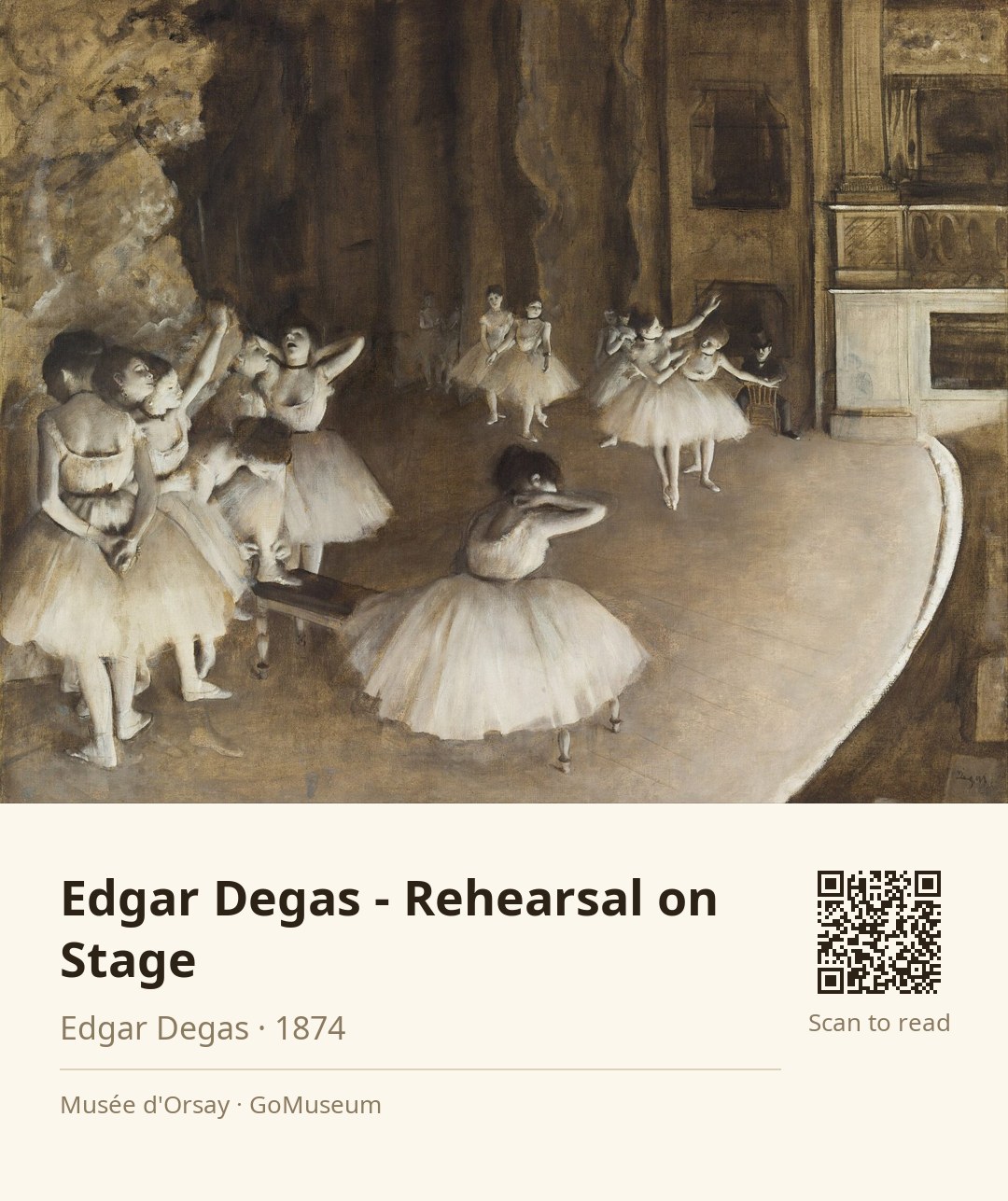
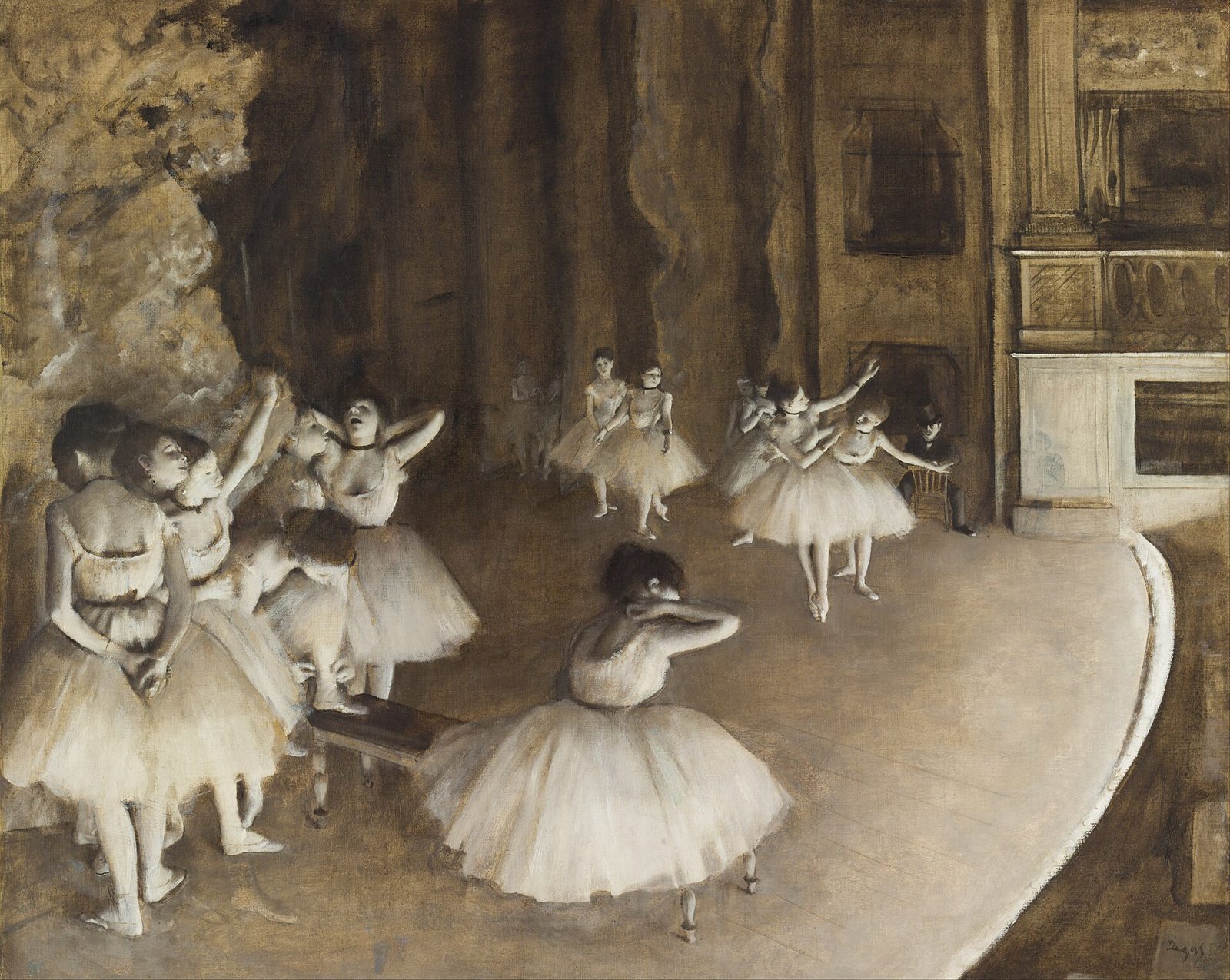
🎧 This work has audio narration — listen in the appTake a moment to look closely at Edgar Degas's "Rehearsal on Stage." Notice how the ballerinas are captured mid-movement, their bodies bending and stretching in a dance that feels almost alive. The muted colors create a sense of intimacy, drawing you into this private moment of preparation before the performance.
These details matter because they reflect Degas's fascination with movement and the human form, showcasing his mastery as a draftsman. He didn’t just paint dancers; he painted the very essence of their art, the grace and discipline that goes into every performance. This painting, created in 1874, was part of the first Impressionist exhibition, a bold statement that challenged traditional art norms.
Degas, often seen as a realist rather than an Impressionist, focused on capturing the world around him in a way that felt true to life. His unique perspective on dance, influenced by his own rigorous training and keen observation, allows us to witness a fleeting moment that might otherwise go unnoticed.
As you stand here, think about the dedication these dancers must have had, practicing tirelessly for their moment in the spotlight. What emotions do you think they felt during this rehearsal?
Edgar Degas, born on July 19, 1834, in Paris, was a pivotal figure in the Impressionist movement, though he preferred to be labeled a realist. Known for his exceptional skill in drawing, Degas focused on capturing movement, particularly in his depictions of dancers, which constitute over half of his oeuvre. His works also include racehorses and portraits that reveal psychological depth and human isolation.
Degas came from a cultured, affluent family; his mother was a Creole from New Orleans, and his father was a banker. After his mother's death, he pursued art against his father's wishes, studying at the École des Beaux-Arts and drawing inspiration from classical masters during his time in Italy. His early ambition to be a history painter shifted as he embraced contemporary subjects, influenced by artists like Édouard Manet.
Despite being a founding member of the Impressionists, Degas's approach diverged from his peers, as he often worked in his studio rather than en plein air. His innovative techniques and themes sparked debate among critics and continue to influence art history today. Degas passed away on September 27, 1917, leaving behind a legacy that challenges traditional boundaries in art.
Edgar Degas's 'Rehearsal on Stage' was painted in 1874 and made its debut at the first Impressionist exhibition in Paris, where it was displayed as number 60. This was a pivotal moment in art history, as it marked a bold departure from traditional norms. The painting was part of Degas's personal collection until 1893 when it was sold to Gustave Mulbacher. Later, it became part of the collection of Isaac de Camondo, who bequeathed it to the Musée d'Orsay in 1911. The painting captures a moment of intense focus and preparation, reflecting the dedication of the dancers, which resonated with audiences and collectors alike.
In 'Rehearsal on Stage,' Degas employs a horizontal format that draws your eye across the canvas, mimicking the stage's depth. The brushwork is both fluid and dynamic, capturing the dancers in mid-motion, as if they might leap off the canvas at any moment. Notice how he uses muted colors to create a sense of intimacy; the soft greys and subtle pastels allow the figures to blend into the background, emphasizing their movement rather than their individual features. This technique of using light and shadow enhances the three-dimensionality of the dancers, making them feel almost sculptural. Degas's choice of composition, with figures arranged in a semi-circle, invites you into their world, making you feel like an observer in this private moment of artistry and discipline.
One intriguing aspect of 'Rehearsal on Stage' is that a reversed engraving of the painting appears in the background of another artwork, 'Marie Coca and Her Daughter,' painted by Suzanne Valadon in 1913. This connection highlights the lasting impact of Degas's work and its presence in the artistic community long after its creation.
Degas's use of a horizontal format not only captures the stage's depth but also reflects his innovative approach to composition, inviting viewers to feel as though they are part of the rehearsal itself.
Growing up in a wealthy family with a Creole mother from New Orleans, Degas had access to cultural experiences that shaped his artistic vision, allowing him to portray the dancers with a unique blend of intimacy and observation.