Le Printemps
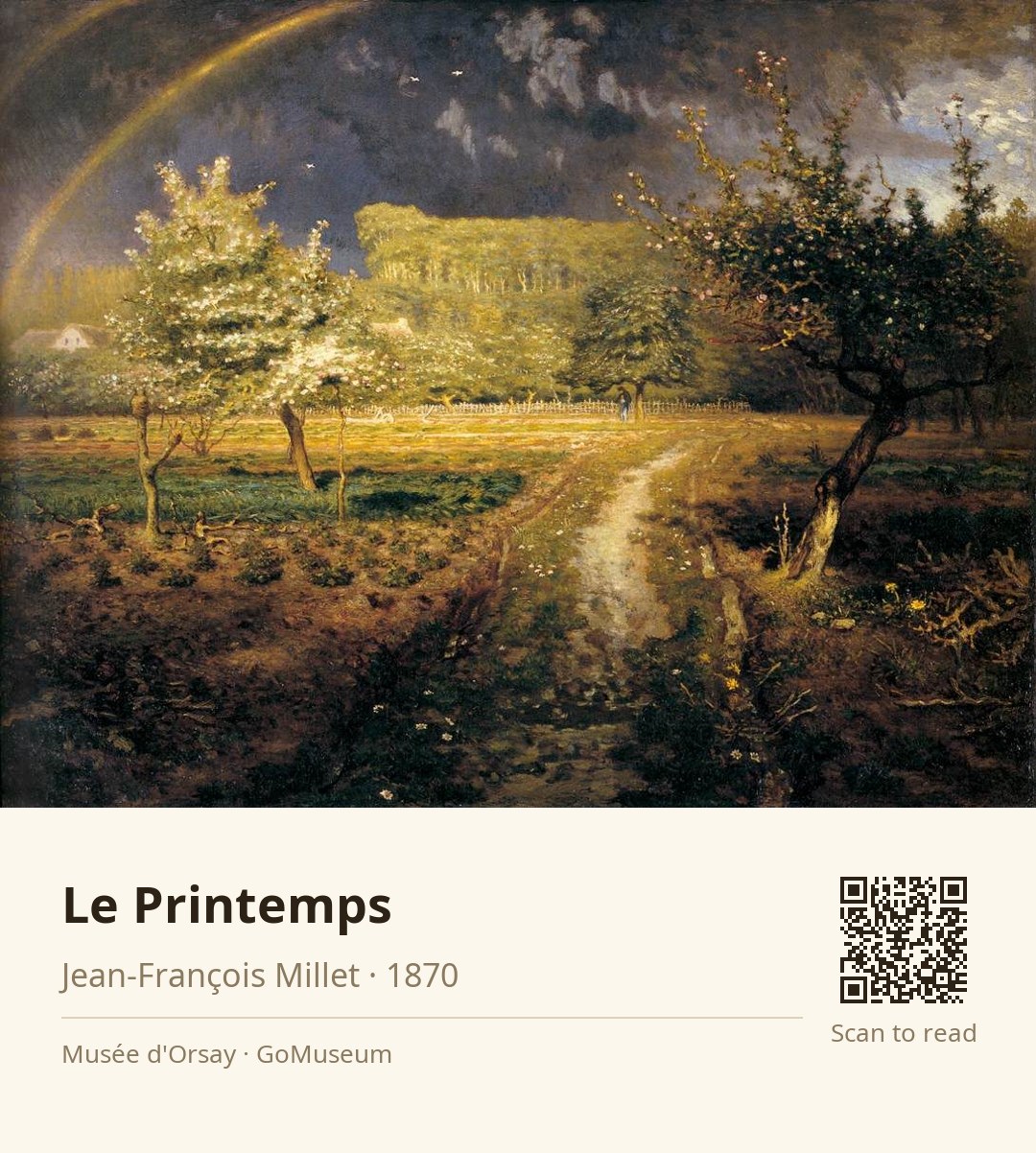
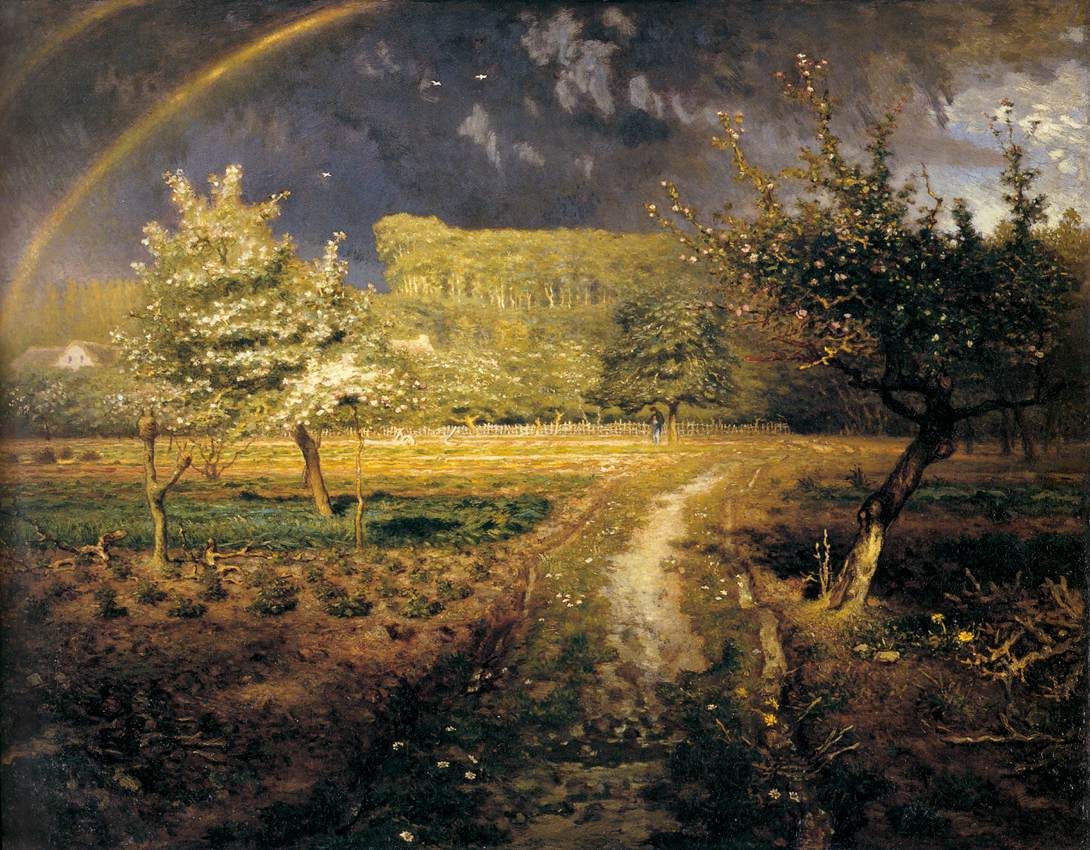
🎧 This work has audio narration — listen in the appTwo blossoming trees frame a winding dirt path in Jean-François Millet's "Le Printemps," their branches heavy with delicate white and pink flowers. A vibrant rainbow arcs across a dramatic sky, contrasting with the dark clouds that hint at an impending storm, while a figure walks along the path, seemingly at peace in this rural landscape.
The interplay of these elements captures the essence of spring, a time of renewal and hope, while also suggesting the unpredictability of nature. Millet’s choice of earthy browns and greens, punctuated by the bright colors of the blossoms and the rainbow, evokes a sense of life awakening after winter's grasp. This painting is part of a larger, unfinished cycle representing the seasons, commissioned by Frédéric Hartmann in 1868, reflecting Millet's deep connection to the rhythms of rural life and the changing seasons.
Jean-François Millet was a pivotal figure in 19th-century French art, born on October 4, 1814, in Gruchy, Normandy. As a founding member of the Barbizon school, he is celebrated for his profound depictions of peasant life, embodying the Realism movement. Millet's early years were steeped in agricultural labor, which deeply influenced his artistic themes. After studying under various artists, he moved to Paris, where he initially struggled but eventually gained recognition for his work.
Millet's paintings often highlighted the dignity of rural laborers, showcasing their struggles and connection to the land. His notable works, such as "The Gleaners" and "The Angelus," reflect a shift from idealized pastoral scenes to a more authentic representation of contemporary social conditions. Despite facing criticism early in his career, he found success in the mid-1850s, producing masterpieces that resonated with the public and critics alike.
Millet's legacy lies in his ability to elevate the everyday lives of farmers to the realm of fine art, influencing generations of artists and solidifying his place in art history as a champion of the working class. He passed away on January 20, 1875, in Barbizon, leaving behind a rich body of work that continues to inspire.
Jean-François Millet's "Le Printemps" was created between 1868 and 1873, commissioned by Frédéric Hartmann in March 1868. This painting is part of an unfinished cycle representing the seasons, which Millet left incomplete at his death. It entered public collections in 1887 and was housed at the Louvre until 1986, when it was transferred to the Musée d'Orsay in Paris.
In "Le Printemps," a winding dirt path cuts through a vibrant rural landscape, flanked by two blossoming fruit trees, their branches heavy with delicate white and pink flowers. The scene is alive with color, featuring earthy browns and greens that ground the composition, while a dramatic sky looms above, filled with dark clouds and a striking rainbow that arcs across the canvas. The brushwork captures the textures of the foliage and the play of light, creating a sense of depth and movement in this serene yet dynamic spring setting.
The work is recognized as a significant landscape painting, showcasing Millet's transition towards pure landscapes. It reflects his deep connection to the rhythms of rural life and the changing seasons, marking a notable evolution in his artistic focus.
Interestingly, a smaller pastel version of a similar composition exists at the Calouste-Gulbenkian Museum in Lisbon, Portugal.
Yes, there is a smaller pastel version of a similar composition located at the Calouste-Gulbenkian Museum in Lisbon.
In addition to landscapes, Millet is well-known for his depictions of peasant farmers, which reflect his connection to rural life and the Realism art movement.