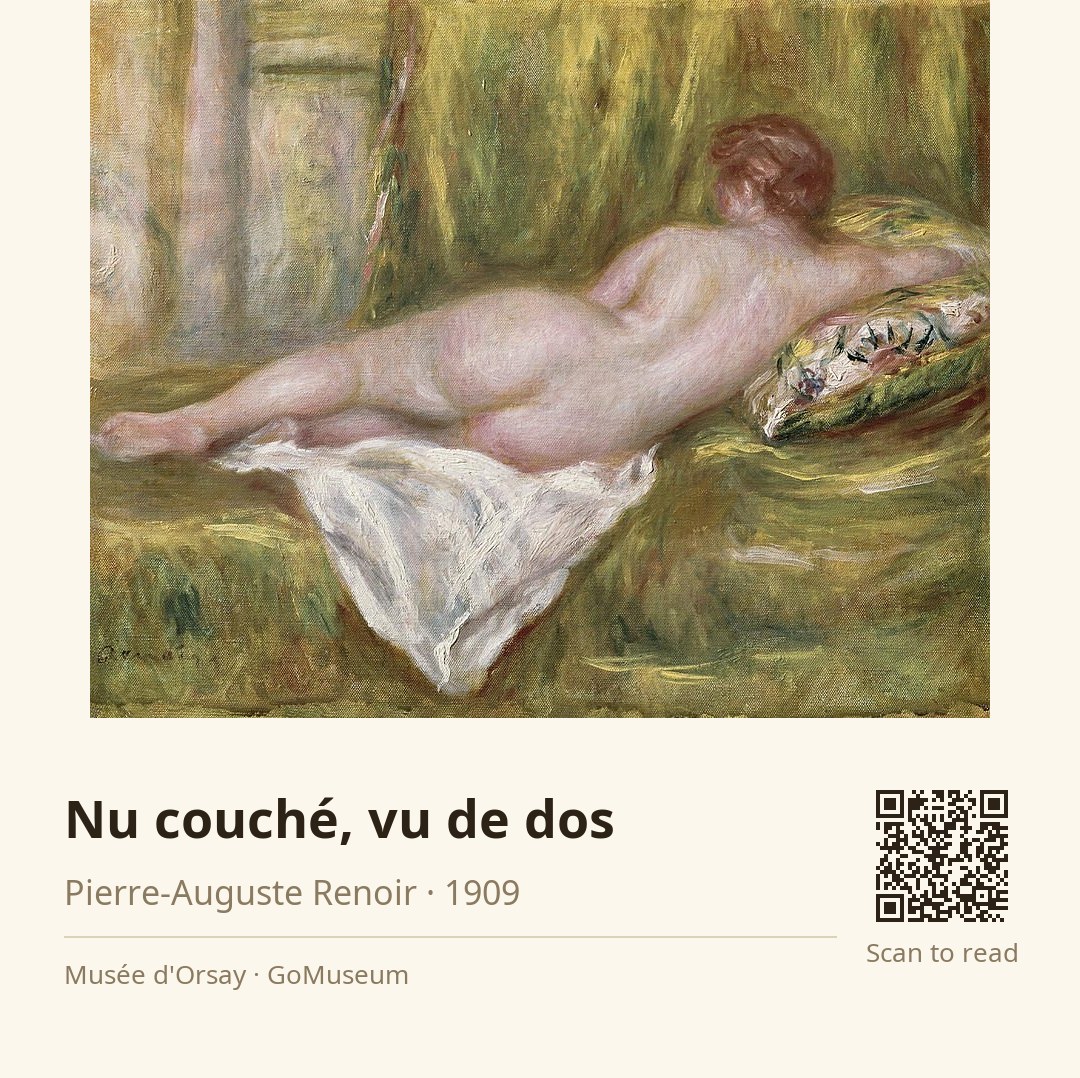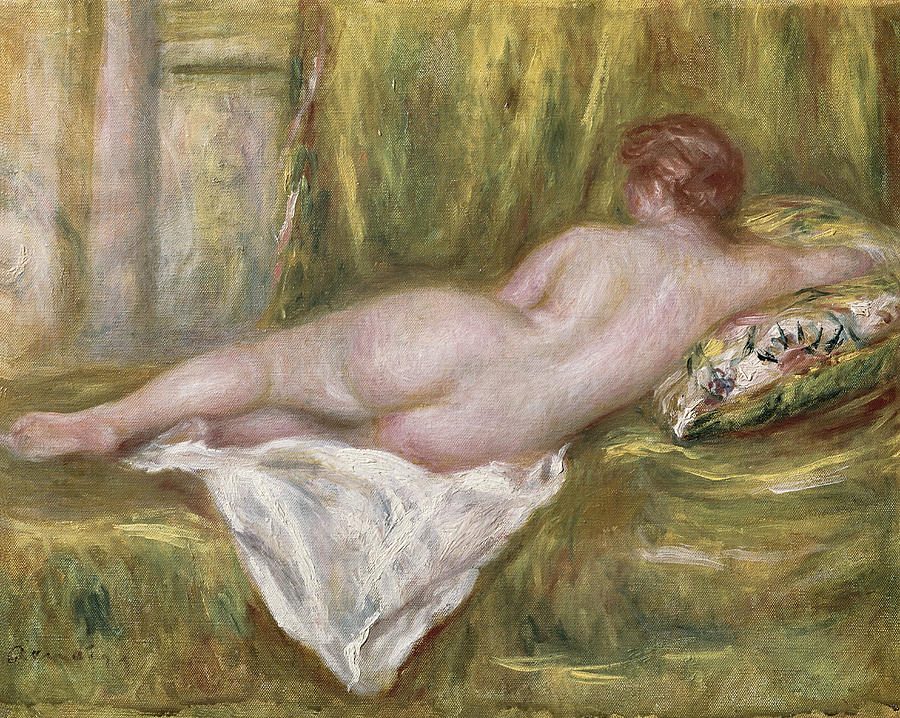
Nu couché, vu de dos
🎧 This work has audio narration — listen in the appTake a moment to really absorb the scene in front of you. Renoir's "Nu couché, vu de dos" invites you into a world of serene intimacy, capturing the beauty of the female form in a way that feels both timeless and deeply personal. Notice how the soft, flowing lines of the figure contrast with the vibrant, textured brushstrokes of the background. The way the light dances across her skin creates a sense of warmth and life, almost as if she could breathe.
These details matter because they reflect Renoir's mastery in portraying not just a subject, but an emotion. This painting, created in 1909, is a celebration of femininity and sensuality, echoing the influences of earlier masters like Velázquez. It’s not just about the naked body; it’s about the essence of being, the quiet strength of vulnerability.
Renoir was a leading figure in the Impressionist movement, known for his ability to capture light and movement. His works often explore themes of beauty and joy, and this piece is no exception. It’s a moment frozen in time, inviting you to ponder the relationship between the viewer and the subject.
As you stand here, consider what feelings this artwork stirs within you. How does it challenge or affirm your own perceptions of beauty?
Pierre-Auguste Renoir, born on February 25, 1841, in Limoges, France, emerged as a pivotal figure in the Impressionist movement. His early life in a modest family led him to Paris, where he honed his artistic skills amidst the masterpieces of the Louvre. Initially apprenticed in a porcelain factory, Renoir's passion for painting flourished, particularly after studying under Charles Gleyre, where he befriended fellow artists like Monet and Sisley.
Renoir's work celebrated feminine beauty and vibrant social scenes, exemplified in iconic pieces like "Dance at Le Moulin de la Galette." Despite facing criticism early on, he gained recognition, especially after participating in the first Impressionist exhibition in 1874. His style evolved over the years, transitioning towards realism influenced by classical masters like Raphael.
Throughout his life, Renoir balanced personal struggles, including health issues, with a prolific output, reportedly creating around four thousand works. He became a beloved figure in art history, known for his warm palette and expressive brushwork. Renoir passed away on December 3, 1919, leaving a legacy that continues to inspire artists and art lovers alike.
Renoir's "Nu couché, vu de dos" was created in 1909 and is a testament to his evolving style as a leading figure in the Impressionist movement. This painting was later showcased at the Exposition Universelle in Paris in 1937, where it was celebrated among masterpieces of French art. The painting has a rich provenance, having passed through the hands of notable figures like the art dealer Ambroise Vollard and Dr. Each owner contributed to its legacy, ensuring that this intimate portrayal of femininity remained in the public eye. The work's reception has varied over time, reflecting the shifting tides of artistic appreciation and the evolving conversation around the female form in art.
As you gaze at the painting, notice the way Renoir's brushwork dances across the canvas. The soft, flowing lines of the figure create a sense of movement and life, while the vibrant, textured strokes of the background add depth and energy. Renoir's choice of color is particularly striking; the warm hues on the figure's skin contrast beautifully with the cooler tones surrounding her, drawing your eye to the subject. The composition is masterfully balanced, with the figure positioned in a way that feels both intimate and inviting. The scale of the painting, at 41 by 52 inches, allows for a close encounter, making you feel as though you're sharing a moment with the subject. This technique of blending light and shadow gives the painting a three-dimensional quality, enhancing the emotional resonance of the scene.
This painting, inspired by Velázquez's 'Venus at Her Mirror,' not only reflects Renoir's mastery of color and light but also marks a significant shift in the portrayal of the female nude in art. By focusing on the back of the figure, Renoir invites viewers to contemplate not just beauty but also intimacy and vulnerability. This approach influenced countless artists who followed, encouraging them to explore the complexities of the human experience through the lens of beauty and sensuality.
One intriguing aspect of Renoir's life is that despite his immense success, he faced significant financial struggles early in his career. At times, he couldn't afford paint and had to rely on the generosity of friends and patrons. This struggle only fueled his determination to succeed, ultimately leading him to become one of the most celebrated artists of his time.
Renoir met Richard Wagner in 1882 while in Palermo, Sicily, and painted Wagner's portrait in just thirty-five minutes, showcasing his ability to capture likeness quickly.
Despite his later success, Renoir faced significant financial difficulties early on, often unable to afford paint, which led him to rely on the support of friends and patrons, fueling his determination to succeed in the art world.
Renoir's painting draws inspiration from Velázquez's 'Venus at Her Mirror', reflecting a lineage of artistic exploration of the female form that spans centuries.