Apples and Oranges
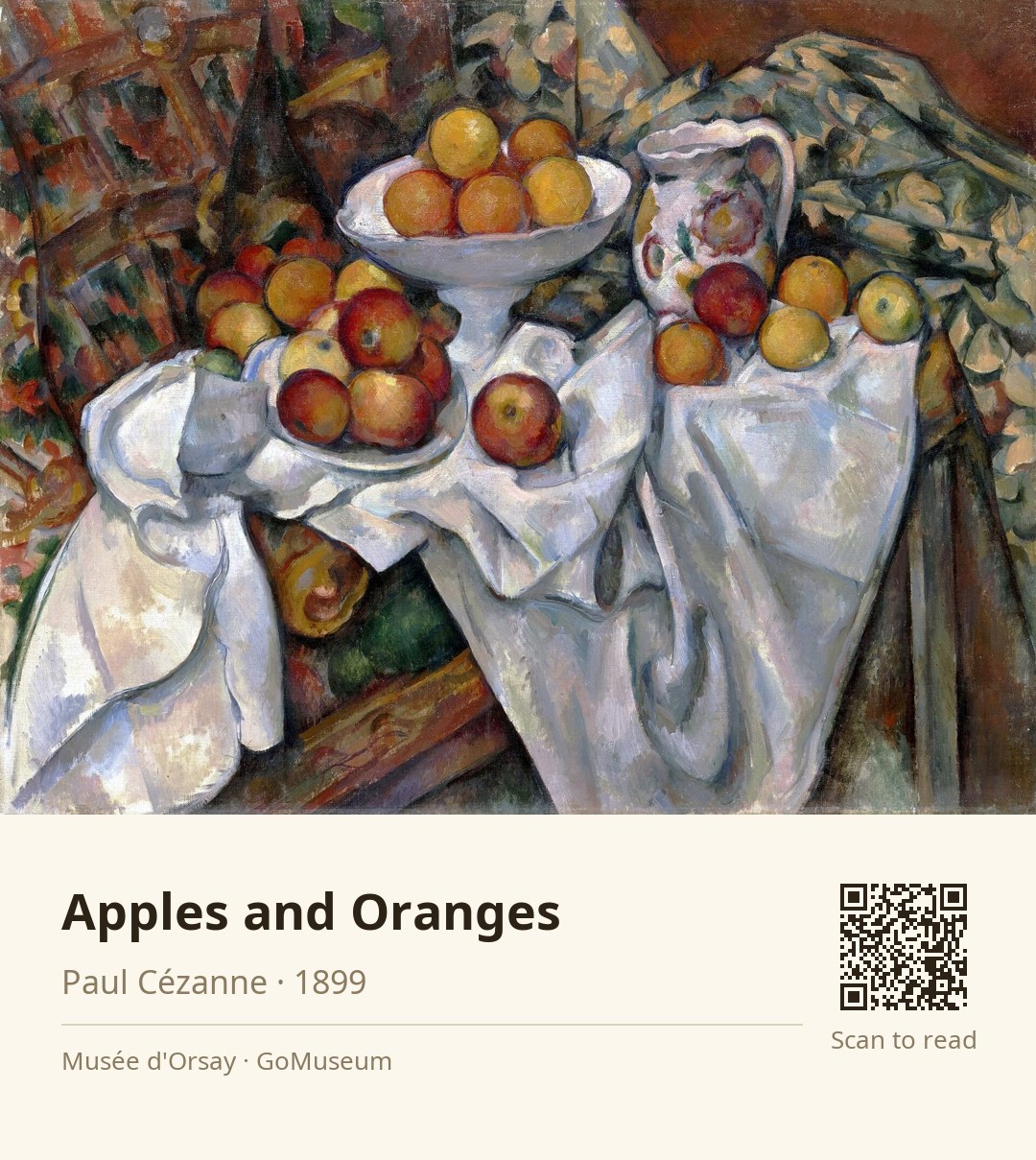
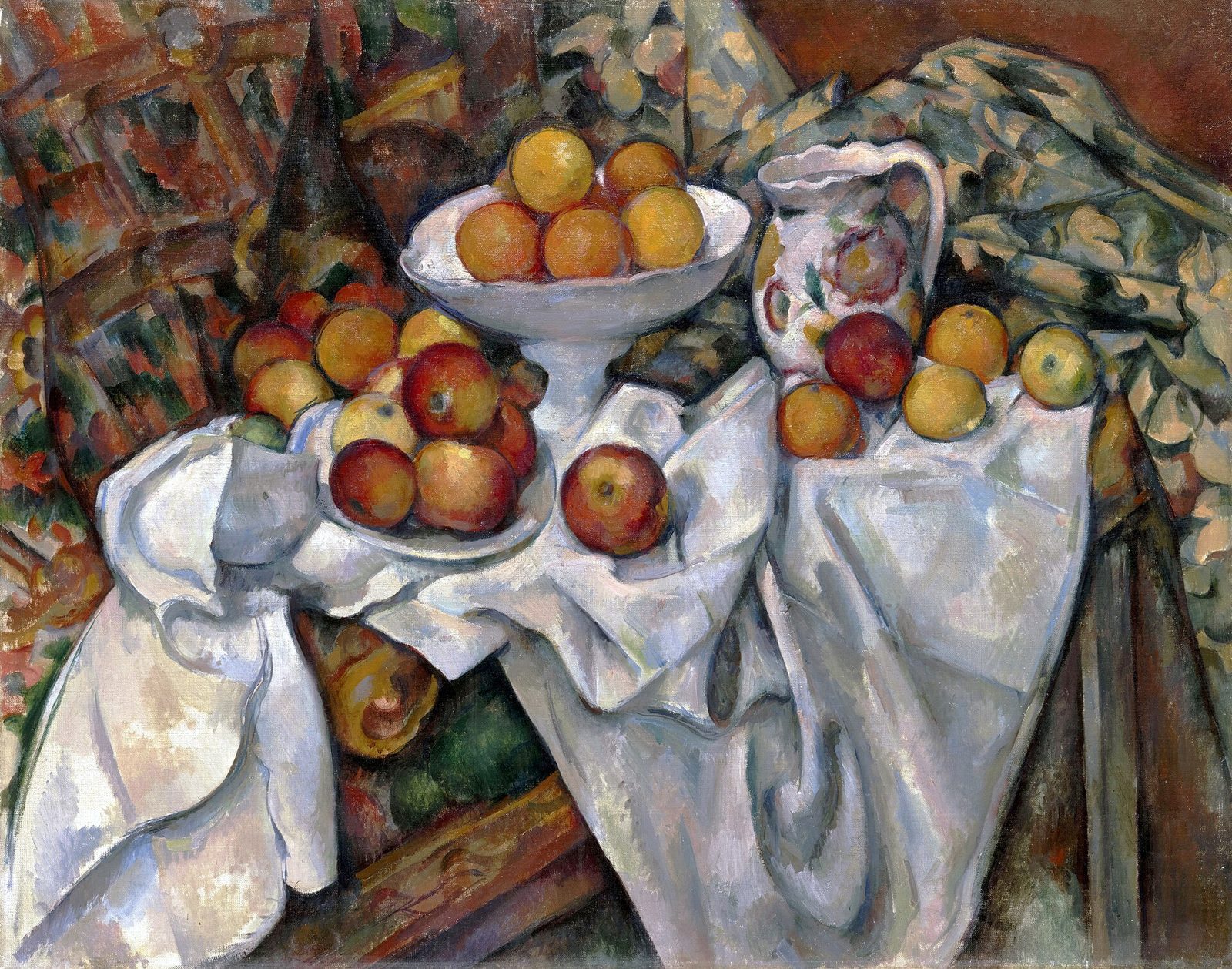
🎧 This work has audio narration — listen in the appTake a moment to really look at Cézanne's "Apples and Oranges." Notice how the fruits seem to spill out of their bowls, almost inviting you to reach out and grab one. The vibrant oranges contrast beautifully with the deep reds of the apples, creating a lively dance of color on the canvas.
These details matter because they showcase Cézanne's revolutionary approach to still life. He wasn't just painting objects; he was exploring the very essence of form and color. The way he uses broken brushstrokes and layered colors gives the fruits a three-dimensional quality, making them feel alive. This technique was a precursor to modern art movements, influencing artists like Picasso and Matisse.
Cézanne created this piece in 1899, during a time when he was refining his unique style, bridging Impressionism and the emerging Cubism. He often revisited themes of fruit, using them to delve deeper into the nature of perception and reality.
As you stand here, think about how this painting challenges you to see the ordinary in extraordinary ways. What do you think Cézanne was trying to convey about the relationship between color and form?
Paul Cézanne was a French Post-Impressionist painter born on January 19, 1839, in Aix-en-Provence. His innovative approach to color and form bridged the gap between Impressionism and the emerging Cubism of the early 20th century. Initially influenced by Romanticism and Realism, Cézanne developed a unique style that emphasized the underlying structure of objects, using repetitive brushstrokes and planes of color to create depth and complexity in his work.
Despite facing ridicule and misunderstanding from critics during his early career, Cézanne garnered support from fellow artists like Camille Pissarro and the art dealer Ambroise Vollard, who recognized his talent. His first solo exhibition in 1895 marked a turning point, leading to greater appreciation of his contributions to art. Cézanne's legacy is profound; both Henri Matisse and Pablo Picasso acknowledged him as a foundational figure in modern art, dubbing him "the father of us all." He passed away on October 22, 1906, leaving behind a transformative body of work that continues to influence artists today.
Cézanne's "Apples and Oranges" was first owned by the art critic Gustave Geffroy, who sold it in January 1907 to the Bernheim-Jeune gallery. Just a few months later, in May of the same year, Count Isaac de Camondo acquired it, and by 1908, he bequeathed it to the Louvre Museum. This painting became part of the Musée d'Orsay's collection when it was established. The painting was inspired by an earlier work featuring the same objects, showcasing Cézanne's ongoing exploration of still life. Its early reception was mixed, with many critics struggling to understand his innovative approach, but it gradually gained recognition, influencing generations of artists.
In "Apples and Oranges," Cézanne's brushwork is both meticulous and expressive, creating a dynamic interplay of light and shadow. Notice how he employs broken brushstrokes to build texture, lending the fruits a palpable, almost tactile quality. The vibrant colors—deep reds and bright oranges—are layered, allowing them to shimmer with life. The composition is structured diagonally, drawing your eye across the canvas, while the fruits seem to spill out, inviting you into the scene. Cézanne's choice of a white bowl and cloth enhances the colors, making them pop even more. The shadows he casts are not just dark patches; they are infused with blues, adding depth and volume to the otherwise flat surfaces. This technique of color modulation and geometric form is what sets Cézanne apart, making the ordinary feel extraordinary.
One fascinating tidbit about 'Apples and Oranges' is that it was inspired by another still life Cézanne painted just months earlier, featuring the same objects. This earlier work, 'Still Life with Curtain and Flowered Pitcher,' is now housed in the Hermitage Museum in St. Petersburg. It’s intriguing to think that Cézanne was so captivated by these simple fruits that he felt compelled to reimagine them in a new composition, showcasing his evolving artistic vision.
Cézanne's 'Apples and Oranges' was inspired by an earlier painting titled 'Still Life with Curtain and Flowered Pitcher,' which featured the same objects and was created just a few months prior.
Cézanne employed broken brushstrokes and layered colors to build texture, which gives the fruits a tactile quality and enhances their three-dimensional appearance on the canvas.