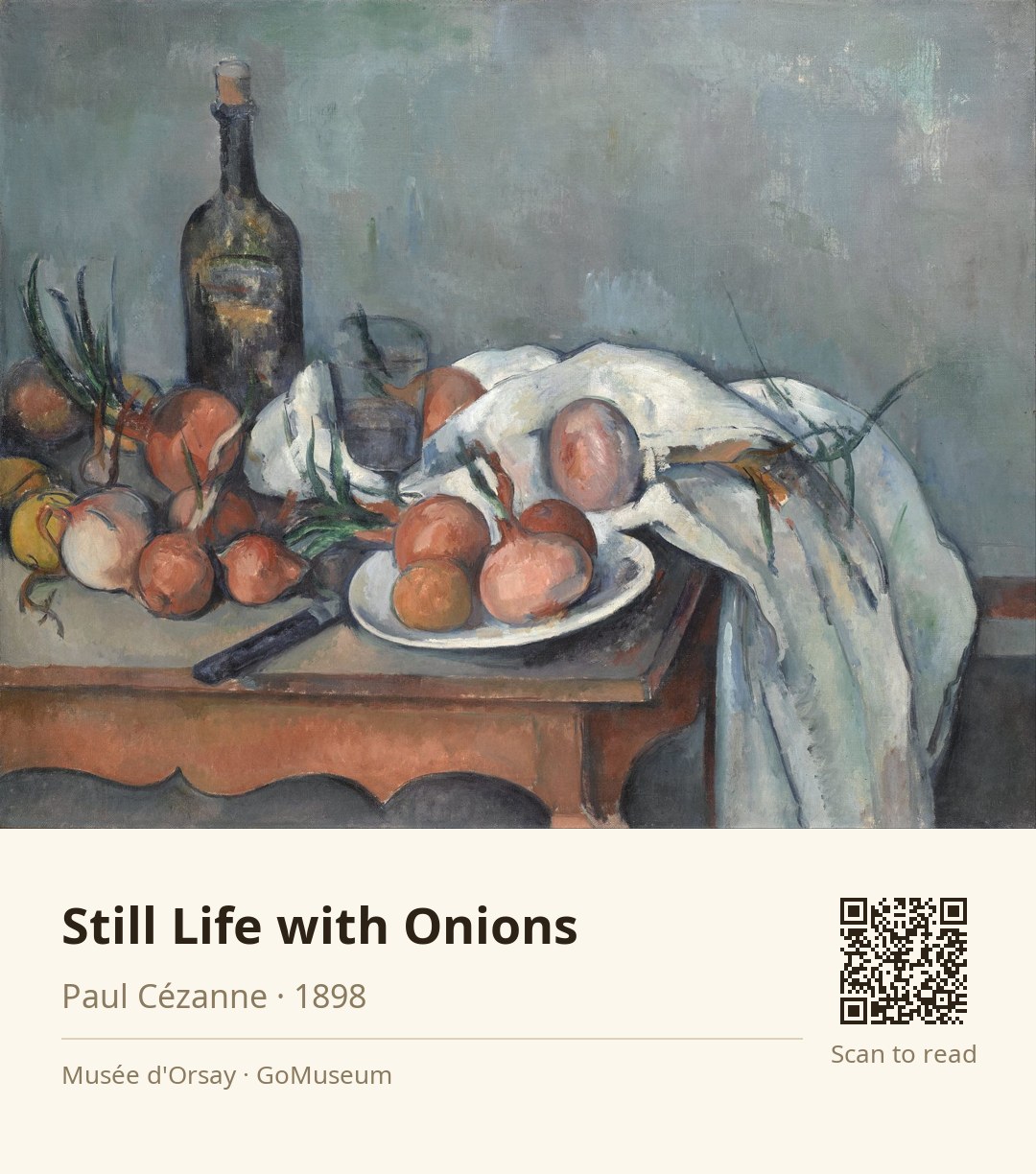
Still Life with Onions
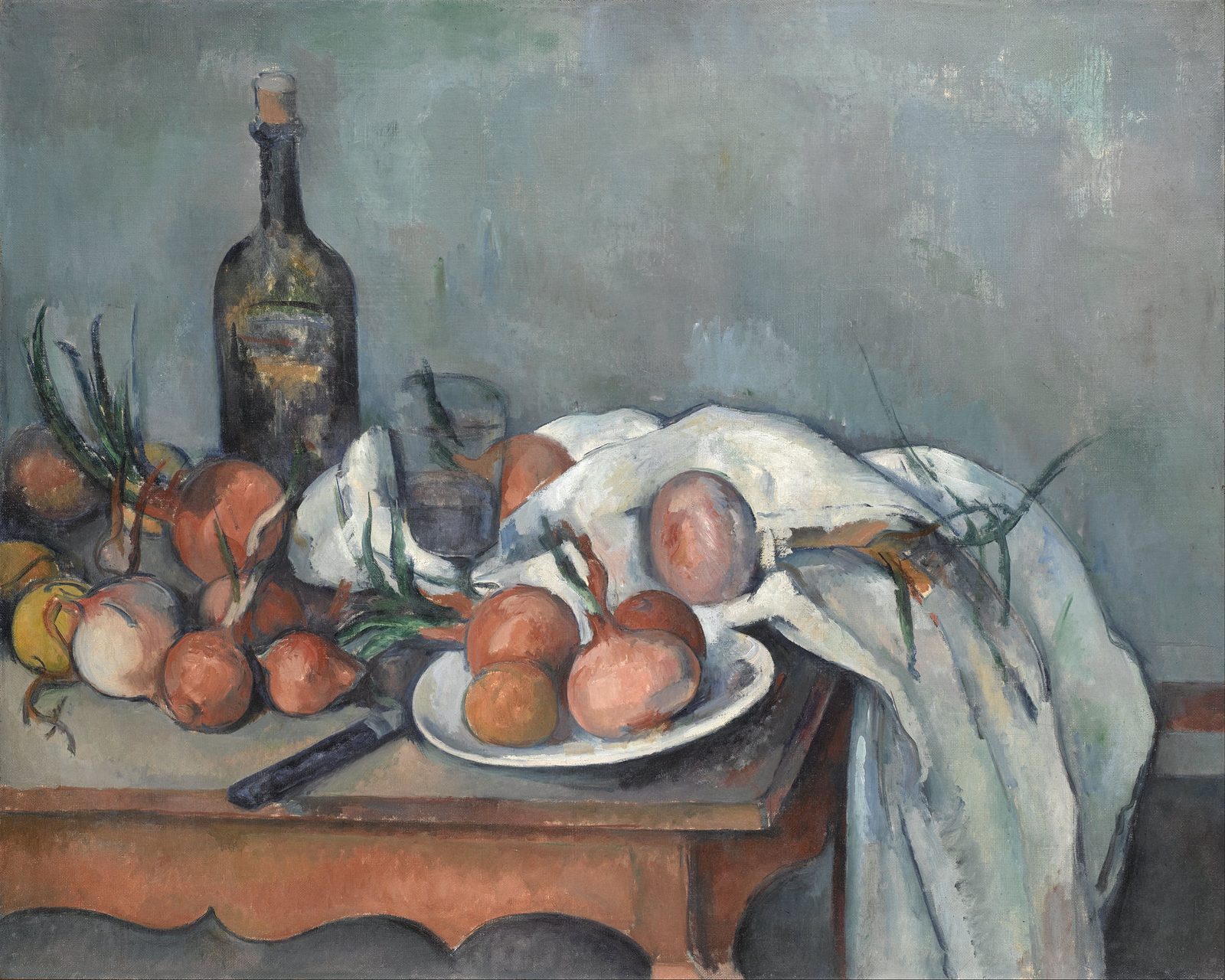
🎧 This work has audio narration — listen in the appTake a moment to really look at Paul Cézanne's "Still Life with Onions." Notice how the onions seem to almost pulse with life, their skins glistening under the light, while the drapery behind them flows like a gentle breeze. The way the knife leans diagonally across the table adds a dynamic tension, doesn’t it? These details matter because they reveal Cézanne's innovative approach to perspective. He plays with different viewpoints, showing the bottle and table frontally, while the glass is seen from above. This technique creates a sense of depth and invites you to engage with the composition, making you feel as if you could reach out and touch the objects. Cézanne painted this piece in 1898, during a time when he was redefining how we see still life. He wasn't just arranging objects; he was exploring the very essence of form and color, bridging the gap between Impressionism and what would become Cubism. So, as you stand here, think about how these onions, simple as they may seem, are part of a larger conversation in art history. What do you think Cézanne was trying to express about everyday objects?
Paul Cézanne was a French Post-Impressionist painter born on January 19, 1839, in Aix-en-Provence. His innovative approach to color and form bridged the gap between Impressionism and the emerging Cubism of the early 20th century. Initially influenced by Romanticism and Realism, Cézanne developed a unique style that emphasized the underlying structure of objects, using repetitive brushstrokes and planes of color to create depth and complexity in his work.
Despite facing ridicule and misunderstanding from critics during his early career, Cézanne garnered support from fellow artists like Camille Pissarro and the art dealer Ambroise Vollard, who recognized his talent. His first solo exhibition in 1895 marked a turning point, leading to greater appreciation of his contributions to art. Cézanne's legacy is profound; both Henri Matisse and Pablo Picasso acknowledged him as a foundational figure in modern art, dubbing him "the father of us all." He passed away on October 22, 1906, leaving behind a transformative body of work that continues to influence artists today.
Notice how he employs a method known as 'perspective relevée,' which allows him to present objects from multiple viewpoints simultaneously. The onions, with their textured skins, are painted with a series of small, deliberate brushstrokes that create a sense of depth and movement. The interplay of light and shadow is particularly striking; Cézanne captures the way light glints off the onion skins, giving them a lifelike quality. The diagonal placement of the knife adds a dynamic tension to the composition, drawing your eye across the canvas. His choice of a muted background allows the vibrant colors of the onions to pop, emphasizing their importance in the arrangement. This careful orchestration of elements not only showcases his innovative approach but also invites you to explore the relationships between the objects.
By breaking away from traditional perspectives and introducing a more dynamic approach to composition, Cézanne influenced countless artists who followed. His innovative use of color and form challenged the conventions of his time, prompting a reevaluation of how objects could be represented. This painting, with its bold brushwork and complex layering, encapsulates his quest for a new artistic language, making him a foundational figure in modern art. Remember, Cézanne is often called the 'father of us all' by later masters like Picasso and Matisse, highlighting his profound impact on the art world.
Did you know that Cézanne's still lifes were often met with confusion and even ridicule during his time? This particular piece, 'Still Life with Onions,' created between 1896 and 1898, was part of his journey to redefine how objects could be represented on canvas. While today we admire his bold brushstrokes and innovative perspectives, back then, many critics just didn't get it. It wasn't until the late 1890s that his work began to gain traction, thanks in part to fellow artists and a few brave collectors who saw the genius in his approach.
Cézanne's brushstrokes are characterized by their repetitive and exploratory nature, which contributes to the textured appearance of the onion skins, enhancing their lifelike quality and depth.
Cézanne came from a relatively affluent family due to his father's banking success, which allowed him the financial security to pursue art without the immediate pressure of selling his work for survival.
Cézanne's paintings, including 'Still Life with Onions,' were often met with incomprehension and ridicule during his lifetime, with appreciation for his work growing primarily among fellow artists rather than the general public.