Poseuse assise, de profil
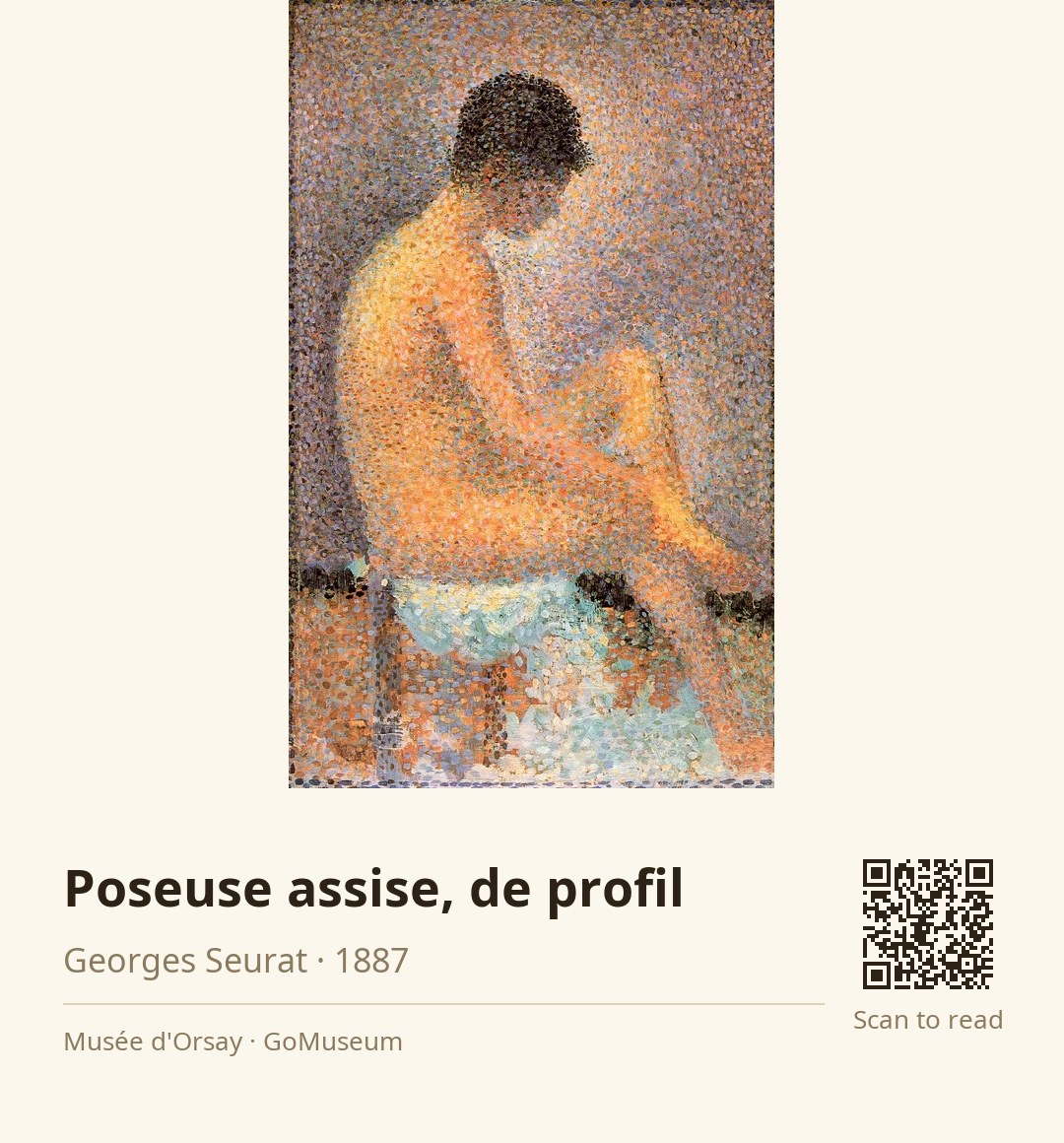
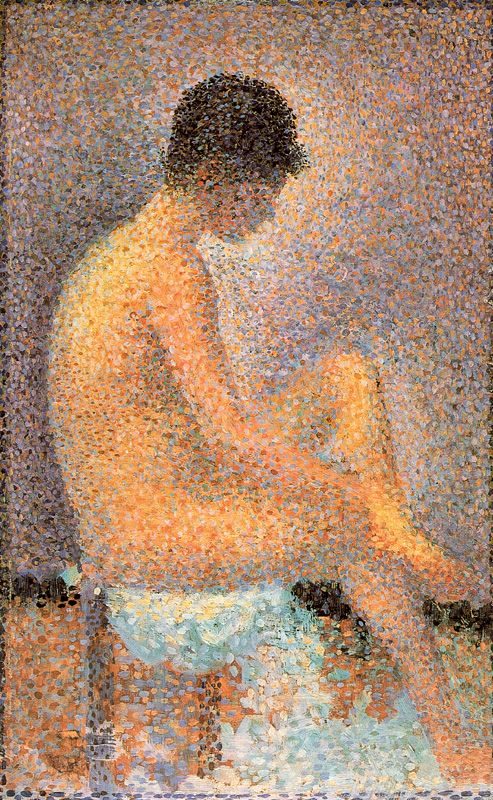
🎧 This work has audio narration — listen in the appTake a moment to really look at "Poseuse assise, de profil" by Georges Seurat. Notice how the model sits, her left foot resting on her right knee, creating a relaxed yet poised posture. The way Seurat uses tiny dots of color—his signature pointillism—gives the painting a shimmering quality, almost as if the figure is alive and breathing. This detail isn’t just about technique; it reflects Seurat's fascination with light and color. Each dot interacts with the ones around it, allowing your eyes to blend them optically. This method was revolutionary, pushing the boundaries of how color could be perceived on canvas. It’s a glimpse into Seurat’s innovative mind, where art meets science. Created in 1887, this work served as a study for his larger piece, "Les Poseuses." Seurat was deeply invested in capturing the essence of his subjects, and this painting is a beautiful example of his exploration of form and light. As you stand here, think about the model's quiet confidence. What stories might she hold? What was it like to be captured in such a unique way by an artist who changed the course of modern art?
Georges Seurat was a French post-Impressionist artist born on December 2, 1859, in Paris. He is best known for developing pointillism, a technique that uses tiny dots of color to create optical blending. Seurat's character was marked by a unique blend of sensitivity and logical precision, which drove his innovative approach to art. His most famous work, "A Sunday Afternoon on the Island of La Grande Jatte," completed between 1884 and 1886, is a monumental piece that showcases various social classes enjoying leisure time in a park. This painting not only exemplifies his mastery of color theory but also played a pivotal role in the evolution of modern art, marking the beginning of Neo-Impressionism.
Seurat's artistic journey began with formal training at the École des Beaux-Arts, where he honed his skills in drawing and color. Despite facing rejection from the Paris Salon, he found a platform with the Société des Artistes Indépendants, where he exhibited his groundbreaking works. His influence extended beyond his lifetime, inspiring movements such as Fauvism and Cubism. Seurat's legacy as a pioneer of modern art is underscored by his meticulous approach to composition and color, making him a central figure in the history of 19th-century painting. He passed away on March 29, 1891, leaving behind a profound impact on the art world.
Georges Seurat painted 'Poseuse assise, de profil' in 1887, during a period of intense exploration and innovation in his artistic practice. This work was commissioned as a study for his larger piece, 'Les Poseuses,' which is now housed in the Barnes Foundation in Philadelphia. The painting was first exhibited at the Salon des Indépendants in Paris in 1890, where it was part of a groundbreaking movement that sought to challenge traditional artistic conventions. Over the years, it has been displayed in various prestigious exhibitions, including the 1900 'Seurat, la revue blanche' and the 1920 showcase at the Galerie Bernheim-Jeune. Its provenance traces back to Félix Fénéon, a key supporter of Seurat, who acquired it after the artist's untimely death in 1891.
As you gaze at 'Poseuse assise, de profil,' pay attention to Seurat's meticulous brushwork. He employs his signature pointillism, using tiny dots of color that vibrate with energy. This technique isn't just a gimmick; it’s a calculated approach to color theory. Each dot interacts with its neighbors, creating an optical blending that gives the figure a lifelike shimmer. Notice how the composition is structured; the model's relaxed posture is framed by the vertical format of the painting, drawing your eye up and down. The use of light and shadow is subtle yet effective, enhancing the three-dimensionality of the figure. The scale of the painting, relatively small at 25 by 16 inches, invites you to come closer, to engage with the details, and to appreciate the complexity of Seurat's vision.
Did you know that this painting, 'Poseuse assise, de profil,' is actually a preparatory work for Seurat's larger piece 'Les Poseuses'? It's fascinating to think that this small oil on wood panel, measuring just 25 by 16 inches, served as a stepping stone for a much grander vision. Seurat meticulously crafted this study, capturing the model's profile with his signature pointillist technique, which would later define his most famous works. It's like peeking behind the curtain at the artist's creative process!
Félix Fénéon was a key supporter of Seurat and acquired 'Poseuse assise, de profil' after the artist's death. He played a crucial role in promoting Seurat's work and was instrumental in establishing the Neo-Impressionist movement, helping to shape the legacy of Seurat's innovative techniques.
Seurat was known for his extensive preparatory studies, often creating numerous sketches and smaller paintings before embarking on a larger canvas. This meticulous approach demonstrates his commitment to planning and understanding color theory, which was essential for his pointillist style.