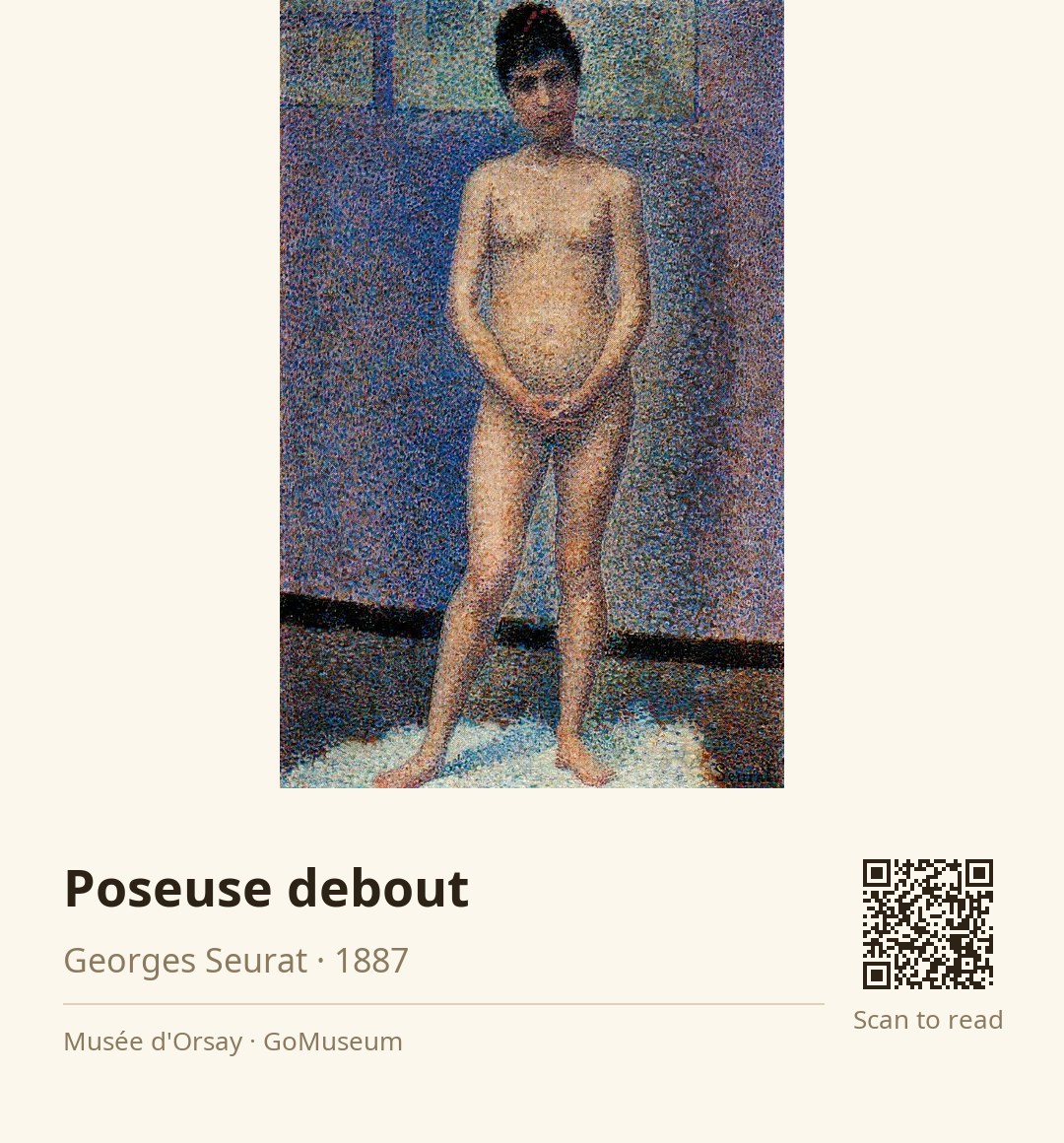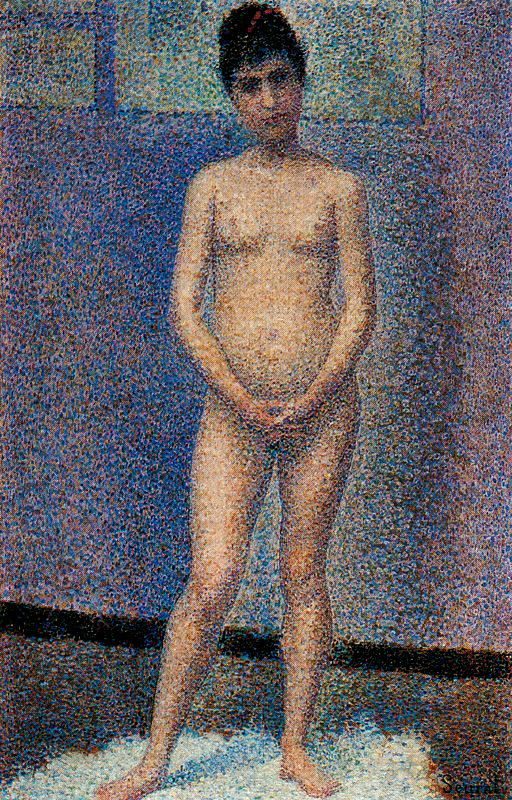
Poseuse debout
🎧 This work has audio narration — listen in the appTake a moment to really look at Seurat's "Poseuse debout." Notice how the model stands confidently, her body turned slightly, yet her gaze is directed straight at you. This direct engagement pulls you into the scene, making you feel like part of the moment. Now, focus on the background—a soft lilac hue that envelops her. This isn’t just a backdrop; it’s a deliberate choice by Seurat, enhancing the figure’s presence and creating a sense of intimacy. The color contrasts with her skin, emphasizing the curves and contours of her form. Seurat was a pioneer of pointillism, using tiny dots of color to create depth and vibrancy. Here, he’s not just depicting a figure; he’s exploring how color interacts with light and form, inviting you to see beyond the surface. This technique was revolutionary, influencing countless artists after him. Created in 1887, this work is a preparatory study for a larger piece, "Les Poseuses," showcasing Seurat’s innovative approach to capturing the human figure. It reflects his fascination with both art and science, blending emotion with precision. As you stand here, think about the connection between the artist, the model, and you, the viewer. What stories might she hold? What emotions does her gaze evoke in you?
Georges Seurat was a French post-Impressionist artist born on December 2, 1859, in Paris. He is best known for developing pointillism, a technique that uses tiny dots of color to create optical blending. Seurat's character was marked by a unique blend of sensitivity and logical precision, which drove his innovative approach to art. His most famous work, "A Sunday Afternoon on the Island of La Grande Jatte," completed between 1884 and 1886, is a monumental piece that showcases various social classes enjoying leisure time in a park. This painting not only exemplifies his mastery of color theory but also played a pivotal role in the evolution of modern art, marking the beginning of Neo-Impressionism.
Seurat's artistic journey began with formal training at the École des Beaux-Arts, where he honed his skills in drawing and color. Despite facing rejection from the Paris Salon, he found a platform with the Société des Artistes Indépendants, where he exhibited his groundbreaking works. His influence extended beyond his lifetime, inspiring movements such as Fauvism and Cubism. Seurat's legacy as a pioneer of modern art is underscored by his meticulous approach to composition and color, making him a central figure in the history of 19th-century painting. He passed away on March 29, 1891, leaving behind a profound impact on the art world.
Georges Seurat's 'Poseuse debout' was created in 1887 and is a preparatory study for his larger work 'Les Poseuses.' This piece was first exhibited at the Salon des Indépendants in Paris the same year, where it was likely met with a mix of intrigue and skepticism, typical for Seurat's innovative style. Over the years, it has been part of numerous exhibitions, including notable showcases in 1892 and 1900, and even as late as 1936. Its provenance traces back to Félix Fénéon, a significant supporter of Seurat, who sold it at auction in 1947. The journey of this artwork reflects the evolving appreciation for Seurat's pointillism, which initially faced resistance but ultimately paved the way for new artistic movements.
Notice how the soft lilac background envelops the model, enhancing her presence and creating an intimate atmosphere. This method not only adds depth but also invites you to engage with the painting on a sensory level. The composition is structured yet fluid, with the model's confident stance and direct gaze drawing you in, making you feel as if you're part of the scene. The scale of the work, though modest, is impactful, allowing for a detailed exploration of the human figure.
This painting, a preparatory study for his larger piece 'Les Poseuses', illustrates Seurat's innovative approach to color theory, drawing on scientific principles of color contrast. His method of using tiny dots of color not only influenced his contemporaries but also paved the way for future movements like Fauvism and Cubism. Seurat’s legacy is profound; he challenged artists to think about color and light in a new way, forever altering the landscape of modern art. Remember, this small work is not just a study—it's a stepping stone to a new artistic language that continues to resonate today.
This small oil on wood painting, created in 1887, captures a female model standing against a lilac background, showcasing Seurat's signature pointillist technique. It's fascinating to think that this seemingly simple study played a crucial role in the development of one of his major works, demonstrating how even the smallest pieces can hold immense significance in an artist's journey.